You launch a campaign with a $500 daily budget, but Ads Manager shows only $120–$150 in spend by the end of the day. The audience size is large, the ad is approved, and engagement metrics look normal.
In many cases, the cause is not the creative or the audience. The campaign simply cannot compete in most auctions because the bid cap is too restrictive.
Bid caps can protect acquisition costs, but they also change how the campaign participates in Meta’s auction system. When the cap is set too low, the algorithm is forced to ignore large portions of available inventory.
How the Facebook Ad Auction Actually Works
Every impression opportunity on Facebook or Instagram triggers an automated auction. Multiple advertisers may compete for the same user at the same moment.
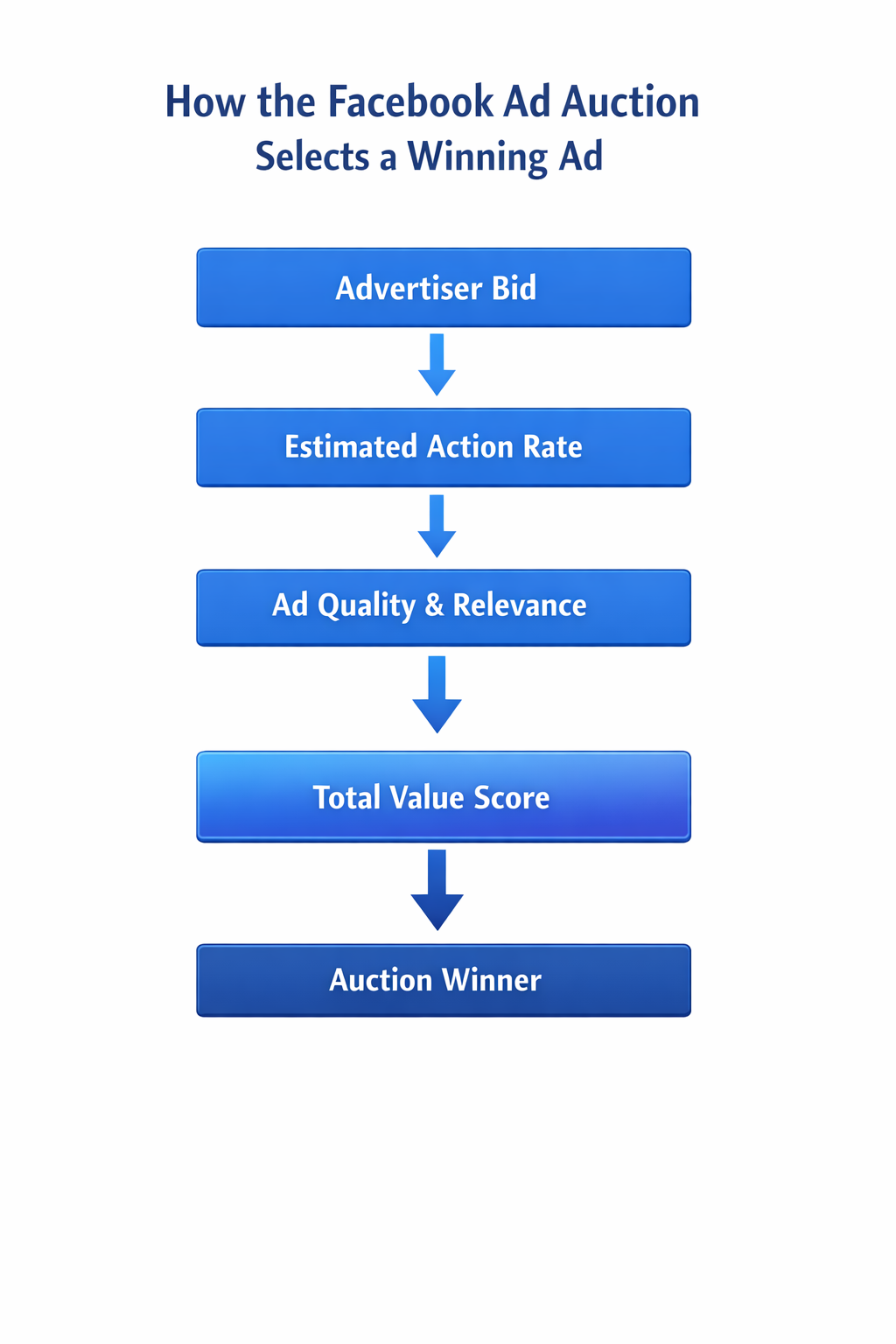
Meta determines the winner using a combined value score built from three signals:
-
Advertiser bid.
This represents how much the system is allowed to bid for the optimization event. With automatic bidding, Meta adjusts this number dynamically across auctions. A bid cap introduces a ceiling that the algorithm cannot exceed. -
Estimated action rate.
Meta predicts how likely the user is to complete the optimization event. For example, in a purchase campaign the system evaluates behavioral patterns such as product views, checkout signals, and past purchase behavior. -
Ad quality and relevance signals.
Engagement history, negative feedback, and content quality influence how competitive the ad appears in the ranking.
These components combine into a total value score. The ad with the highest score wins the impression.
A bid cap restricts the first element. If the system estimates that the winning bid will exceed your cap, the campaign never enters that auction.
What a Bid Cap Actually Changes in Delivery
Many advertisers assume that a bid cap only controls the price they pay for conversions. In reality, it limits the auctions the campaign can enter.
Without a cap, the algorithm adjusts bids based on predicted conversion probability. It may bid aggressively for a user who recently viewed a product page and bid much lower for a user with weaker signals.
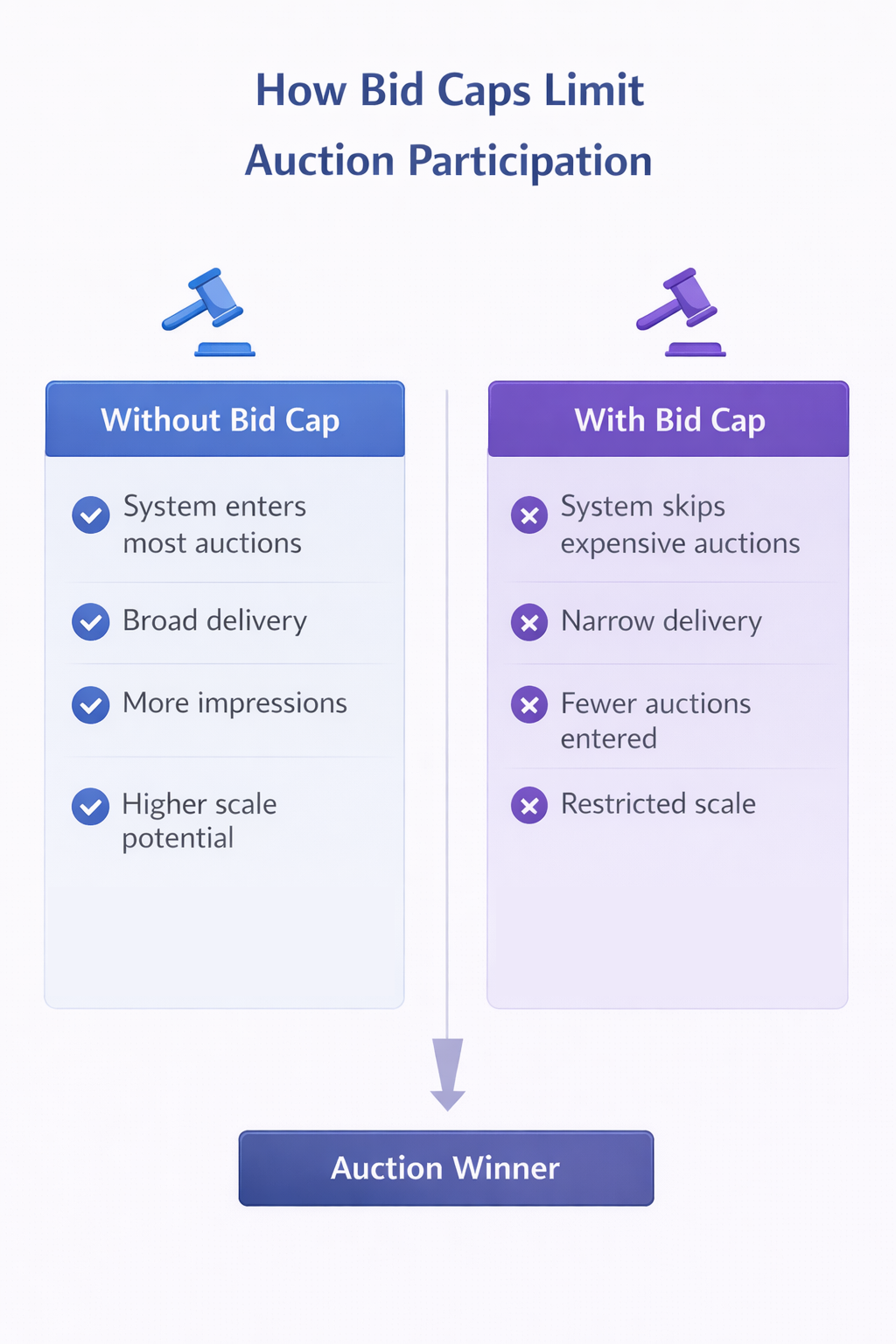
Once a bid cap is introduced, the system must ignore any auction where the estimated winning price exceeds that limit.
Two delivery shifts usually follow:
-
High-intent auctions disappear from the campaign’s reach.
Users with strong purchase signals often attract multiple advertisers, which increases auction prices beyond the cap. -
Delivery concentrates on cheaper inventory.
The system favors impressions with lower competition, such as late-night traffic or broader audience segments.
In Ads Manager, this pattern often appears as low CPM combined with limited reach growth.
Why Campaign Spend Often Drops After Adding a Bid Cap
A common sign of an overly strict bid cap is underdelivery. Even with a large audience, the campaign struggles to spend its full budget.
Several platform signals usually appear:
-
Uneven hourly spend.
Delivery spikes during low-competition hours, then slows down when auction prices increase later in the day. -
Slow reach growth.
Instead of expanding across the entire targeting pool, the campaign repeatedly enters a smaller subset of inexpensive auctions. -
Frequency rises faster than expected.
Because fewer users are reachable within the cap, impressions accumulate within a limited portion of the audience.
These patterns are easy to verify in Ads Manager using reach, frequency, and hourly delivery reports.
If you notice these signals, the issue may not be targeting quality. In many cases, the campaign simply cannot compete in the majority of auctions.
Why Lower CPA Can Reduce Total Conversions
Advertisers often observe that campaigns with strict bid caps show a lower average CPA while generating fewer total purchases.
This happens because the most competitive auctions frequently contain the highest-intent users. Multiple advertisers target those users at the same time, which raises the auction price.
When the bid cap blocks those auctions, the campaign avoids impressions that might still convert at higher prices.
Instead, the algorithm shifts delivery toward cheaper impressions where the predicted conversion probability is lower.
The result is a common tradeoff:
-
CPA appears efficient.
-
Total conversion volume declines.
Understanding this tradeoff is important when evaluating whether the bid cap actually improves performance.
How Audience Quality Interacts With Bid Caps
Bid caps become even more restrictive when audience signals are weak.
If the algorithm cannot confidently identify high-intent users inside your targeting pool, it must bid conservatively in most auctions. Once a cap is introduced, many of those auctions become inaccessible.
This is why audience structure matters. Campaigns built from strong behavioral signals tend to tolerate bid caps better.
For example, advertisers often see stronger performance when campaigns are based on high-quality Custom Audiences rather than broad targeting. The mechanics behind building these audiences are explained in How to Create High-Converting Facebook Custom Audiences.
Audience depth also matters for scaling. If the seed audience lacks behavioral diversity, the algorithm struggles to expand efficiently. The scaling mechanics are described in The Ultimate Guide to Facebook Lookalike Audiences.
Signals That Your Bid Cap Is Too Low
Several observable metrics usually indicate that the cap is blocking large portions of the auction environment.
| Signal in Ads Manager | What It Usually Means |
|---|---|
| Campaign underspends budget | The bid cap prevents the campaign from competing in many auctions, so the algorithm cannot find enough eligible impressions. |
| CPM much lower than account average | The campaign only enters low-demand auctions where competition is weaker and inventory is cheaper. |
| Reach grows slowly | The system cannot access competitive auctions that contain a broader set of users. |
| Frequency rises quickly | Delivery concentrates on a smaller segment of the audience because higher-cost inventory is blocked by the cap. |
When these signals appear, the cap is likely limiting auction participation rather than improving efficiency.
Situations Where Bid Caps Can Still Work
Bid caps are most effective when the advertiser already understands the typical auction price for conversions.
They tend to work best in scenarios such as:
-
Short-window retargeting campaigns.
Users who recently visited a product page or started checkout often convert predictably, making cost control easier. -
Mature advertising accounts with stable CPA benchmarks.
Historical performance data helps determine realistic bid ranges. -
Highly qualified audiences built from strong intent signals.
For example, audiences built from active community participation — such as Facebook groups — can provide stronger purchase signals. Methods for identifying these audiences are explained in How to Build Your Target Audience from a Facebook Group and Using Facebook Groups to Reach Ready-to-Buy Users.
In these cases, the bid cap acts as a guardrail rather than a strict restriction.
The Real Tradeoff Behind Bid Caps
Bid caps do not simply control costs. They change how your campaign competes inside the auction system.
When the cap is restrictive, the campaign withdraws from many competitive auctions and concentrates on cheaper inventory. Delivery becomes narrower, data accumulates more slowly, and scaling becomes harder.
When the cap leaves room for auction variation, the algorithm can still compete for valuable impressions while keeping costs within acceptable limits.
The key question is not whether bid caps reduce CPA.
The real question is how many valuable auctions your campaign must abandon before that CPA improvement appears.