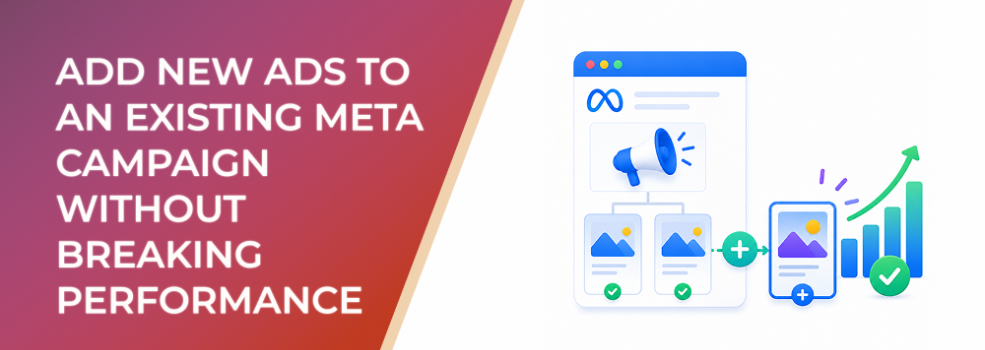
You do not always need a new campaign to test a new ad.
Meta allows advertisers to create new ads using an existing campaign or ad set, provided the existing campaign or ad set has already been published and approved. This can be useful when you want to test new creative, refresh messaging, or expand variations without rebuilding your structure from scratch.
The key is knowing when this helps performance and when it creates confusion.
What This Workflow Is Trying to Solve
Creating a new campaign every time you need a new ad can make an ad account messy fast.
You end up with too many campaigns, overlapping audiences, scattered budgets, and reporting that is hard to interpret. Adding a new ad to an existing campaign can keep testing cleaner when the campaign objective, audience, budget structure, and conversion goal are still valid.
This workflow is especially useful for creative iteration.
If the campaign is already reaching the right audience and optimizing toward the right goal, adding another ad can help test a new message, image, video, hook, CTA, or format without changing everything else.
Business Impact on CPA, CAC, ROAS, and Testing Speed
Adding ads to an existing campaign can improve testing efficiency.
It can support:
- Faster creative testing without rebuilding campaign structure.
- Cleaner CPA comparisons when the audience and objective remain stable.
- Lower wasted spend from avoiding unnecessary campaign duplication.
- More consistent CAC analysis when conversion logic stays the same.
- Better ROAS protection when only the ad-level variable changes.
The value comes from variable control.
If you change the campaign, audience, budget, creative, and destination at the same time, you will not know what affected performance. Adding a new ad inside an existing structure can isolate creative impact more cleanly.
Typical Scenarios Where This Applies
Creative refreshes
If a campaign is performing but engagement is fading, adding a new ad can help refresh attention without disrupting the broader setup.
Testing new hooks
You may want to test a problem-focused hook, testimonial angle, product benefit, or offer variation against the same audience.
Adding the ad inside the same campaign can keep the test focused.
Agency campaign management
Agencies often need to add new creative for clients while preserving campaign continuity.
This workflow helps reduce clutter and makes reporting easier.
SMB campaign scaling
A small business may have one reliable campaign and want to add a new ad for a seasonal offer or refreshed creative.
Using the existing campaign can be faster than building a new structure.
B2B lead-generation campaigns
B2B teams may use the same audience and objective but test different value propositions, such as demo, guide, webinar, or consultation messaging.
Risks and Considerations
Adding a new ad is not always the right move.
If the existing campaign has the wrong objective, weak audience, poor budget structure, or outdated conversion path, adding another ad only adds noise.
Another risk is uneven delivery. Meta may allocate budget heavily toward one ad before you have enough data to judge the others. This can make creative tests harder to read.
There is also a risk of damaging an active campaign with too many edits. If you add multiple ads, change budgets, adjust targeting, and edit destinations at once, performance may become difficult to diagnose.
Finally, new ads should be previewed across placements. A creative variation that looks good in isolation may perform poorly because it does not fit the campaign’s selected placements.
Prerequisites and Dependencies
Before adding a new ad to an existing campaign, confirm:
- The existing campaign or ad set is published and approved.
- The campaign objective still matches the business goal.
- The audience is still relevant.
- The budget can support another ad variation.
- The conversion event or destination still works.
- The new ad has a clear testing purpose.
- Existing performance data is stable enough to compare.
- The creative has been previewed across placements.
Do not add new ads just to feel productive. Add them when they answer a specific performance question.
How LeadEnforce Helps
LeadEnforce helps advertisers make better decisions about whether a new ad should be tested inside the same audience or against a more focused one.
If an existing campaign is underperforming because the audience is too broad or low-intent, adding another ad may not solve the issue. The creative may improve slightly, but the campaign still reaches weak prospects.
LeadEnforce helps create audiences from Facebook groups, Instagram profiles, followers, engagers, LinkedIn professional data, and custom social-profile data.
That gives advertisers a stronger foundation before adding ads.
For example, an ecommerce advertiser can add new product creatives to a campaign targeting audiences built from niche Instagram profiles. A B2B team can test new lead-gen messaging against professional segments. An agency can build offer-specific audiences for each client before deciding whether to add ads to an existing structure or create a separate campaign.
Practical Recommendations
Use existing campaigns when the strategy is still valid.
If the objective, audience, budget, and destination are working, add new ads to test creative. If the foundation is broken, fix the foundation first.
Limit the number of new ads added at once. Too many variations can dilute delivery and make results harder to interpret.
Define the test question before launch. For example:
- Does testimonial creative beat product-focused creative?
- Does a demo CTA beat a guide CTA?
- Does a vertical video outperform a static image?
- Does a pain-point headline improve qualified lead rate?
Avoid changing budgets immediately after adding a new ad. Give Meta enough time to allocate delivery and gather signal.
Review results beyond surface metrics. A new ad with cheap clicks may still produce poor lead quality. Compare conversion rate, CPA, qualified lead rate, CAC, and ROAS.
Final Takeaway
Creating a new ad inside an existing Meta campaign can be a smart way to test creative without rebuilding your whole account.
It works best when the existing campaign structure is sound, the test variable is clear, and the audience is relevant enough to produce useful data.
To add new ads to cleaner, higher-intent audience tests, join the free 7-day LeadEnforce trial period.
Related LeadEnforce Articles
- How to Structure a Facebook Ads Campaign Without Wasting Budget — Explains how campaign structure affects testing, budget control, and scalability.
- Campaign Budgets vs Ad Set Budgets: Which Meta Ads Setup Works Better? — Helps advertisers understand budget behavior before adding more ads.
- How to Change Your Meta Ads Budget Without Hurting Performance — Useful when adding new ads requires budget adjustments.
- Meta Ads Manager Explained: How to Manage Campaigns Without Wasting Budget — Provides a broader framework for managing campaigns, ad sets, and ads.
- How to Customize Ad Creative for Placements in Meta Ads Manager — Helps ensure newly added ads are placement-ready before publishing.