Most Facebook campaigns fail at the message level, not the targeting level. The audience may be correct, but the message does not match intent. When intent and messaging diverge, performance drops across the funnel.
Buyer intent is not a demographic trait. It reflects awareness, urgency, and decision readiness. Your ad must respond to that state directly.
Why Buyer Intent Matters More Than Audience Segments
Many advertisers build campaigns around interests and lookalikes. They assume targeting precision will solve performance issues. Messaging receives less strategic attention.
Intent determines how a person interprets your ad. A cold prospect reacts differently than someone comparing vendors. The same creative cannot persuade both groups effectively.
When messaging ignores intent, you see:
-
High click-through rate but low lead quality; curiosity replaces real buying motivation.
-
Strong engagement but weak conversion rate; the message entertains without moving decisions.
-
Rising cost per opportunity; unqualified users enter the funnel and stall sales.
Alignment reduces friction. The ad feels relevant because it answers the exact question in the buyer’s mind.
Understanding the Three Core Intent Stages
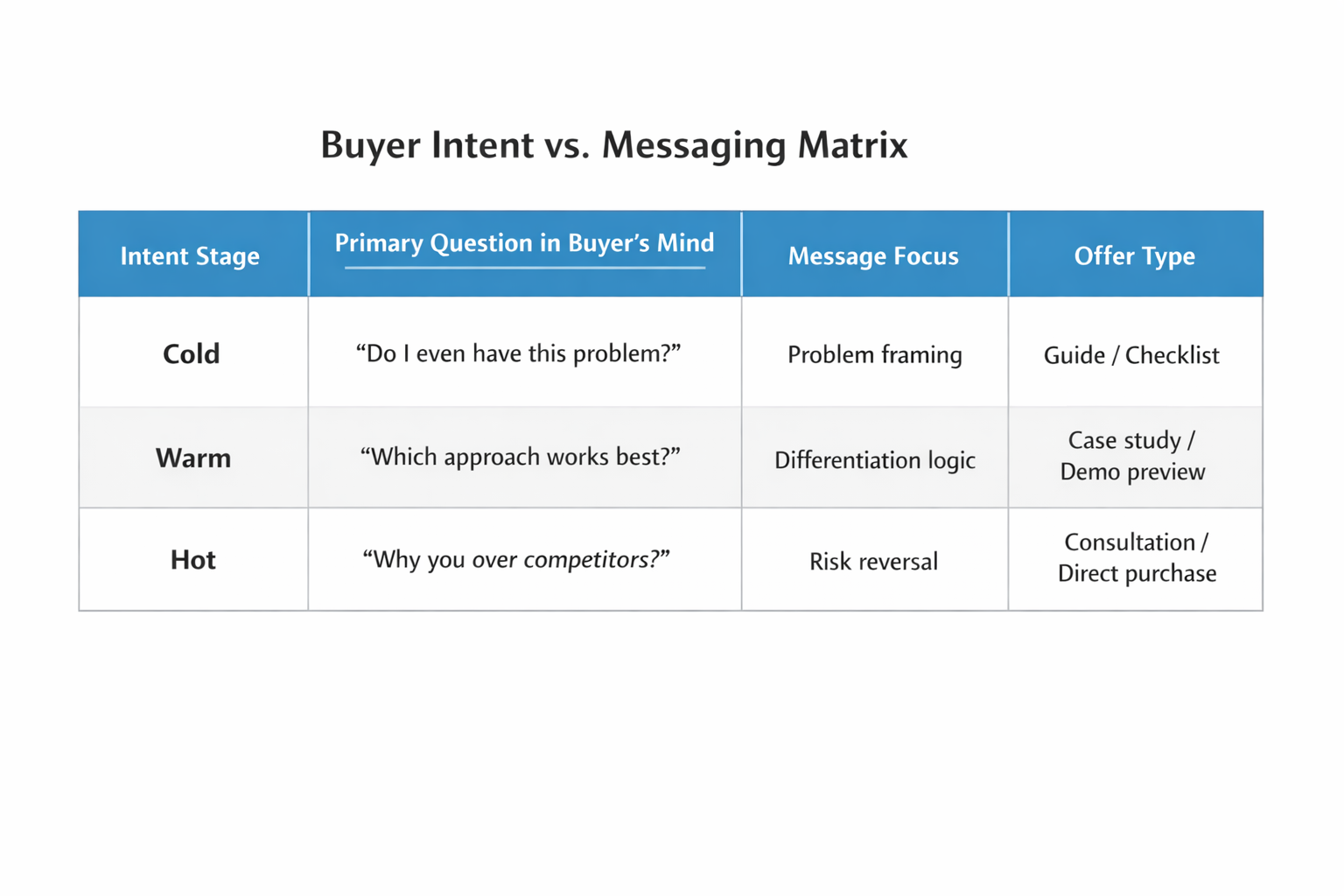
Intent evolves as prospects gather information. Each stage requires different language, proof, and calls to action.
Cold Intent: Problem Aware or Unaware
Cold audiences are not evaluating vendors yet. They may not clearly define their problem.
Messaging at this stage should:
-
Name the problem in simple terms; reflect common frustrations without technical depth.
-
Agitate consequences; show what happens if the issue remains unresolved.
-
Offer low-commitment value; guides, checklists, or short diagnostics work well.
Avoid product-heavy explanations here. Detailed feature breakdowns overwhelm early-stage users and reduce response. For a deeper breakdown of awareness-based messaging, see how to align ad copy with audience awareness levels.
Warm Intent: Solution Aware
Warm audiences recognize their problem. They are exploring solution categories.
Effective messaging at this stage should:
-
Position your approach clearly; explain how your method differs structurally, not emotionally.
-
Introduce light proof; case snippets or performance metrics create credibility.
-
Reduce uncertainty; clarify implementation time, complexity, and expected outcomes.
This is where structured retargeting becomes critical. Engagement audiences and site visitors often sit in this stage. If you need a refresher on audience types, review the complete guide to warm, cold, and custom audiences in Meta Ads.
Hot Intent: Vendor Comparison
Hot prospects compare providers. They care about risk, pricing logic, and fit.
Ad messaging should now:
-
Address objections directly; pricing transparency or contract terms remove hesitation.
-
Emphasize proof depth; detailed case studies or quantified outcomes build confidence.
-
Push strong calls to action; demos, consultations, or direct purchase options fit this stage.
At this level, message precision matters more than reach. High-intent segments convert better because urgency already exists. If you want to refine these segments, explore why high-intent audiences convert better than broad ones.
Mapping Messaging to Funnel Structure
Intent alignment only works when campaign structure reflects intent segmentation. One campaign cannot serve all stages effectively.
Segment Audiences by Behavioral Signals
Intent is observable through behavior. Platform data and CRM signals reveal progression.
Examples of practical segmentation:
-
Video viewers over 50 percent; these users show early curiosity and fit warm messaging.
-
Website visitors to pricing pages; these users display high intent and need comparison-focused ads.
-
Lead form openers without submission; these users require friction-reduction messaging.
Each segment deserves distinct creative and copy. Recycling the same ad weakens performance. For a structural approach to this mapping, read how to map audiences to funnel stages.
Align Objectives With Intent
Campaign objectives must match intent depth. Mismatched objectives distort optimization.
Consider the following structure:
-
Cold traffic; optimize for landing page views or engaged traffic to gather data efficiently.
-
Warm audiences; optimize for leads or initiated checkouts to move users forward.
-
Hot segments; optimize for conversions tied to revenue events.
When objectives and intent align, algorithmic optimization supports your strategy instead of fighting it.
Ad Copy Frameworks That Reflect Buyer Psychology
Copy structure should shift with intent, not just tone.
For Cold Intent: Education First
Use a problem-solution narrative. Start with a specific pain point, then introduce a structured insight.
Example structure:
-
Identify a common operational frustration; describe it in concrete terms.
-
Quantify impact; reference wasted budget, time, or missed revenue.
-
Introduce a simple resource; position it as a starting point, not a pitch.
This lowers resistance and builds relevance.
For Warm Intent: Differentiation Logic
Warm users compare categories. They need clarity more than inspiration.
A practical framework includes:
-
Define the typical approach in the market; explain its limitation clearly.
-
Present your alternative model; describe structural differences.
-
Support with data; share outcome metrics that validate your approach.
Specificity improves trust. Abstract claims reduce credibility.
For Hot Intent: Risk Reduction
Hot prospects fear making the wrong choice. Your copy must remove perceived risk.
Focus on:
-
Guarantees or flexible terms; clarify commitments and exit options.
-
Detailed proof; show case studies with context, not just results.
-
Direct next steps; make the path to action simple and immediate.
Strong calls to action work only when objections are already addressed.
Creative Elements That Reinforce Intent
Messaging extends beyond copy. Visual structure and format influence interpretation.
Match Visual Complexity to Awareness
Cold audiences respond better to simple visuals. Clear headlines and minimal distraction improve comprehension.
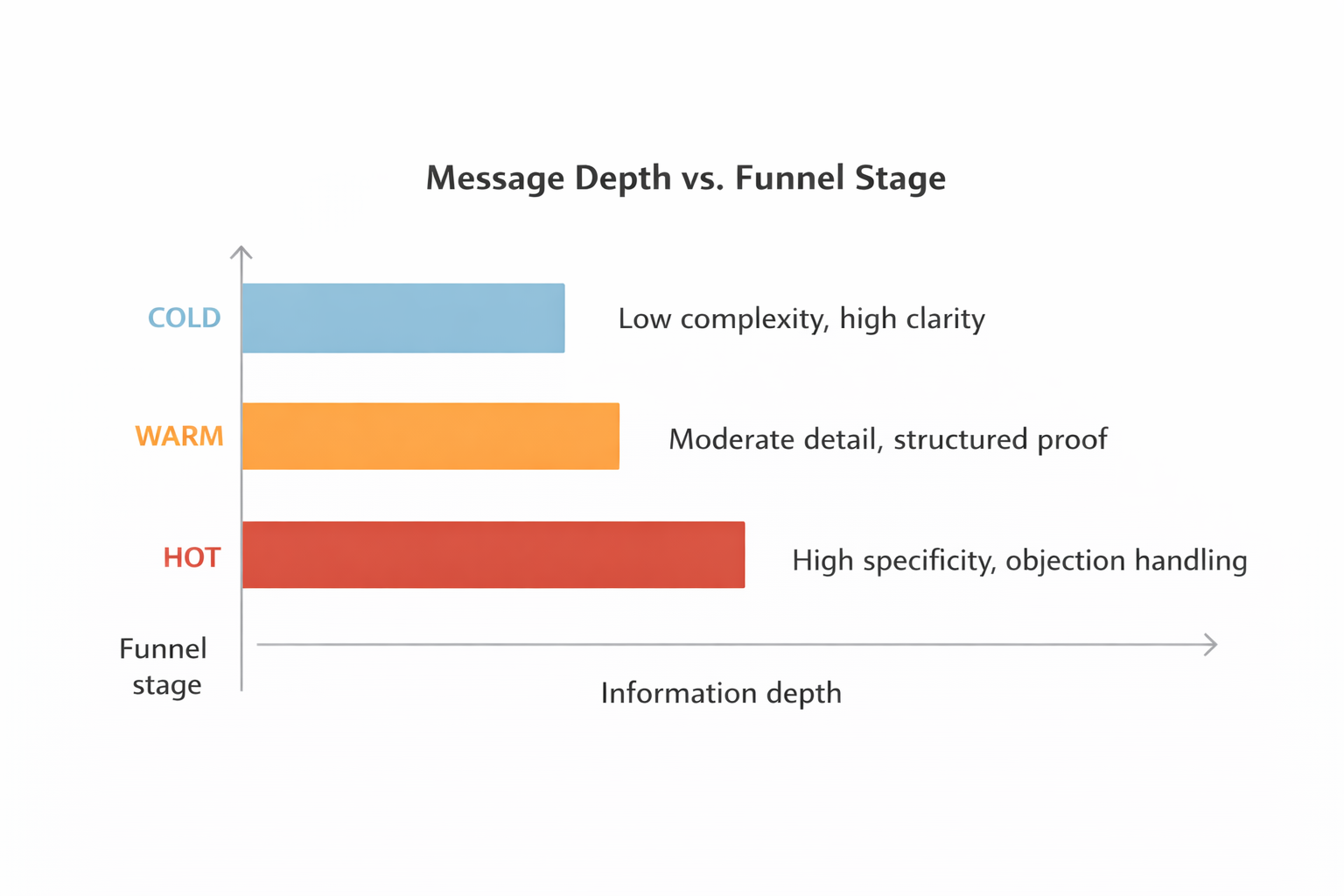
Warm audiences tolerate more detail. Diagrams, process visuals, or comparison graphics can enhance persuasion.
Hot audiences benefit from credibility signals. Screenshots, dashboards, or testimonial overlays reinforce seriousness.
Adjust Offer Friction by Intent
The commitment you request should scale with readiness.
Examples:
-
Cold traffic; offer downloadable content or short quizzes.
-
Warm users; offer strategy calls or tailored reports.
-
Hot prospects; offer direct booking or checkout.
Requesting a demo from cold traffic inflates cost and reduces efficiency.
Measuring Intent Alignment in Performance Data
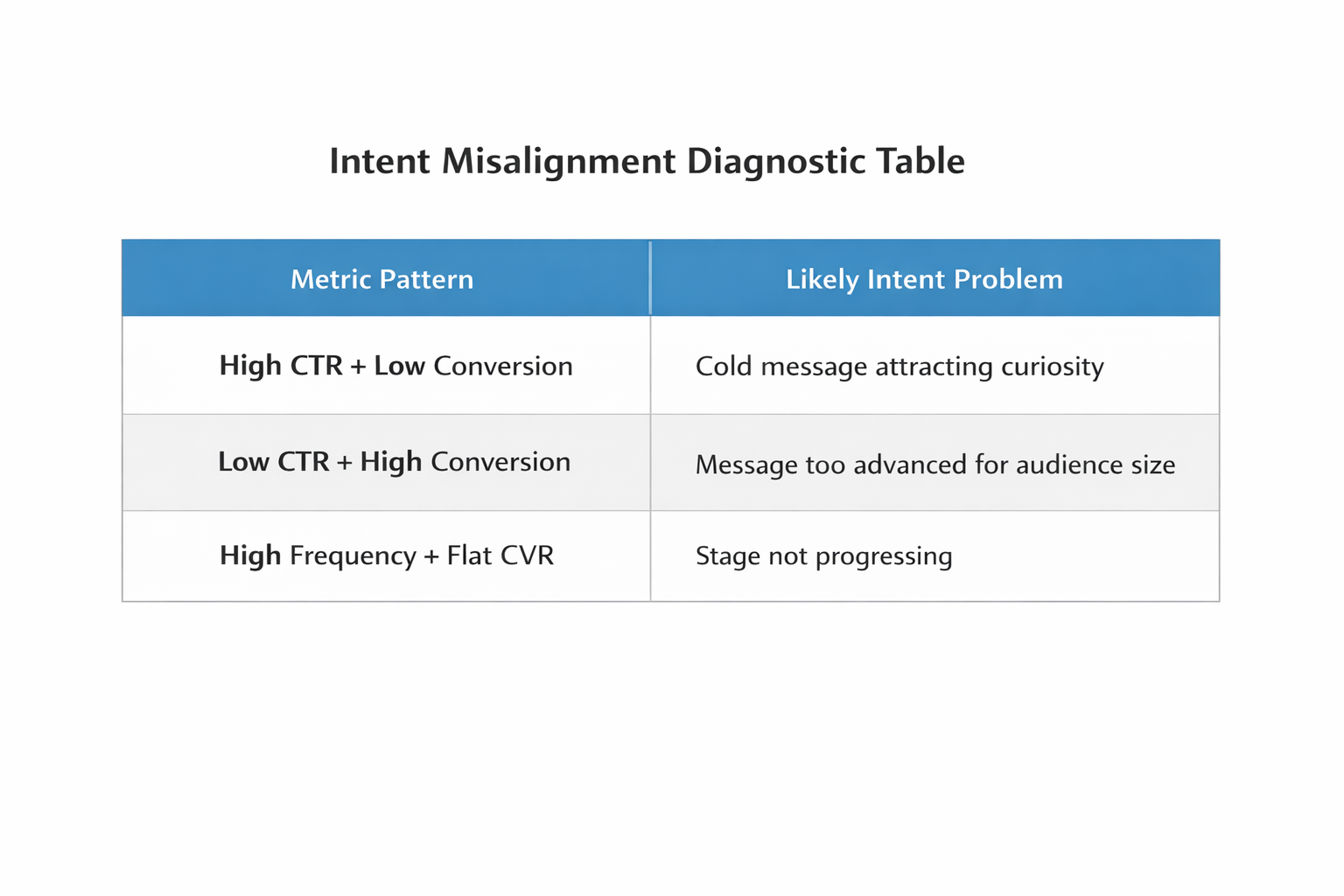
Intent misalignment shows up in metrics. You can diagnose it quickly if you know where to look.
Watch for:
-
High click-through rate with low time on page; messaging attracts curiosity but lacks depth.
-
Strong lead volume with poor meeting rates; offer appeals broadly but not to decision-makers.
-
High retargeting frequency with declining conversion rate; messaging repeats without advancing stage.
Cross-reference ad data with CRM outcomes. Lead-to-meeting rate and meeting-to-close rate reveal true alignment.
Building a Continuous Intent Feedback Loop
Intent is dynamic. Prospects shift stages as they consume content and interact with your brand.
Create a review process:
-
Weekly funnel review; analyze performance by audience segment and intent stage.
-
Creative audit; confirm that messaging reflects current buyer questions.
-
Sales feedback loop; collect objection patterns from calls and integrate them into ads.
Messaging should evolve as objections evolve. Static creative leads to declining efficiency.
Common Alignment Mistakes
Even experienced advertisers overlook structural misalignment.
Frequent issues include:
-
Using identical copy across cold and retargeting campaigns; this ignores stage progression.
-
Scaling budgets before validating intent segmentation; volume amplifies inefficiency.
-
Optimizing for platform metrics alone; revenue outcomes must guide decisions.
Intent alignment is a structural discipline that connects psychology, campaign architecture, and revenue data.
When your message answers the exact question in the buyer’s mind, performance improves naturally. Cost efficiency follows clarity.