In B2B organizations, marketing and sales often operate with separate systems, metrics, and objectives. Marketing optimizes for lead volume and engagement. Sales prioritizes pipeline velocity and closed revenue. Without structured data sharing, these teams rely on assumptions rather than evidence.
Research consistently shows the impact of alignment:
-
Companies with strong marketing and sales alignment achieve 19% faster revenue growth and 15% higher profitability.
-
Misalignment can cost organizations 10% or more of annual revenue.
-
79% of marketing leads never convert to sales, largely due to lack of follow-up or qualification gaps.
The common denominator in both success and failure is data.
Why Data Sharing Is the Core of Alignment
Alignment is not about meetings. It is about shared visibility.
When marketing and sales operate from different datasets, several issues emerge:
-
Conflicting definitions of qualified leads
-
Inconsistent account prioritization
-
Poor follow-up timing
-
Limited feedback loops
-
Inaccurate revenue attribution
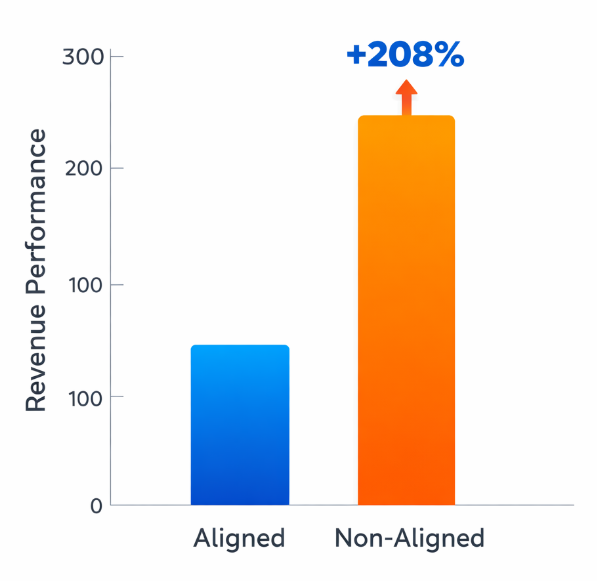
Revenue comparison between organizations with aligned sales and marketing vs non-aligned, highlighting a 208% uplift in marketing-sourced revenue
Data sharing creates a single operational reality. Both teams evaluate the same accounts, contacts, intent signals, and engagement history.
Step 1: Define Shared Metrics and Lead Stages
Alignment begins with standardized definitions.
Both teams must agree on:
-
Ideal Customer Profile (ICP) criteria
-
Marketing Qualified Lead (MQL) thresholds
-
Sales Qualified Lead (SQL) criteria
-
Opportunity stages
-
Closed-won qualification rules
Organizations that formalize SLA agreements between marketing and sales see significantly higher lead acceptance rates.
Key practice:
Create documented definitions inside your CRM and marketing automation platform to prevent subjective interpretation.
Step 2: Centralize Account and Contact Intelligence
Disconnected databases are one of the primary causes of friction.
A centralized system should include:
-
Firmographic data (industry, company size, revenue)
-
Technographic insights
-
Behavioral engagement data
-
Buying intent signals
-
Sales activity history
When sales can see marketing engagement data — such as content downloads, website visits, and campaign interactions — outreach becomes context-driven rather than generic.
Studies show that personalized outreach based on behavioral data can increase response rates by over 30%.
Step 3: Use Account-Based Data to Prioritize Outreach
Account-based strategies require synchronized targeting.
Marketing may run campaigns targeting specific industries or segments. Sales must prioritize the same accounts.
Shared data ensures:
-
Campaign visibility for sales teams
-
Identification of high-intent accounts
-
Coordinated outreach timing
-
Reduced overlap or duplication
Companies implementing account-based alignment strategies report 36% higher customer retention and 38% higher sales win rates.
Step 4: Build a Closed Feedback Loop
Data flow must be bidirectional.
Marketing provides:
-
Engagement data
-
Campaign performance metrics
-
Intent scoring
Sales provides:
-
Lead quality feedback
-
Objection insights
-
Buying committee structure
-
Closed-won and closed-lost reasons
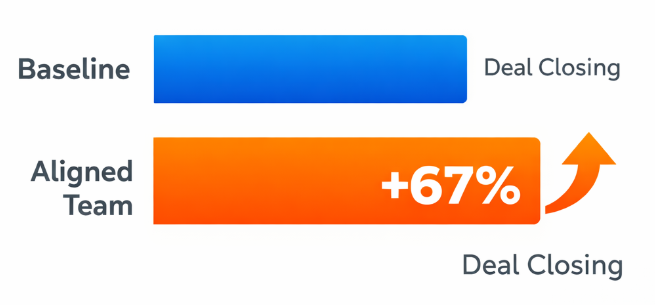
Comparison of deal-closing effectiveness showing a 67% increase for companies with strong marketing and sales alignment
Without structured feedback, marketing continues optimizing for volume instead of conversion quality.
Quarterly data audits between teams improve forecasting accuracy and reduce pipeline leakage.
Step 5: Align Technology Stack and Automation
Technology fragmentation creates data gaps.
Ensure integration between:
-
CRM systems
-
Marketing automation platforms
-
Data enrichment tools
-
Intent data providers
-
Analytics dashboards
Organizations with fully integrated revenue tech stacks experience up to 30% higher pipeline visibility and improved reporting accuracy.
Automation should trigger:
-
Sales alerts for high-intent activity
-
Lead routing based on ICP criteria
-
Re-engagement campaigns for stalled opportunities
Step 6: Implement Revenue-Based Reporting
Marketing should not report solely on lead generation metrics.
Shared dashboards should track:
-
Pipeline contribution
-
Revenue influenced by marketing
-
Opportunity conversion rates
-
Sales cycle length by segment
-
Customer acquisition cost (CAC)
Revenue-based reporting transforms marketing from a cost center into a revenue partner.
Common Data Sharing Mistakes to Avoid
-
Overloading sales with unqualified leads
-
Failing to document definitions
-
Delayed CRM updates
-
Relying on manual data entry
-
Ignoring data hygiene and enrichment
Poor data quality reduces trust between teams. Trust erosion leads to process breakdown.
The Measurable Impact of Alignment
When marketing and sales operate on shared data:
-
Lead acceptance rates increase
-
Pipeline velocity improves
-
Forecasting becomes more accurate
-
Customer acquisition costs decline
-
Revenue growth accelerates
Organizations that integrate data sharing into their revenue operations framework consistently outperform competitors in growth and profitability.
Conclusion
Marketing and sales alignment is not achieved through collaboration workshops. It is built through structured data architecture, shared metrics, and synchronized account visibility.
When both teams operate from a unified dataset, strategy becomes coordinated, outreach becomes personalized, and revenue becomes predictable.
Alignment is not a cultural initiative. It is a data initiative.