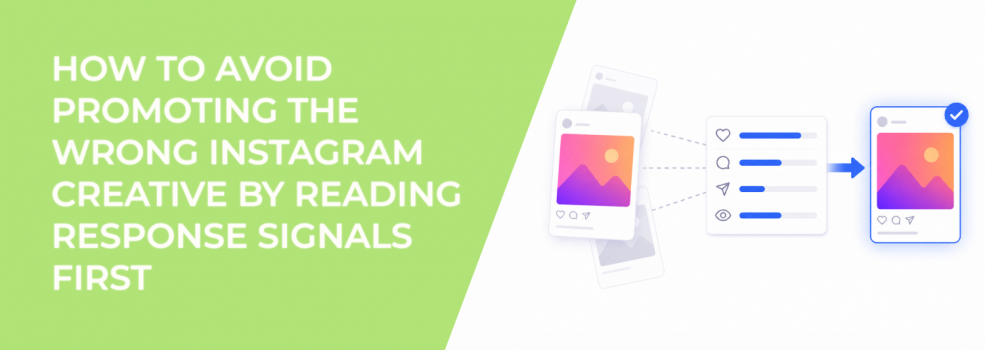
Some Instagram creatives look ready for promotion because they generate visible activity.
The post gets reactions, the Reel collects views, or the Story receives replies. The advertiser promotes it, expecting paid delivery to multiply the result. Instead, CPM rises, clicks stay shallow, and the campaign struggles to move users beyond the first interaction.
The problem is not that the creative had no response.
The problem is that the wrong response was treated as a buying signal.
Problem: Advertisers promote creatives before checking what the response actually means
Instagram response signals are not equal.
A like can mean the user enjoyed the visual. A comment can come from disagreement, curiosity, or entertainment. A view can happen without real attention if the user never processes the offer.
This creates a selection problem before the campaign starts.
The advertiser chooses the creative with the most obvious activity, not the creative with the strongest commercial response pattern. Once that asset enters paid delivery, Meta expands based on the behavior it already attracts.
If the creative attracts passive or unfocused response, the campaign often finds more users who behave the same way.
That usually shows up as:
- Cheap early clicks, but weak landing-page depth.
- Strong post engagement, but low conversion rate.
- High view count, but poor retention after the hook.
- Many comments, but few product-specific questions.
- Good reach, but weak saved or shared intent.
This is why advertisers need to read engagement metrics like a media buyer, not like a social media manager.
1. Classify response signals before choosing what to promote
Before promoting an Instagram creative, separate response signals into three groups.
First, check attention signals. These show whether users stopped long enough to process the creative. For video, look at retention after the first seconds. For Stories, watch tap-forward and exit behavior. For Feed, compare reach against profile visits, saves, and meaningful comments.
Then check intent signals. These show whether users moved closer to a buying action. Product questions, repeated profile visits, saves, link clicks with strong page depth, and add-to-cart behavior matter more than broad reactions.
Finally, check mismatch signals. These reveal when the creative is attracting the wrong audience. A post may receive comments from people who like the topic but do not fit the offer. A Reel may get shares because it is entertaining, while product-page behavior stays weak.
This classification helps avoid promoting the loudest creative by mistake.
A creative with fewer reactions but stronger intent signals often deserves budget before a high-volume post with shallow engagement.
2. Look for response consistency, not one strong metric
One strong metric can mislead creative selection.
A Reel with strong views but weak retention is not a strong paid asset. A Feed post with many likes but no saves may be entertaining without creating consideration. A Story with replies but high exits may be provoking reaction without moving users forward.
The better question is whether several response signals point in the same direction.
Useful creative signals include:
- Retention stays strong after the hook.
- Saves increase with reach, not only with follower exposure.
- Comments mention use cases, objections, pricing, or product fit.
- Profile visits rise after the creative is posted.
- Clicks lead to real page activity, not immediate exits.
These are the kinds of creative signals that predict winners because they connect attention to next-step behavior.
The signal does not need to be perfect. It needs to be coherent.
If attention, intent, and post-click behavior all move in the same direction, the creative is more likely to survive paid promotion.
3. Promote in stages before assigning serious budget
The safest way to avoid promoting the wrong Instagram creative is to treat promotion as confirmation, not a full commitment.
Start with a small test budget and watch whether paid response matches the original organic response. If the creative looked strong organically but produces weaker paid traffic, the original response may have come from followers, loyal fans, or low-intent engagement.
Early paid testing should answer three questions:
- Does the creative hold attention outside the existing audience?
- Do clicks produce meaningful landing-page behavior?
- Does Meta find similar users without CPA rising too quickly?
If the answer is no, do not force the creative into larger spend.
This is where advertisers can spot winning ads before they peak instead of waiting until wasted budget confirms the mistake.
Final takeaway
The wrong Instagram creative is not always the one with weak engagement.
Often, it is the creative with strong but misleading response signals. It gets attention, reactions, or views, but fails to attract users who show real purchase intent.
Before promoting a creative, read the response pattern behind the numbers. Strong paid assets usually show consistent attention, intent, and post-click behavior before budget increases.