Clicks, scroll depth, time on page, product views, form starts, and purchases all reveal intent. Unlike declared interests or broad demographic data, on-site behavior is based on what people actually do. This makes it one of the strongest foundations for building high-quality marketing audiences.
Industry benchmarks consistently show the value of behavioral data:
-
Visitors who view a product page are 2–3× more likely to convert than homepage-only visitors.
-
Returning visitors account for over 40% of revenue, despite representing a smaller share of total traffic.
-
Behavior-based retargeting campaigns often achieve 50–70% lower cost per acquisition compared to cold traffic campaigns.
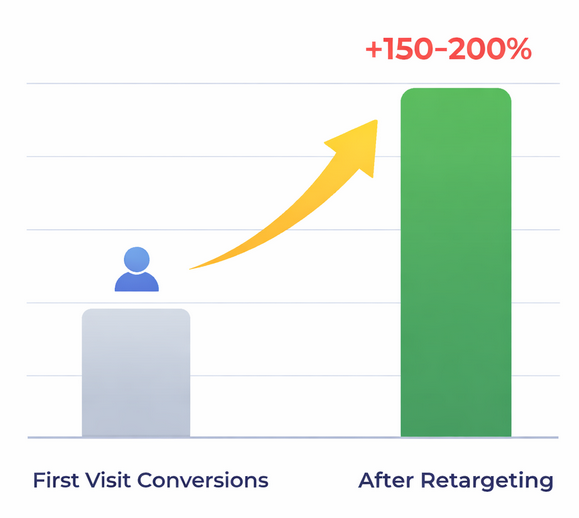
Retargeting lifts conversion rates significantly compared with users who convert on their first visit
These gains are possible because behavioral signals capture intent at the exact moment it forms.
Key Types of On-Site Behavioral Audiences
1. Page-Level Audiences
Segment users based on specific pages they visited:
-
Product or service pages
-
Pricing or comparison pages
-
Blog posts tied to high-intent keywords
Visitors to pricing pages, for example, typically convert at 2× the rate of general site visitors.
2. Engagement-Based Audiences
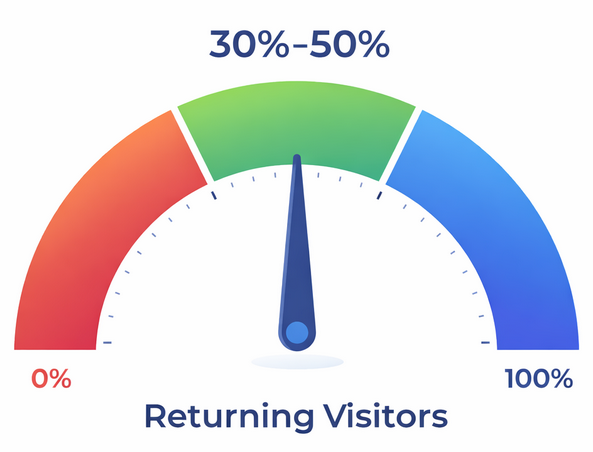
Benchmark range for returning visitors, indicating strong audience engagement and potential for higher conversion
Engagement depth is often more important than raw visits. Useful segments include:
-
Users who spent more than 60 seconds on a page
-
Visitors who scrolled past 75% of content
-
Users who visited multiple pages in a single session
Studies show that highly engaged visitors are up to 3× more likely to convert than low-engagement users.
3. Funnel Stage Audiences
Map behavior to funnel intent:
-
Awareness: blog readers, first-time visitors
-
Consideration: feature pages, case studies, FAQs
-
Decision: pricing pages, checkout initiators
This structure allows messaging to match readiness, increasing conversion efficiency at every stage.
Turning Raw Behavior into Actionable Audiences
Collecting data is only the first step. The real advantage comes from structuring it correctly.
Use Time Windows Strategically
Behavior loses value over time. Segment audiences by recency:
-
Last 7 days: high intent
-
8–30 days: warm consideration
-
31–90 days: re-engagement
Recent visitors typically convert 30–50% better than older segments.
Combine Multiple Signals
Single actions can be misleading. Combining signals increases precision:
-
Viewed product page + spent 60+ seconds
-
Added to cart + did not purchase
-
Visited pricing page + returned within 7 days
Multi-signal audiences consistently outperform single-event audiences in both conversion rate and cost efficiency.
Scaling with Lookalike Expansion
Once behavioral audiences are defined, they become powerful seeds for scale. Lookalike audiences built from high-intent on-site segments routinely outperform interest-based targeting.
Useful benchmarks:
-
Lookalikes based on converters show 60–80% higher conversion rates than interest-based audiences.
-
Smaller, high-quality seed audiences often outperform larger but less specific ones.
The key is quality first, scale second.
Common Mistakes to Avoid
-
Over-broad audiences: Mixing low-intent visitors with high-intent users dilutes performance.
-
Ignoring recency: Treating 90-day-old visitors the same as 3-day-old visitors reduces relevance.
-
One-size-fits-all messaging: Behavioral segments require tailored creatives and offers.
Avoiding these mistakes can improve results without increasing budget.
Measuring Success
Track performance by segment, not just overall campaign results. Key metrics include:
-
Conversion rate by behavior type
-
Cost per conversion by recency window
-
Frequency and saturation levels
Behavior-driven segmentation often delivers 20–40% efficiency gains within the first optimization cycle.
Recommended Articles
If you want to go deeper, explore these related articles on our blog:
Final Thoughts
On-site behavior turns anonymous traffic into clear intent signals. By structuring audiences around what users actually do, you move from guesswork to precision. The result is better relevance, stronger performance, and scalable growth driven by real data—not assumptions.