
Many small businesses see social media as unreliable or time-consuming. The returns can seem inconsistent. Engagement can feel random. Sales don’t always follow.
But these issues often come from poor planning, not from the platforms themselves.
When social media is treated as a structured system, it supports every stage of growth: brand visibility, lead generation, customer trust, and retention. This becomes clear when you look at how effective local brands approach Facebook and Instagram as part of a broader marketing system, not just a posting channel.
A useful reference is this step-by-step Facebook marketing strategy for local businesses.
The key is clarity. You need to know what you're doing, why you're doing it, and how to measure success.
Strategy First, Then Content and Spend
Jumping straight into posts or ads without a clear strategy is a common mistake. Every business, no matter the size, should define three things before doing anything on social:
1. Business Objective
Set a short-term focus. Are you trying to generate leads, improve customer lifetime value, or reduce acquisition costs?
Clear objectives also help you choose the right campaign structure later. If this step is skipped, even well-designed campaigns struggle to perform. This overview of Meta ad campaign objectives and how to choose the right one explains why alignment matters.
2. Marketing Role
Decide how social media supports that goal. Is it about building brand awareness, building trust, or generating direct sales?
3. Core Metrics
Pick 1–2 metrics that signal progress. These might be cost per lead, percentage of followers who convert, or engagement-to-sale ratio.
Once you know these, your content and ad spend will have direction. You’ll stop posting aimlessly or boosting for reach alone.
Combine Organic and Paid — Don’t Separate Them
Organic content and paid ads are most effective when they work together. Relying on only one limits your results.
What Organic Tells You
Organic content is your test lab. It helps you see what kind of messages, visuals, or formats your audience responds to.
Watch for:
-
Saves and shares, which signal relevance;
-
Comments, especially when they include questions or objections;
-
Link clicks, which show true interest.
If organic reach feels weak, the issue is often structural, not algorithmic. This guide on how to rescue Facebook organic reach outlines what usually goes wrong and how to fix it.
What Paid Can Do
Once something works organically, paid promotion helps you scale it. Use Meta Ads Manager to amplify high-performing posts, or turn them into structured campaigns.
Organic shows what resonates. Paid makes it reach more people, faster.
Build a Real Content System, Not Just a Calendar
Many small businesses think in terms of content types — quotes, behind-the-scenes, tips. But strong performance comes from thinking in content functions.
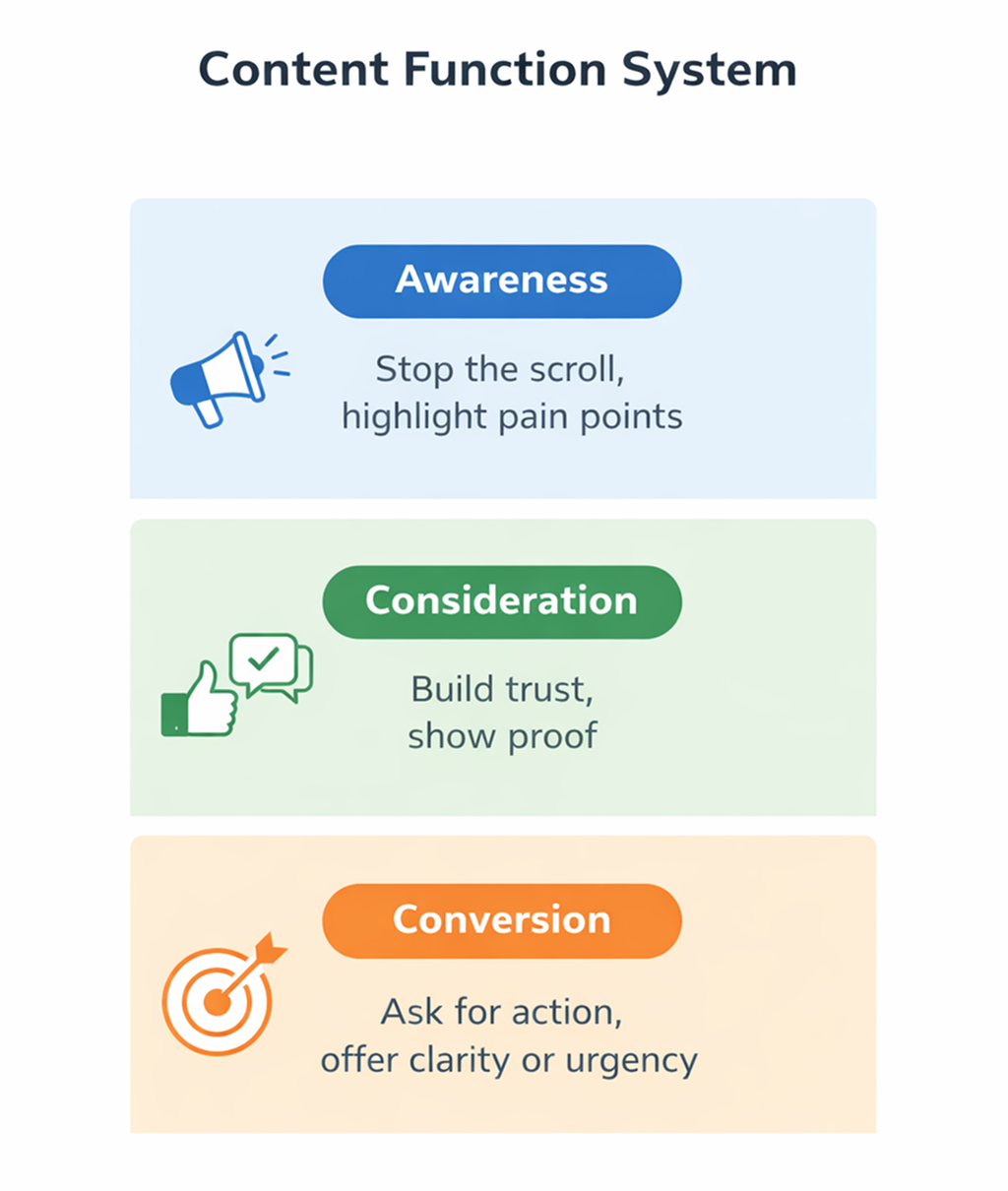
Here’s a system that works well, even on small teams:
Awareness Content
Goal: Get in front of people who’ve never heard of you.
-
What to post: short videos, visual hooks, bold statements or myths.
-
Tip: Focus on the customer’s problem, not your product yet.
Consideration Content
Goal: Build trust and familiarity.
-
What to post: customer reviews, FAQs, demos, or case studies.
-
Tip: Focus on showing — not telling — why you're worth it.
Conversion Content
Goal: Get action — clicks, signups, or purchases.
-
What to post: offers, product comparisons, “why now” messages.
-
Tip: Match the message to the user’s awareness level.
This structure mirrors how effective funnels work in paid media as well. For a deeper look at how these stages connect, see this Facebook ads funnel strategy from audience identification to conversion.
Each of these content types plays a specific role. You don’t need to post all of them every week, but all three should be in rotation.
Run Ads That Match the Funnel
Too many businesses run all ads with a “buy now” CTA. But audiences aren’t always ready. You need to meet them where they are in the decision process.
Use this funnel-based approach to structure campaigns:
| Funnel Stage | Target Audience | Ad Type | Best Objective |
|---|---|---|---|
| Awareness | Cold, broad | Short videos, reels | Video views, engagement |
| Consideration | Warm, engaged | Testimonials, product features | Traffic, lead generation |
| Conversion | Ready to buy | Offers, comparisons | Conversions |
Avoid using the “sales” objective on a cold audience. Meta’s algorithm performs best when each campaign has a clear, specific job.
Build Smarter Audiences with User Behavior
Interest targeting used to be enough. It’s not anymore. Behavior-based audiences are much stronger, especially when budgets are limited.
Here’s what to prioritize:
-
Video viewers: Create audiences from people who watched 50% or more of a specific video.
-
Page or site visitors: Retarget based on recency (7-day and 30-day windows).
-
Lead form engagers: Focus on users who opened but didn’t complete a form.
-
Email lists: Upload and build Lookalikes from high-value customers.
If you want to go deeper here, this complete guide to Facebook Lookalike Audiences explains how to seed and scale them correctly.
These signals show intent. Meta rewards campaigns that use clean signals with better delivery and lower costs.
Choose Formats That Match the Message
A good message can fall flat in the wrong format. Use each format intentionally:
| Format | Best For | Notes |
|---|---|---|
| Reels / short video | Building reach and discovery | Add captions and movement early |
| Carousel posts | Teaching or explaining something | Use steps or comparisons |
| Stories | Driving urgency or response | Use polls, countdowns, and clear CTAs |
| Static images | Familiarity or highlighting key points | Keep design simple and focused |
Don’t reuse the same creative across formats. Crop, redesign, or rewrite to fit where it lives.
Measure What People Do, Not Just What They Click
Clicks and impressions are easy to track. But they don’t always reflect intent.
Instead, ask:
-
Are users spending time on your site after clicking?
-
Are they watching videos all the way through?
-
Are they moving from ads to real conversations or purchases?
If your CTR is high but leads are low, the issue might be the landing page. If engagement is strong but growth is flat, you might be reaching the same audience too often.
Interpret data in context. Adjust strategy based on behavior, not just metrics.
Retain, Don’t Just Acquire
Acquisition gets the attention. Retention builds the business.
Even if you’re early-stage, start thinking about retention through social. For example:
-
Add post-purchase flows to retarget customers with new offers or referrals.
-
Feature loyal customers to build community and credibility.
-
Use feedback loops like polls and comments to keep engagement active.
A small brand can grow faster than a big one when it focuses on relationships, not just reach.
Final Thought: Simplicity Wins When It’s Backed by Clarity
You don’t need constant content or big budgets. You need:
-
A clear strategy tied to real business goals;
-
A system for learning from what works and what doesn’t;
-
A process for using paid and organic content together.
Small businesses don’t win on volume. They win on relevance, speed, and sharp thinking.
When your social media plan is structured, every post, ad, and dollar works harder.
