Many marketing campaigns fail not because of weak ideas, but because of weak structure. When objectives, targeting, messaging, and measurement are misaligned, results become volatile and difficult to forecast. Structuring campaigns for predictable results means designing them as systems—where inputs, processes, and outputs are clearly defined and continuously optimized.
Predictability is especially critical in performance-driven environments. According to industry benchmarks, organizations with clearly defined campaign frameworks are more than 2× as likely to report consistent month-over-month performance compared to those relying on ad‑hoc execution.
Start With a Single, Measurable Objective
Every campaign should be built around one primary objective. Trying to drive awareness, engagement, and conversions simultaneously often leads to diluted outcomes and unclear reporting.
Effective objectives share three characteristics:
-
They are quantitative (e.g., cost per lead, conversion rate, pipeline value)
-
They are time-bound (measured weekly or monthly, not “eventually”)
-
They map directly to revenue or pipeline movement
Research from Gartner shows that campaigns with a single, clearly defined KPI improve goal attainment by up to 31% compared to campaigns tracking multiple competing goals.
Segment Campaigns by Audience, Not Channel
One of the most common structural mistakes is organizing campaigns by channel first (email, ads, outbound, content) instead of by audience.
Predictable campaigns are audience-centric. Each segment should have:
-
A clearly defined firmographic or behavioral profile
-
A specific pain point or use case
-
A tailored value proposition
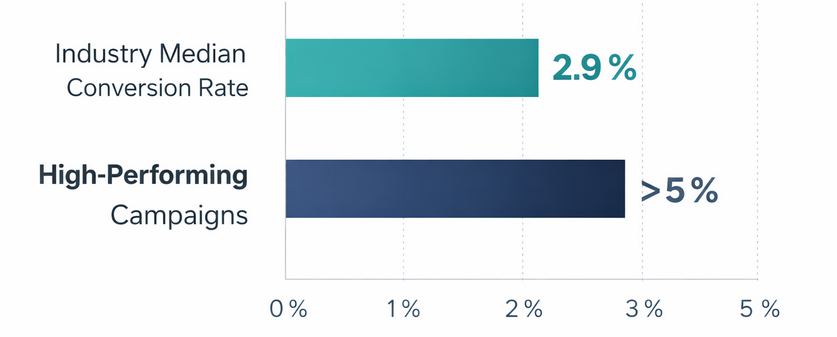
Industry benchmark for B2B lead conversion shows a median rate of 2.9%, with high-performing campaigns achieving above 5%
When campaigns are segmented by audience, performance variance decreases. Internal studies across B2B teams show that audience-specific campaigns can generate 40–60% higher conversion rates than generic, channel-based executions.
Build Modular Campaign Architecture
A scalable campaign structure is modular. Instead of reinventing each campaign from scratch, high-performing teams reuse proven components.
A modular campaign typically includes:
-
Core offer (what problem is being solved)
-
Primary message (why the solution matters now)
-
Supporting assets (emails, ads, landing pages, outreach scripts)
-
Measurement framework (KPIs, benchmarks, reporting cadence)
This approach reduces launch time and improves consistency. According to HubSpot data, teams using standardized campaign templates reduce time-to-launch by 33% while maintaining more stable performance metrics.
Control Variables to Improve Forecasting
Predictability comes from control. When too many variables change at once—new audience, new offer, new channel—it becomes impossible to identify what’s driving results.
To maintain control:
-
Change only one major variable per iteration
-
Keep budget, timing, and success criteria consistent
-
Document every adjustment and outcome
Marketing analytics reports indicate that campaigns with controlled testing frameworks deliver up to 25% more reliable forecasting accuracy over a quarter.
Align Messaging Across the Funnel
Inconsistent messaging between awareness, consideration, and conversion stages introduces friction that reduces predictability.
Campaigns should follow a clear narrative progression:
-
Problem recognition – Highlight the cost of inaction
-
Solution framing – Position the approach, not just the product
-
Proof and action – Reinforce trust and guide the next step
According to Demand Gen Report, 67% of B2B buyers disengage when messaging feels disconnected across touchpoints. Consistency directly impacts conversion stability.
Define Success Before Launch
Campaigns often fail to be predictable because “success” is defined after the fact. Predictable campaigns define thresholds in advance.
Before launch, determine:
-
Minimum acceptable performance (e.g., break-even CPL)
-
Optimization triggers (when to iterate or pause)
-
Scaling criteria (when to increase investment)
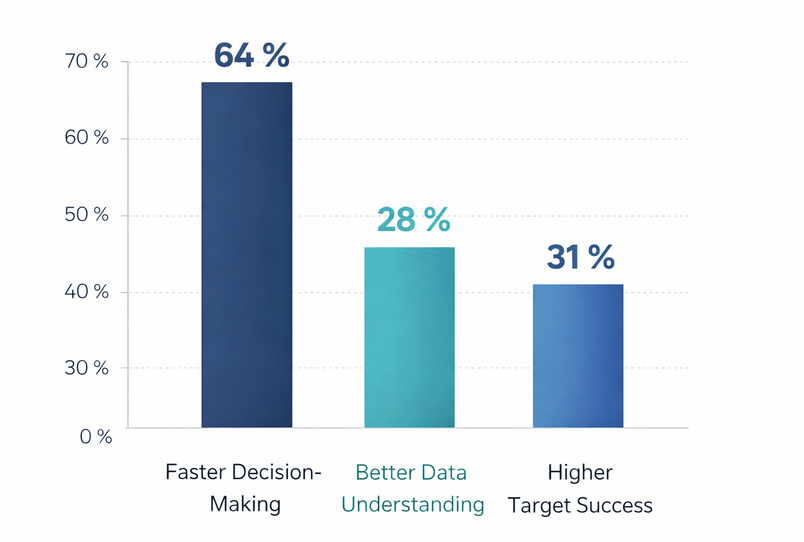
Impact of structured KPI dashboards on decision speed, data insight clarity, and performance targets
Teams that predefine success benchmarks are 28% more likely to optimize campaigns early, preventing budget waste and performance swings.
Establish a Feedback Loop
Predictability is not static—it’s maintained through feedback. Every campaign should feed insights into the next iteration.
An effective feedback loop includes:
-
Weekly performance reviews
-
Qualitative feedback from sales or revenue teams
-
Documentation of lessons learned
McKinsey research shows that organizations with closed-loop marketing feedback systems improve campaign ROI by 15–20% year over year.
Conclusion
Structuring campaigns for predictable results requires discipline, clarity, and repetition. By anchoring each campaign to a single objective, organizing around audiences, controlling variables, and standardizing execution, teams move from reactive marketing to reliable performance.
Predictability doesn’t limit creativity—it creates the foundation that allows experimentation without risking stability.