Resilient ad strategies are designed to withstand volatility. Algorithm updates, rising costs, tracking limitations, and creative fatigue are no longer exceptions — they are the norm. Brands that rely on a single audience, format, or signal often see sudden drops in performance, while those that diversify and systematize their approach continue to grow.
Resilience in advertising is not about reacting faster; it is about building systems that are less sensitive to disruption.
Why Ad Resilience Matters More Than Ever
According to industry benchmarks, over 60% of advertisers report performance instability after major ad platform updates, while acquisition costs have increased by more than 25% year over year across major social platforms. At the same time, audiences are exposed to thousands of ads per day, which accelerates creative fatigue and lowers engagement rates.
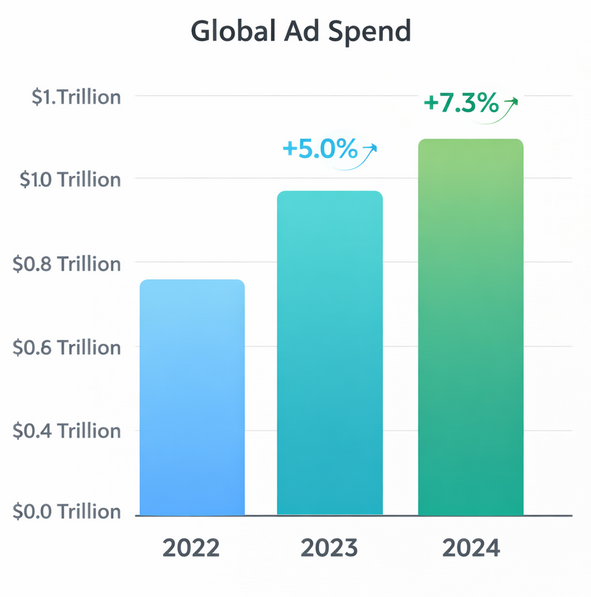
Global advertising spend has grown steadily year-over-year, with total spend reaching approximately $1.1 trillion in 2024
In this environment, resilient strategies focus on three priorities:
-
Reducing dependency on any single targeting method
-
Preserving performance when signals degrade
-
Maintaining consistent learning for ad algorithms
Diversify Audience Inputs
Relying on one audience type creates a single point of failure. When that audience shrinks, becomes restricted, or loses accuracy, performance drops immediately.
A resilient approach layers multiple audience sources:
-
Seed audiences built from high-intent user actions
-
Behavioral and engagement-based segments
-
Broader prospecting pools supported by smart exclusions
Advertisers who test and rotate multiple audience inputs typically see up to 30% more stable cost-per-acquisition over time compared to single-audience strategies.
Structure Campaigns for Stability
Campaign structure plays a major role in long-term resilience. Over-fragmented setups reset learning too often, while overly consolidated structures make it hard to isolate problems.
Best practices include:
-
Grouping similar audiences and objectives
-
Allowing sufficient budget per ad set to maintain learning
-
Avoiding frequent resets unless performance degradation is consistent

In 2025, cost-per-click rose in 86% of industries, underscoring increased competition and the need for diversified advertising strategies
Data shows that campaigns allowed to run through full learning phases convert up to 40% more efficiently than those frequently restarted.
Build Creative Systems, Not One-Off Ads
Creative fatigue is one of the fastest causes of performance decline. The solution is not endless experimentation, but a repeatable creative system.
Resilient creative frameworks include:
-
Multiple visual formats per message
-
Clear value propositions tested across angles
-
Ongoing rotation schedules rather than reactive changes
Advertisers using structured creative testing frameworks report engagement rates that are 20–35% higher over longer campaign lifecycles.
Use Data Signals That Scale
As third-party tracking becomes less reliable, strategies must rely on scalable and durable data signals. This includes prioritizing quality events, meaningful engagement actions, and first-party data sources that continue to feed algorithms even when external signals weaken.
Campaigns optimized for higher-quality conversion events often see 15–25% stronger performance consistency compared to those optimized for shallow metrics.
Monitor Trends, Not Daily Fluctuations
Resilient strategies are measured by trend stability, not daily volatility. Short-term swings are unavoidable; long-term direction is what matters.
Effective monitoring focuses on:
-
Rolling averages instead of daily results
-
Performance by audience group, not individual ads
-
Fatigue indicators rather than isolated dips
Brands that evaluate performance weekly instead of daily are significantly less likely to make changes that harm algorithm learning.
Prepare for Platform Changes in Advance
No platform remains static. Privacy updates, targeting restrictions, and auction dynamics will continue to evolve. Resilient advertisers plan for change by maintaining adaptable structures and diversified inputs rather than waiting for disruption.
A future-proof strategy is one that can absorb change without needing a full rebuild.
Related Articles
To deepen your understanding of sustainable advertising performance, explore these articles:
Conclusion
Resilient ad strategies are built on diversification, structure, and systems — not shortcuts. By focusing on stability instead of short-term wins, advertisers can protect performance, scale with confidence, and stay competitive in an increasingly unpredictable ad landscape.