For advertisers running Facebook and Instagram campaigns, performance issues often trace back to how campaigns are structured and managed — not just the platform itself.
Too many businesses blame the algorithm, creative fatigue, or “bad leads,” when the real issues lie in strategy execution. Whether you’re scaling a DTC brand or generating B2B leads, avoiding common management mistakes can unlock significantly better results.
In this article, we’ll walk through the most damaging Facebook Ads management mistakes — and how to fix them with precision, not guesswork.
Why Most Facebook Ad Campaigns Underperform
Facebook’s advertising system is powerful, but also complex. It’s driven by machine learning and dependent on clean signals, smart targeting, and strategic alignment across campaign elements.
Performance usually drops when advertisers lose visibility into why results change. Many teams focus on surface-level metrics instead of diagnosing deeper funnel issues. If your numbers look acceptable but revenue doesn’t follow, it’s often because key signals are being misread.
This is where a deeper approach to measurement matters, as outlined in how to analyze Facebook ad performance beyond CTR and CPC.
Let’s break down the most critical Facebook Ads management mistakes — and how to resolve them with expert-level thinking.
1. Using the Wrong Objective for the Funnel Stage
Every Facebook campaign must be built around a specific business goal. But using the wrong campaign objective — like optimizing for purchases when the audience has never heard of you — creates friction between what Facebook optimizes for and what users are ready to do.
This mistake often leads to stalled learning phases and inconsistent delivery. Facebook struggles when conversion signals are weak or premature, especially with cold traffic. This directly impacts lead quality and downstream performance, a problem explored in how Facebook ad objectives impact lead quality.
A better approach is to map objectives to funnel stages:
-
Top-of-funnel (cold audiences): Video views, engagement, or traffic to build awareness and retargeting pools.
-
Mid-funnel (warm audiences): Lead or landing page view objectives for users who already interacted.
-
Bottom-of-funnel (hot leads): Conversion or catalog sales objectives for users showing intent.
When objectives align with user intent, Facebook’s algorithm can optimize efficiently instead of guessing.
2. Mismanaging Account Structure and Audience Overlap
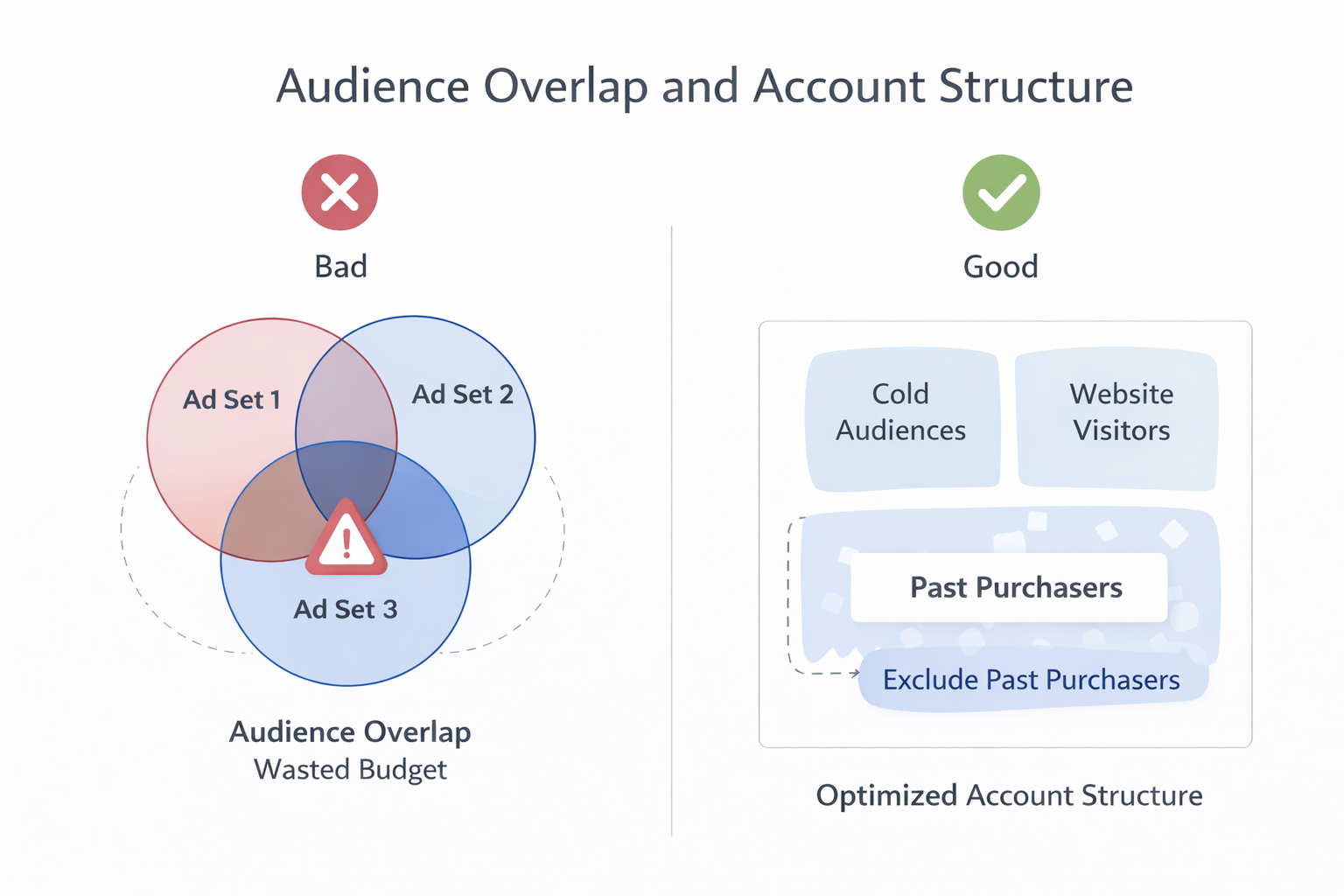
As accounts grow, complexity becomes the enemy of performance. Poorly structured ad accounts — with overlapping audiences and mixed objectives — often cause ads to compete against each other in the auction.
This internal competition quietly drives up CPMs and suppresses delivery. Many advertisers never realize this is happening until costs rise without explanation. If performance drops despite stable creatives and offers, audience overlap is often the hidden issue.
This is explained in detail in why audience overlap is killing Facebook ad performance.
To prevent this problem:
-
Separate campaigns by funnel stage.
-
Use exclusions consistently (for example, excluding purchasers from prospecting).
-
Avoid duplicating similar audiences across active campaigns.
Clean structure improves data clarity and gives Facebook stronger optimization signals.
3. Letting Creatives Burn Out Without Rotation
Facebook prioritizes engagement signals. When the same creative runs too long, users stop responding, even if targeting remains unchanged. This leads to ad fatigue — higher costs, lower CTR, and declining conversion rates.
Many advertisers misinterpret this as a targeting or budget issue and rebuild campaigns unnecessarily. In reality, the creative has simply lost effectiveness. Knowing when and how to refresh ads is critical, which is covered in how to avoid ad fatigue and keep optimal ads costs.
Early warning signs include:
-
CTR dropping more than 25% from baseline.
-
Frequency rising above 3.0 on cold audiences.
-
Increased ad hides or negative feedback.
Creative rotation should focus on new angles and messaging, not just visual changes.
4. Using Broad Targeting Without Data Signals
Broad targeting can work — but only when supported by strong creative and reliable conversion data. Without those signals, Facebook spreads spend too thin and struggles to learn.
This mistake is common with newer brands or accounts rebuilding after performance drops. Broad targeting often produces clicks without conversions, leading advertisers to blame traffic quality. In reality, intent alignment is missing. This scenario is described clearly in why ads get clicks but no sales and how to fix audience misalignment.
A more effective approach includes:
-
Starting with warm audiences and lookalikes based on buyers.
-
Layering interests with exclusions to control intent.
-
Testing broad targeting only after validating creative and offer fit.
Broad targeting is a scaling lever — not a shortcut to results.
5. Mismatched Offers and Disconnected Messaging
Even strong targeting can’t save a weak or confusing offer. Many Facebook Ads fail because the promise made in the ad doesn’t match the landing page experience.
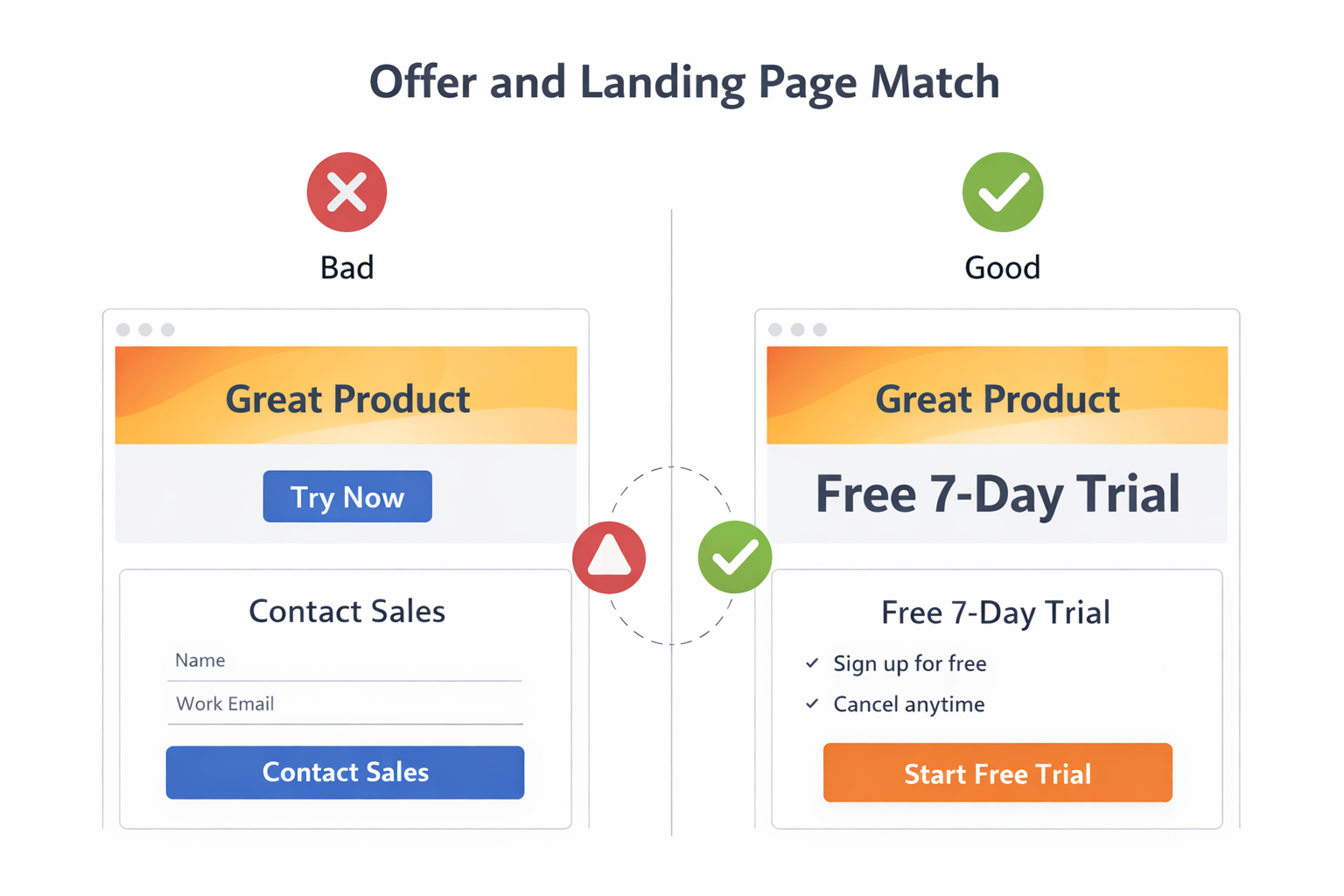
When users click expecting one outcome and see another, trust breaks immediately. This often results in high CTR but poor conversion rates. If leads look cheap but never turn into customers, messaging is usually the problem. This is closely tied to
why ad copy hurts lead quality and how to fix it.
To improve alignment:
-
Match ad headlines and CTAs to the landing page exactly.
-
Make the value proposition clear above the fold.
-
Use urgency only when it’s real and supported by the offer.
Ads sell the click. Pages close the conversion. Both must feel like one conversation.
6. Ignoring Facebook’s Native Optimization Tools
Facebook Ads Manager includes powerful tools that many advertisers underuse. Without structured testing and deeper reporting, optimization becomes reactive instead of systematic.
One of the most valuable tools is the Experiments section, which allows clean A/B testing without audience overlap. Advertisers who rely on guesses instead of controlled tests scale slower and waste budget.
A practical walkthrough is available in how to test ads with Facebook’s Experiments section.
Key tools to use regularly include Experiments, breakdown reports, and ad relevance diagnostics.
7. Budget Mismanagement and Scaling Errors
Budget problems rarely come from spending too little. They usually come from scaling at the wrong time or spreading spend too thin.
Scaling during the learning phase resets optimization and destabilizes delivery. At the same time, running many low-budget ad sets prevents Facebook from gathering enough data. If campaigns plateau or fluctuate, scaling strategy is often the issue. This is addressed in why Facebook ads stop scaling and how to fix it.
Budget decisions should be gradual, structured, and tied to performance stability.
8. Tracking Vanity Metrics Instead of True KPIs
Clicks, impressions, and even CPL can be misleading when viewed in isolation. Many advertisers judge performance too early using metrics that don’t reflect revenue impact.
A campaign might generate low-cost leads that never convert, or high CTR ads that produce no sales. The solution is aligning KPIs with funnel stage and business outcomes.
Marketing metrics should reflect sales reality — not numbers that look good in reports.
Final Takeaway: Better Management Drives Better Results
Facebook and Instagram ads still offer exceptional potential — but only when campaigns are managed with strategic discipline. Most performance issues stem from misalignment, not platform limitations.
Fixing even one of these mistakes can significantly improve efficiency, scalability, and profitability.