
On platforms like Facebook and Instagram, users scroll quickly and judge even faster.
If your ad doesn’t deliver a clear benefit in the first few seconds, it will likely be ignored.
Communicating value means more than just offering a promotion or listing features.
It’s about showing your audience exactly how your product or service improves their life, job, or results.
When value is clear, engagement rises. Clicks become more qualified. Conversions become more consistent.
And your campaigns begin to scale with far greater efficiency.
Learn how ad structure supports performance in Facebook Ads Funnel Strategy: From Audience Identification to Conversion.
What “Communicating Value” Actually Involves
In performance marketing, value refers to the real-world impact your offer creates for the user.
It answers the unspoken question in every viewer’s mind: “What’s in it for me?”
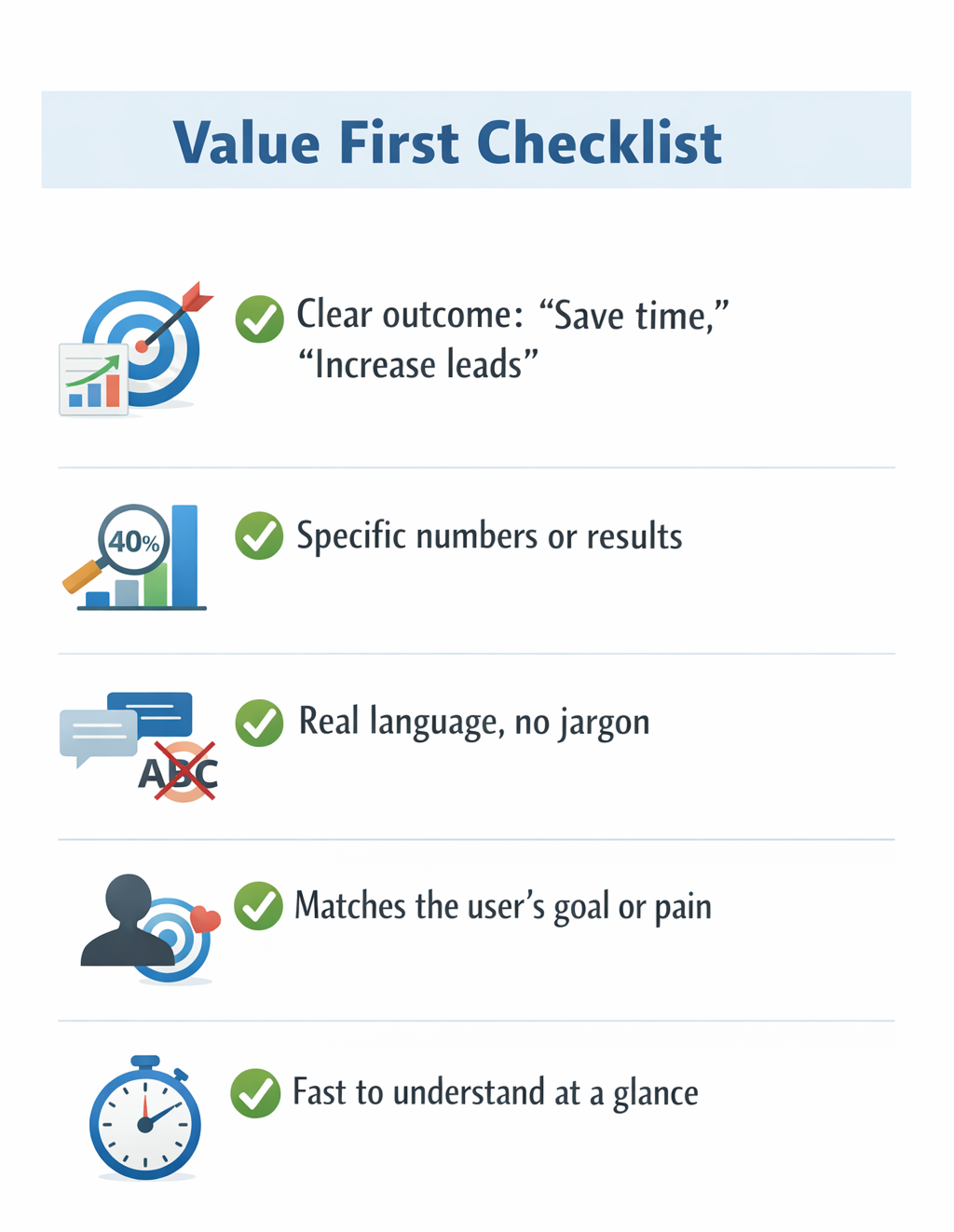
Importantly, this value must be perceived quickly, emotionally, and logically.
There are several forms it can take:
-
Time saved: Appeal to professionals looking for speed. Example: “Automate your daily reporting in under 10 minutes.”
-
Cost reduced: Ideal for budget-conscious buyers. Example: “Lower your customer acquisition cost by up to 40%.”
-
Outcome gained: Speak to results the user cares about. Example: “Double your qualified leads with smarter retargeting.”
True value is not just about being cheaper or faster — it’s about helping the user succeed in their specific context.
For targeting ideas that align with these outcomes, explore Behavior-Based Facebook Targeting: The Secret Weapon of Top E-commerce Brands.
Core Principles for Communicating Value in Digital Ads
1. Lead With Outcomes, Not Product Features
Features explain what a product does. Outcomes show why it matters.
Most ad creatives still lead with technical attributes. That’s a missed opportunity.
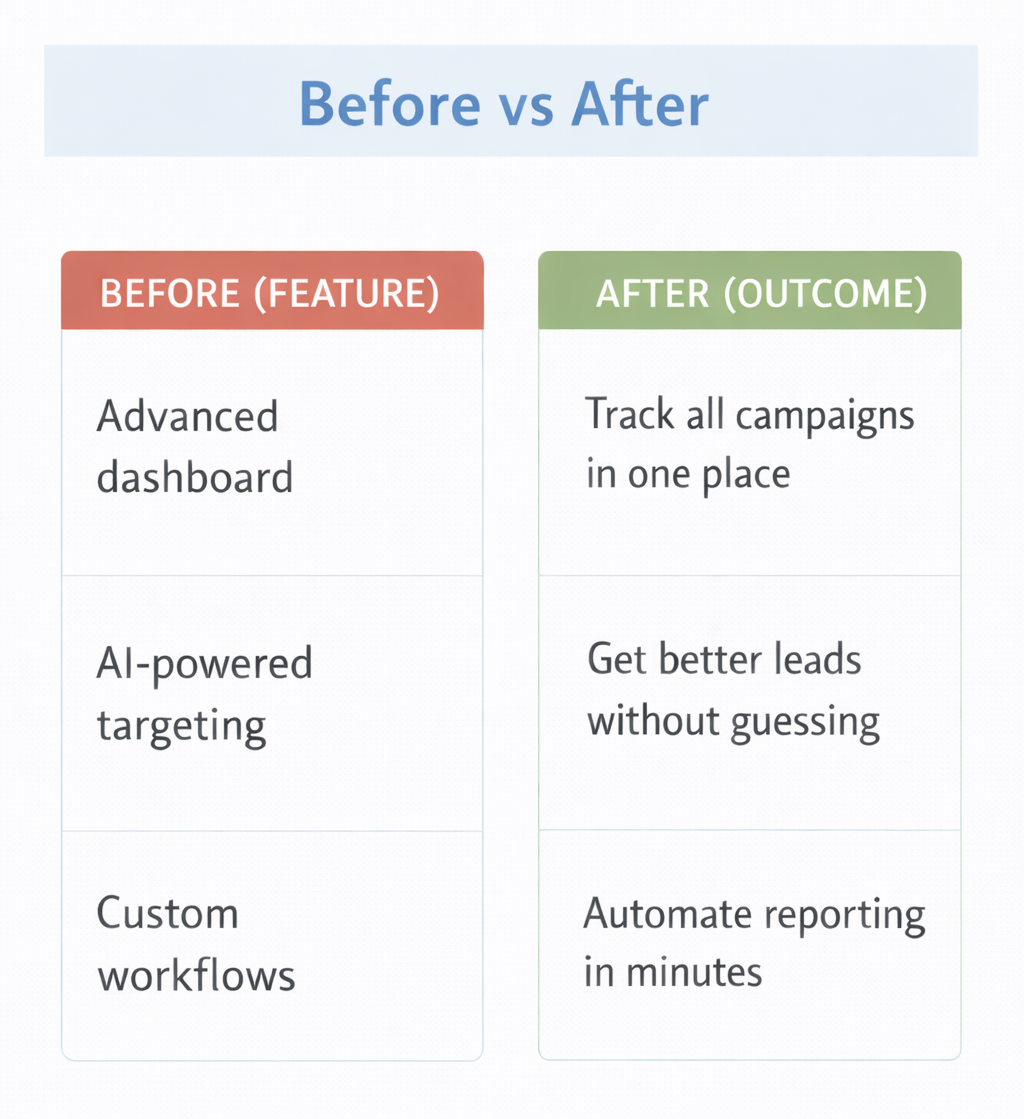
- Example of a feature-led message: “Customizable reporting dashboards for eCommerce.”
- Example of an outcome-led message: “Track all your Shopify ad results in one place, without switching tabs.”
When you lead with a real-world result, you create instant relevance and urgency.
2. Be Specific and Concrete
Vague or inflated claims trigger skepticism. Specific language increases clarity and credibility.
Rather than saying your solution is “advanced” or “industry-leading,” consider how you can prove the claim:
-
“Used by 1,200+ ad managers in 28 countries.”
-
“Connects Meta Ads, Google Sheets, and GA4 in under five minutes.”
-
“Improves ROAS by an average of 23% in the first month.”
Specifics imply confidence, experience, and transparency — all key to building trust.
3. Match Your Message to the Funnel Stage
Audiences at different stages of awareness respond to different types of value. If your message doesn’t align, even strong creative may fail to convert.
Understand why mid-funnel messaging matters in Why Your Facebook Campaign Needs a ‘Middle of Funnel’ Strategy.
Where to Communicate Value Within the Ad Itself
Headline and Primary Text
This is where value must be communicated first. Users often read only the headline before making a decision.
Write as if it’s your only chance to connect.
Strong examples:
-
“Why your ROAS keeps dropping — and how to fix it.”
-
“Marketers are saving 8 hours a week with this reporting shortcut.”
Keep your headline focused, benefit-driven, and relevant to a pain point or goal.
See more copywriting techniques in 5 Ways to Make People Click Your Ad Thanks to the Ad Copy.
Creative Visuals
Your image or video shouldn’t just decorate the message. It should reinforce or clarify it.
Smart visual tactics include:
-
A simple “before vs. after” result (e.g., messy dashboard vs. clean view).
-
Real product interface in use (especially for tools or platforms).
-
A chart or stat that supports the claim (“+72% CTR after testing new creatives”).
Visuals help the user feel the benefit.
Call-to-Action (CTA)
Your CTA should build on the value you promised, not contradict or dilute it.
Avoid generic CTAs unless absolutely necessary. Instead, choose wording that suggests what happens next and why it’s worth clicking.
Examples:
-
“See it in action.”
-
“Get campaign insights instantly.”
-
“Try the playbook — free.”
For CTA best practices and related funnel tips, refer to How to Create a Facebook Lead Magnet That Converts Visitors Into Leads.
Mistakes That Undermine Perceived Value
Even strong offers can appear weak when presentation fails. Watch for these common pitfalls in your messaging:
-
Overuse of buzzwords without backing claims.
-
Excessive focus on internal product features instead of user transformation.
-
Lack of data, proof, or testimonials.
-
Broad targeting that makes the message feel irrelevant.
Solving these requires tight alignment between creative, targeting, and customer insight.
Final Thought: Make Value the Centerpiece of Every Ad
High-performing ads don’t just look good. They make it instantly clear what’s in it for the user — and what happens next.
To recap, make sure your ads:
-
Focus on the outcome;
-
Use concrete, specific language;
-
Match the user’s funnel stage;
-
Reinforce value across headline, visual, and CTA.
Want to dive deeper? Explore Why Your Facebook Ads Look Great But Still Don’t Sell to learn what may still be missing.
When value is obvious and relevant, you move beyond just impressions. You create momentum, action, and long-term brand growth.