Testing is how accounts improve—but unmanaged testing is how spend leaks. Most teams don’t lose money because ideas are bad; they lose money because they test too many variables at once, change settings mid-flight, or keep “maybe” campaigns running long after the data stopped improving.
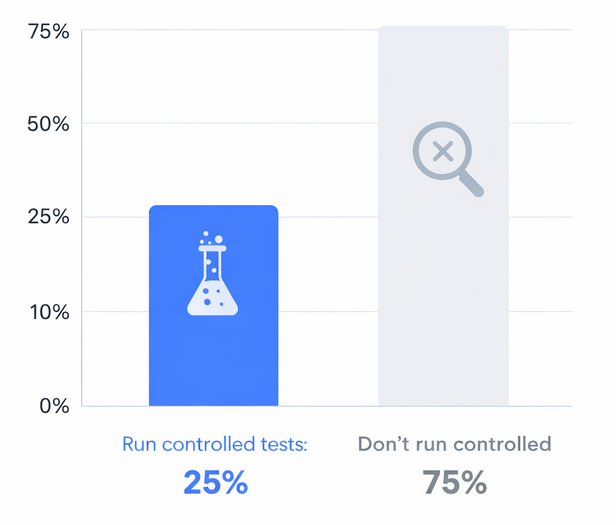
Less than a quarter of advertisers regularly run controlled tests, highlighting common hesitation despite testing’s value.
A good testing system does two things at the same time:
-
Protects downside with clear guardrails.
-
Creates repeatable learning you can use in the next campaign.
Below is a spend-control framework you can apply to creative tests, audience tests, offer tests, landing page tests, or funnel-stage tests.
1) Start with a hypothesis and a single success metric
Every test should fit in one sentence:
“If we change X, we expect Y to improve because Z.”
Then pick one primary metric (the “decision metric”). Examples:
-
Lead campaigns: Cost per lead (CPL)
-
Purchase campaigns: Cost per purchase (CPA) or ROAS
-
Top-of-funnel: Cost per landing page view (or cost per 1,000 impressions if awareness)
Add two guardrails so you don’t optimize yourself into a corner:
-
Quality guardrail: lead-to-sale rate, conversion rate, average order value
-
Delivery guardrail: frequency, CPM, or click-through rate
When the decision metric improves but a guardrail breaks, you don’t scale—you investigate.
2) Build a “test box” that prevents runaway spend
Spend control starts before launch. Define these four numbers for every test:
-
Daily cap (how much you’re willing to burn in 24 hours)
-
Timebox (how many days you’ll run before deciding)
-
Minimum signal (the smallest amount of data you need before judging)
-
Stop-loss (the point where you shut it down early)
A simple budget formula
Use a target number of results to decide the test budget.
-
If your target CPA is €25 and you want 20 results before deciding, your test budget is roughly:
€25 × 20 = €500
Split that across your timebox to get your daily cap:
-
€500 over 5 days ≈ €100/day
This prevents the common mistake of launching a test with an arbitrary daily budget and hoping it “figures itself out.”
3) Don’t starve the algorithm (or you’ll pay for noise)
Many tests fail not because the idea is wrong, but because the campaign never exits the unstable learning stage.
A common benchmark is aiming for about 50 optimization events per week after a significant edit; falling short can keep performance volatile and harder to evaluate. (leadenforce.com)
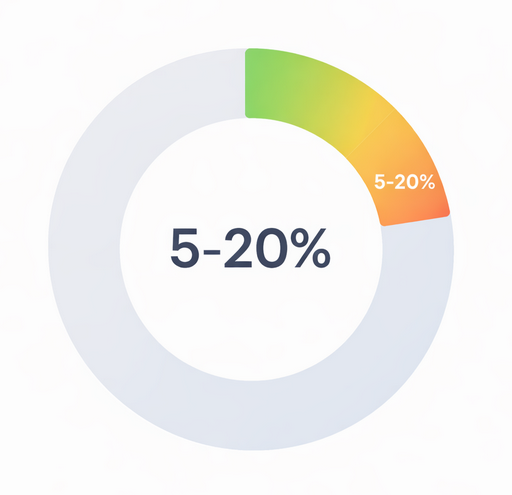
Recommended experiment budget as a share of total marketing spend — most professionals advise allocating between 5% and 20% to testing
If you’re testing a conversion event (leads/purchases) and you’re nowhere near that volume, you have three options:
-
Test higher up the funnel (e.g., landing page views) until you have enough volume.
-
Consolidate (fewer ad sets, fewer audiences) so signals accumulate faster.
-
Increase budget briefly inside a strict timebox to collect enough data, then decide.
4) Prefer fewer, cleaner tests over many messy ones
When you test too many things at once, you don’t learn—you only shuffle spend.
Use this hierarchy:
-
Creative first (usually the biggest swing)
-
Then offer/angle
-
Then audience
-
Then landing page
If you change creative and audience and optimization event in the same week, any “winner” is unreliable.
5) Choose the right budget structure for testing
You’re choosing between two goals:
-
Control (each variant gets spend)
-
Efficiency (the platform shifts spend to what it thinks is working)
For early tests, prioritize control:
-
Use separate ad sets or a structured split so each variant gets a fair shot.
-
Keep budgets steady during the timebox.
Once you have a clear winner, you can move to a more efficient structure for scaling (and increase spend gradually, not suddenly). A common approach is increasing budgets 20–30% every few days on proven winners. (leadenforce.com)
6) Set stop-loss rules you will actually follow
A stop-loss rule is a pre-commitment. It prevents the “maybe it turns around tomorrow” trap.
Pick rules that match your funnel:
Lead-gen example
Stop the test if any of the following happens:
-
CPL is 50% above target after the minimum signal is reached
-
CTR is falling while frequency rises (creative fatigue)
-
Lead quality guardrail drops (e.g., booked-call rate)
Purchase example
Stop the test if:
-
CPA is 40% above target after the minimum signal
-
Add-to-cart rate collapses (offer mismatch)
-
ROAS stays below your break-even point for the full timebox
If you need inspiration for time-based guardrails: a practical rule of thumb is to give new ads 3–5 days to gather stable directional data before making big decisions. (leadenforce.com)
7) Watch frequency early—fatigue can masquerade as “bad testing”
When audiences are too tight, spend control becomes impossible: delivery saturates, frequency climbs, and performance drops.
As a practical signal, CTR often declines once frequency pushes beyond roughly 3–4 exposures, especially early in a run. (leadenforce.com)
If frequency is rising fast in the first 48–72 hours, it’s usually a structure problem (audience too small, too many ad sets competing, or creative not rotating), not an idea problem.
8) Use a decision log so you compound learning
The fastest way to control spend long-term is to avoid paying for the same lesson twice.
Create a simple log with:
-
Hypothesis
-
Variant details (creative, audience, offer, landing page)
-
Budget box (daily cap, timebox, stop-loss)
-
Primary metric + guardrails
-
Decision (kill / iterate / scale) and why
Even a basic spreadsheet turns “testing” into an asset.
A spend-control checklist you can copy
Before launch:
-
One hypothesis, one primary metric, two guardrails
-
Test budget set from target CPA × required results
-
Daily cap + timebox written down
-
Stop-loss rules decided in advance
-
Structure chosen to ensure fair delivery
During the test:
-
Avoid significant edits that restart learning
-
Monitor frequency and delivery volatility
-
Make decisions only after minimum signal (unless stop-loss triggers)
After the test:
-
Document what happened and what you’ll test next
-
Scale winners gradually; don’t “double overnight” unless you can tolerate instability