Ad fatigue is often blamed for declining results, but in reality, creatives are rarely the first bottleneck. According to Meta benchmarks, targeting and audience quality account for a significant share of performance variance in conversion campaigns. When the same ads are shown to the wrong people—or to the same people too often—results decline regardless of how strong the visuals or copy are.
Industry data shows:
-
Advertisers who refresh targeting while keeping creatives unchanged see 15–30% lower cost per acquisition (CPA) on average.
-
Poor audience overlap can increase CPA by up to 40% due to internal competition.
-
Retargeting audiences typically convert 2–3× higher than cold traffic, even with identical creatives.
Before investing time and budget into new designs, it’s worth fixing the foundations.
1. Improve Audience Quality, Not Quantity
One of the fastest ways to improve performance is narrowing and refining who sees your ads.
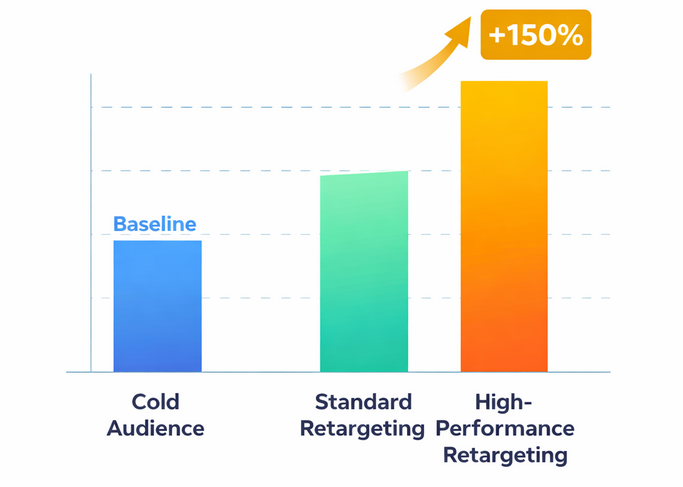
Retargeting campaigns often deliver significantly higher conversion rates vs. cold targeting, boosting conversions by up to 150%
Large audiences often look attractive, but smaller, higher-intent audiences usually outperform them. Internal platform studies consistently show that:
-
1% lookalike audiences convert up to 70% better than broader 5–10% lookalikes.
-
Highly relevant custom audiences produce 20–35% lower CPA compared to interest-based targeting.
Action steps:
-
Break large audiences into smaller segments based on intent or source.
-
Prioritize first-party data (website visitors, engaged users, high-quality leads).
-
Exclude low-intent or already converted users to avoid wasted impressions.
This alone can unlock significant gains without touching creatives.
2. Eliminate Audience Overlap
Overlapping audiences cause your ad sets to compete against each other in the auction. This often results in higher costs and unstable delivery.
Studies of account-level optimization show that removing major overlaps can:
-
Reduce CPMs by 10–25%
-
Improve delivery stability
-
Increase conversion volume without budget increases
Action steps:
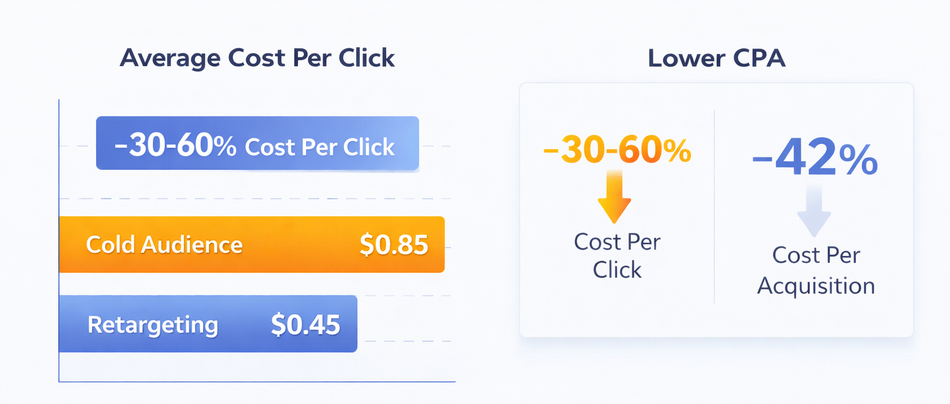
Retargeting campaigns can cost substantially less per click and lower overall acquisition costs compared to cold audience ads
-
Audit overlap between custom, lookalike, and retargeting audiences.
-
Separate prospecting and retargeting clearly.
-
Use exclusions aggressively to ensure each ad set serves a unique group.
Even strong creatives underperform when multiple ad sets fight for the same users.
3. Let the Algorithm Learn (Stop Resetting It)
Frequent edits reset the learning phase. While creative changes are a common trigger, structural changes can be just as disruptive.
Platform performance data shows:
-
Ad sets exiting the learning phase deliver up to 20% more stable CPA.
-
Frequent resets can delay optimization by 5–7 days each time.
Action steps:
-
Avoid unnecessary edits once an ad set is performing.
-
Scale budgets gradually (no more than 15–20% per day).
-
Focus on improving input quality (audiences, conversion events) rather than constant tweaks.
Better inputs allow the algorithm to do its job—even with the same creatives.
4. Optimize Conversion Signals
If your conversion events are noisy or low-quality, performance will suffer regardless of creatives.
Accounts using optimized conversion signals report:
-
25–40% higher conversion rates
-
Faster exit from the learning phase
Action steps:
-
Optimize for events with sufficient volume and strong intent.
-
Consolidate fragmented events when possible.
-
Ensure conversion tracking is accurate and consistent across campaigns.
Strong signals help platforms deliver ads to users most likely to convert—without changing visuals or copy.
5. Scale What Already Works
Instead of replacing creatives, scale proven combinations.
Data from high-performing accounts shows that scaling existing winners can outperform creative refreshes by:
-
18–28% lower CPA
-
Higher return on ad spend due to reduced testing risk
Action steps:
-
Duplicate winning ad sets into new, non-overlapping audiences.
-
Expand reach using similar high-quality data sources.
-
Increase budget only after stable performance is confirmed.
Scaling structure beats restarting creative tests in most cases.
Related Articles You May Find Useful
Final Thoughts
New creatives are not a shortcut to better performance. In many cases, the biggest gains come from improving targeting logic, cleaning up audience structure, and feeding better data into the algorithm.
Before launching another design sprint, optimize what’s already running. You may find that performance improves without changing a single ad.