Poor-performing Instagram ads usually get worse after aggressive optimization.
An advertiser sees rising CPA, lower CTR, or weaker conversion volume and immediately starts rebuilding the campaign. The creative changes, the copy changes, the audience changes, and the landing page changes within the same week.
The account keeps spending money, but nobody can clearly explain what actually improved performance.
Small creative tests solve this problem because they reduce uncertainty.
Why large creative changes often make Instagram ads less stable
Instagram’s delivery system depends on historical engagement patterns.
Once an ad starts collecting clicks, watch time, saves, profile visits, and conversions, Meta begins identifying which users respond to that specific creative structure.
Large edits interrupt those signals.
A campaign that previously delivered stable conversion costs suddenly behaves like a brand-new ad entering the auction again. CPM often rises while Meta searches for new engagement behavior.
This becomes especially noticeable in smaller accounts where conversion volume is already limited.
A B2B lead generation campaign generating consistent $32 CPLs may suddenly jump above $50 after replacing multiple creatives simultaneously. Advertisers often blame audience quality first, but the real issue is usually disrupted optimization continuity.
This is why experienced media buyers rely on frameworks like this creative testing matrix instead of rebuilding campaigns impulsively.
The real problem behind poor-performing Instagram ads
Weak Instagram ads rarely fail because everything is broken.
Usually one specific element damages performance: the opening hook, the visual hierarchy, the CTA placement, the first sentence, or the offer framing. Large redesigns hide which element actually caused the problem.
For example, an ecommerce advertiser may redesign the product image, the discount language, and the headline simultaneously.
ROAS improves slightly, but CPC also increases. Now the advertiser cannot identify whether the image improved attention, the offer improved buyer intent, or the new headline simply attracted more curiosity clicks.
The campaign generated movement, not clarity.
That confusion slows future optimization because every scaling decision becomes guesswork.
How small creative tests make weak ads easier to fix
Small tests isolate one meaningful variable at a time. Instead of rebuilding the campaign, advertisers test one focused adjustment while keeping the rest of the system stable.
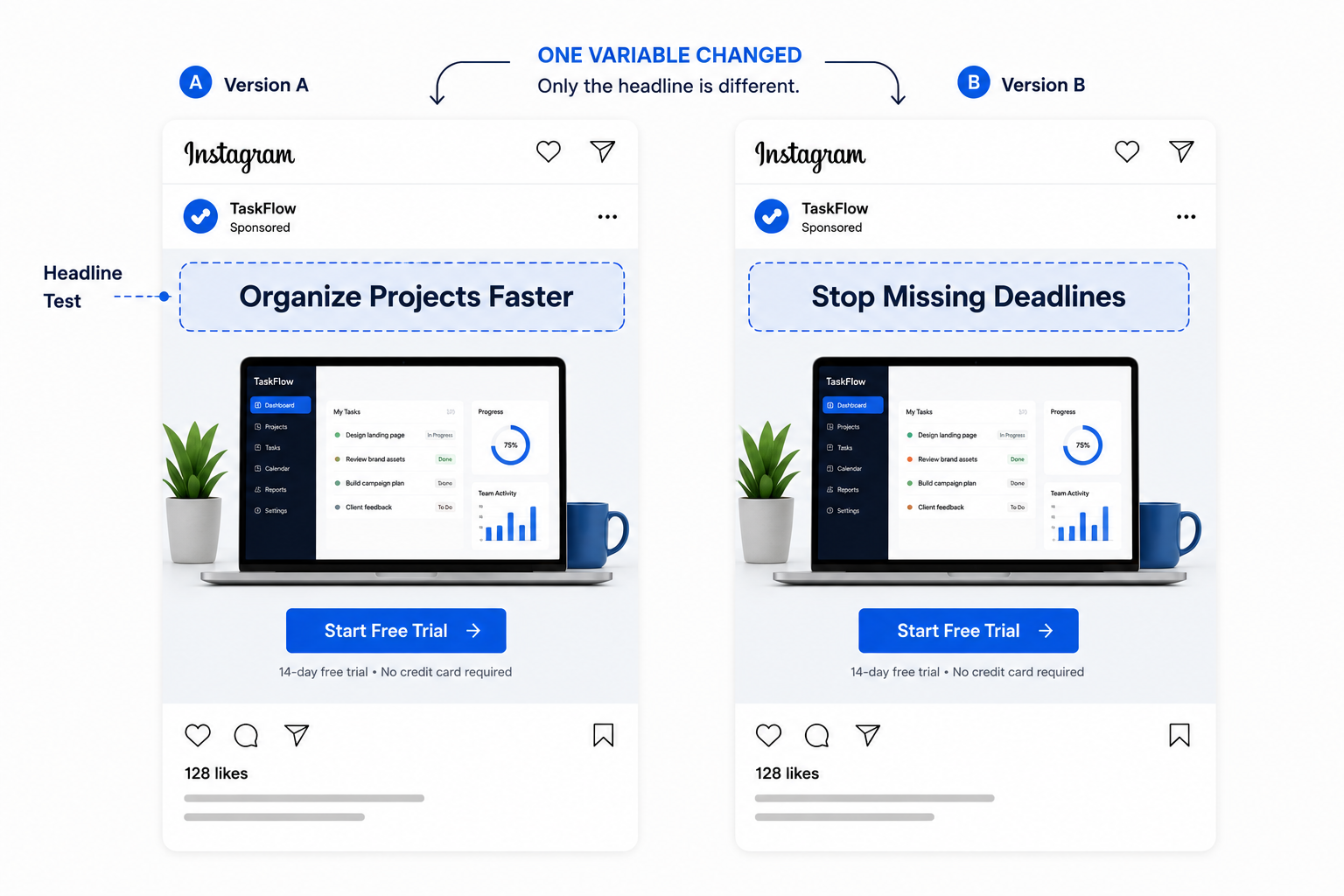
Examples include:
- Testing a different first-frame image while keeping copy identical.
This reveals whether scroll-stop weakness is hurting CTR. - Rewriting only the headline.
If conversion rate improves while CTR remains stable, the issue was message clarity after the click. - Simplifying the visual layout.
Too many focal points often reduce comprehension speed during feed scrolling. - Moving the CTA closer to the product image.
Disconnected CTAs regularly reduce action rates because users process the design out of sequence.
These are relatively small changes, but they often create measurable improvements in CPC, CTR, CPA, and lead quality.
This becomes much easier when advertisers structure creative tests properly instead of launching dozens of simultaneous variations.
Why controlled testing lowers wasted ad spend
Instagram campaigns become expensive when advertisers optimize without clean comparisons. Mixed changes create mixed signals.
A campaign may improve CTR while lowering purchase intent. Another may reduce CPM while increasing low-quality traffic. Without isolated tests, advertisers cannot confidently identify what improved results.
That uncertainty wastes budget because scaling decisions become unreliable. This is one reason many advertisers eventually discover why most ad tests fail only after spending weeks inside noisy experiments with no useful conclusions.
Small creative tests produce cleaner cause-and-effect relationships.
That helps advertisers scale winners faster, kill weak creatives earlier, and protect stable campaigns from unnecessary disruption.
Final takeaway
Poor-performing Instagram ads do not always need a full rebuild.
Most of the time, the better move is to protect the campaign structure and test one creative variable at a time. Small tests make performance changes easier to explain, reduce wasted spend, and help advertisers identify what actually moves CPC, CPA, CTR, and conversion rate.
The fastest path to better Instagram ad performance is not more random optimization. It is cleaner testing.