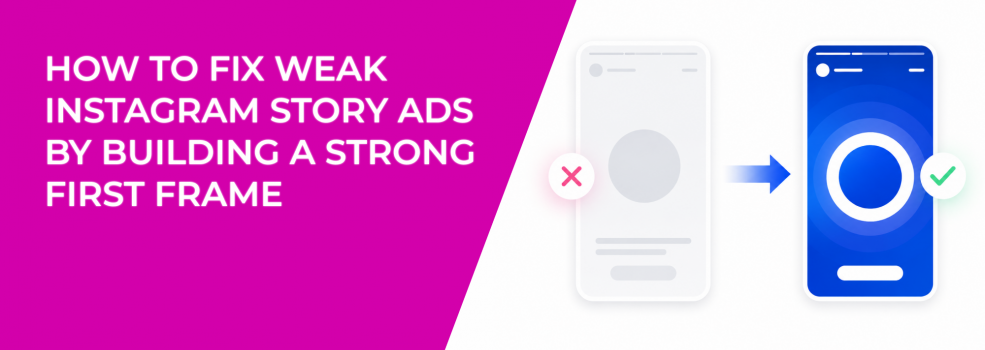
A weak Instagram Story ad usually fails before the viewer understands what is being sold. The first frame appears, the user sees no clear reason to care, and the next tap happens almost automatically.
This is not only a creative problem. It becomes a delivery and cost problem because Meta keeps buying impressions, but the ad fails to create enough early attention to support clicks, form starts, purchases, or qualified visits. If the first frame cannot hold attention, later scenes rarely get a fair chance.
Weak Story ads lose the auction after they lose the viewer
Instagram Stories are built for fast movement. Users tap through friend updates, creator content, brand posts, and ads in the same vertical flow. A Story ad that opens slowly feels like friction in that flow.
The first frame has to work before the user decides whether the ad is worth another second. If the opening frame shows a logo animation, a vague lifestyle shot, or a product with no context, the viewer has to do too much interpretation. Most users will not wait for the offer to become clear.
That early drop-off can quietly affect campaign efficiency. Lower retention often means fewer engaged users moving toward clicks or conversions. As a result, CPC can rise, CPA can drift upward, and ROAS can weaken even when the ad itself looks polished in a creative review.
This is why advertisers need to think about how little time advertisers have to earn attention. The first frame is not decoration. It is the first filter between paid reach and useful attention.
A strong first frame creates immediate context
The strongest first frames answer one question quickly: “Why am I seeing this?” The answer does not need to be long, but it needs to be visible.
A SaaS lead generation ad might open with a dashboard showing missed leads by source. A local service ad might show the exact problem the customer wants fixed. An e-commerce ad might open with the product solving a specific use case instead of sitting in a clean but empty composition.
The viewer should understand the category, the problem, and the implied benefit without waiting for the second scene. That does not mean stuffing the frame with text. It means removing anything that delays comprehension.
A first frame usually becomes stronger when it includes:
- A clear subject. The product, problem, or outcome should be the dominant visual element, not a small detail buried in the layout.
- A fast relevance cue. The viewer should recognize who the ad is for through the situation, pain point, or use case.
- A visible directional signal. Motion, framing, or visual hierarchy should guide the eye toward the main idea.
- A reason to keep watching. The opening should create enough curiosity or value to make the next frame feel useful.
These elements matter because Story ads have little room for slow explanation. A viewer who cannot classify the ad quickly will treat it as noise.
The first frame should qualify attention, not just grab it
A bright color, sudden movement, or dramatic visual can stop a viewer for a moment. That does not mean it attracts the right person.
Performance marketers need first frames that qualify attention. The frame should repel users who are unlikely to convert and pull in users who recognize the problem. This is especially important for B2B, high-ticket, and lead generation campaigns where cheap clicks can create expensive sales waste.
For example, a B2B ad that opens with “Still tracking leads in spreadsheets?” qualifies the viewer better than an abstract animation of a laptop. It speaks to a workflow problem. It also gives Meta a better engagement pattern because the people who continue watching are more likely to share the same operational pain.
This is where targeting and creative reinforce each other. LeadEnforce can help advertisers build higher-intent audiences from Facebook groups, Instagram followers, engagers, and public social profile data. But even a strong audience can underperform if the first frame does not match the reason that audience was selected.
A good first frame makes the targeting logic visible.
Weak first frames show up in campaign data
The easiest mistake is judging the full ad when the opening is the real problem. If the offer is good but the first frame is weak, the campaign can look like it has an audience or funnel issue.
In Ads Manager, weak openings often show up as low click-through rate, poor thumb-stop behavior, weak video hold, or high spend with little qualified action. If the ad gets impressions but few meaningful clicks, the first frame should be audited before rebuilding the whole campaign.
Look for patterns such as:
- High impressions with low CTR. The ad is entering auctions, but the creative is not creating enough action.
- Clicks from broad curiosity but weak conversion quality. The opening may attract attention without framing the real offer.
- Strong later scenes but poor early retention. The useful message appears too late in the Story sequence.
- Better performance in Feed than Stories. The concept may work, but the Story opening may be too slow for swipe behavior.
These checks help prevent overcorrection. You may not need a new offer, campaign structure, or audience. You may need a first frame that communicates faster.
Build first frames around the user’s problem
A strong first frame usually starts with the user’s situation, not the brand’s identity. Brand cues still matter, but they should support recognition after the viewer understands relevance.
For a startup offering scheduling software, the opening should not start with a logo reveal. It should show a messy calendar, double booking, or missed meeting request. For an agency selling lead generation, the opening could show “400 clicks, 9 weak leads” next to a form submission screen. For an online store, the frame should show the product in the moment of use, not floating without context.
The goal is not to make the ad busier. It is to make the first signal sharper.
Advertisers can build trust in the first ad impression by using specific situations, credible visuals, and clear value cues. Trust starts when the viewer feels the advertiser understands the actual problem.
Test the first frame before replacing the full ad
Many advertisers rebuild the whole Story ad when performance drops. That can waste production time and muddy the test.
Start by isolating the first frame. Keep the offer, destination, audience, and CTA stable. Then test different openings that change only the first visual signal or first line of copy.
For example, test these variations:
- Problem-first opening. Show the pain point immediately, such as a messy inbox or missed lead report.
- Outcome-first opening. Show the desired result, such as booked calls, cleaner reporting, or faster checkout.
- Audience-first opening. Name or imply the viewer type, such as “For local HVAC teams” or “For SaaS founders.”
- Contrast opening. Show the difference between the current problem and the improved state.
This kind of test gives cleaner evidence than changing five creative elements at once. It also helps you test hooks without wasting budget, especially when daily spend is limited.
Final takeaway
Weak Instagram Story ads often fail because the first frame asks the viewer to wait. A strong first frame does the opposite. It explains relevance, creates context, and gives the viewer a reason to keep watching before the swipe happens.
For performance marketers, that first second can affect more than watch time. It can influence CPC, CPA, lead quality, and scaling potential. Fix the first frame before assuming the campaign needs a full rebuild.