Instagram ads get skipped when the opening hook feels irrelevant, unclear, or too slow. The viewer does not evaluate the entire ad. They judge the first signal and decide whether to keep tapping.
A better hook does more than interrupt the swipe. It tells the right viewer that the ad is connected to a real problem, desire, or buying moment. That difference matters because attention without intent can make campaign data look better while business results get worse.
The wrong hook can win attention and still hurt performance
A hook that shocks, teases, or exaggerates can improve early engagement. It can also bring the wrong people into the funnel.
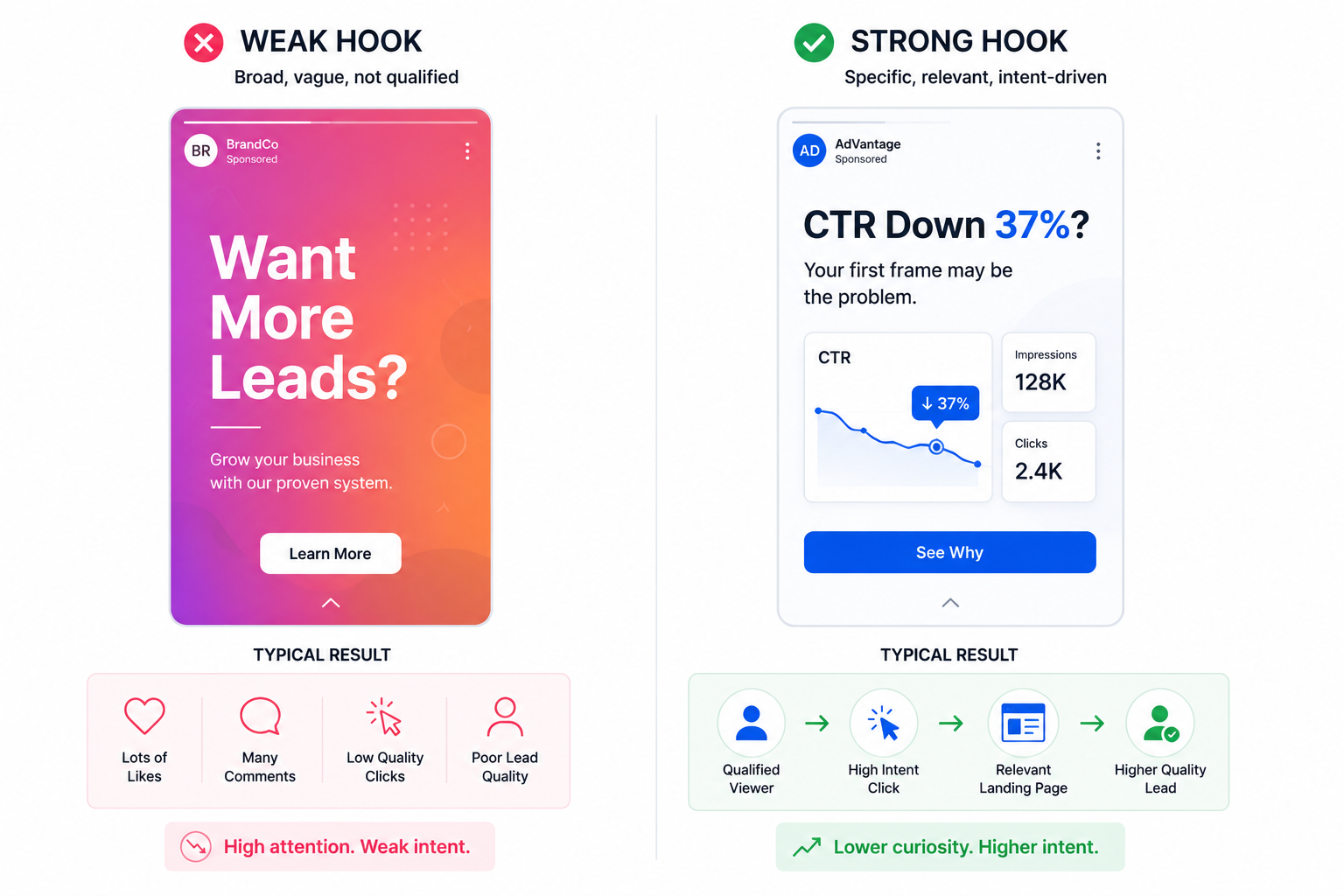
This is common in lead generation campaigns. An ad opens with a broad claim like “Stop wasting money on ads,” and many users pause because the message is familiar. But the click quality may be weak because the hook does not qualify the viewer by business type, problem maturity, budget level, or urgency.
The campaign then collects clicks, comments, or cheap form starts from users who are not ready to act. Sales teams see weak fit. CPA rises after qualification. The platform may keep finding more users who engage with the hook rather than users who match the business outcome.
That is why advertisers should understand why curiosity clicks can destroy campaign efficiency. The hook should not create a gap between attention and intent.
A performance hook names the reason to keep watching
A strong Story hook gives the viewer a fast reason to continue. It does not need to explain the whole offer, but it should make the next second feel useful.
For example, “Your landing page is not the only reason leads are weak” creates a better qualified opening than “Want more leads?” The first version introduces a specific diagnostic angle. It attracts advertisers who are already dealing with a performance problem and looking beyond basic advice.
For e-commerce, “Your product photos may be causing low add-to-cart rates” is stronger than “Need more sales?” It connects a visible creative issue to a measurable funnel problem. The user knows what the ad is about before the second frame appears.
A good hook usually contains one of these signals:
- A specific pain point. The viewer recognizes a problem they already see in performance reports, sales calls, or daily operations.
- A hidden cause. The hook suggests that the obvious explanation may not be the real issue.
- A measurable consequence. The hook connects the problem to CPC, CPA, ROAS, CPL, watch time, or conversion rate.
- A clear audience cue. The opening makes it obvious who the message is for.
The hook works because it reduces uncertainty. The viewer does not need to guess whether the ad is relevant.
Hooks should match buyer intent, not only platform behavior
Instagram users are not always in buying mode. They may be browsing casually, checking Stories quickly, or tapping through while distracted. The hook has to bridge that behavior without pretending every viewer is ready to convert.
For cold audiences, the hook should often start with recognition. It should make the user feel seen before asking for a click. For warm audiences, the hook can move faster toward proof, offer, or next step because the viewer may already know the category.
This is why it helps to align ad messaging with buyer intent. A hook for a cold audience might say, “Still comparing CRM tools before booking demos?” A retargeting hook might say, “Before you choose a CRM, check this workflow gap.”
Both are clear, but they speak to different levels of readiness.
Skipped ads often hide hook-message mismatch
If the opening hook promises one thing and the rest of the ad delivers another, users leave quickly. Sometimes they swipe immediately. Other times they click and bounce because the ad’s promise does not match the landing page.
This mismatch can happen in small ways. A hook about “lower CPA” sends people to a generic service page. A hook about “qualified leads” leads to a broad marketing audit. A hook about “faster checkout” shows a landing page focused on brand story.
The result is weak post-click behavior. CTR may hold, but conversion rate drops. That makes the campaign harder to diagnose because the hook appears to work at the ad level while the funnel rejects the traffic later.
When an ad gets visible engagement but few clicks, it is worth reviewing what to change when an ad gets comments but no clicks. The issue may not be the topic. It may be that the hook creates conversation instead of action.
Build hooks around specific campaign scenarios
A useful hook often comes from a real campaign problem, not a brainstorming session. Look at the account and identify the tension users would recognize.
For example:
- Low CTR with decent reach. Use a hook that questions the first visual or offer clarity.
- Many clicks but poor lead quality. Use a hook that qualifies the viewer before the click.
- Strong engagement but weak conversion rate. Use a hook that moves from entertainment toward intent.
- High CPC in a competitive niche. Use a hook that speaks to a narrow pain instead of a broad benefit.
These hooks are stronger because they come from observable performance issues. They also make creative testing more useful because each version tests a real hypothesis.
Final takeaway
A better Instagram ad hook should stop the right users, not everyone. The goal is not maximum pause rate or maximum curiosity. The goal is to attract attention from people who are more likely to understand the offer and take the next step.
When Instagram ads keep getting skipped, fix the opening hook before changing the full funnel. A sharper hook can improve CTR, protect lead quality, and reduce wasted spend by making intent visible from the first second.