
Marketing campaign structures are often built with growth in mind, but without proper oversight, they can develop inefficiencies that drain budget without delivering proportional results. These inefficiencies—known as budget traps—are subtle, systemic, and often overlooked until performance plateaus or declines.
According to recent industry data, up to 26% of digital advertising spend is wasted due to poor campaign structure, misallocation, and lack of optimization. Identifying and correcting these inefficiencies can significantly improve ROI without increasing spend.
What Are Budget Traps?
Budget traps are structural inefficiencies within campaigns that cause overspending or misallocation of resources. They are not always visible in top-level metrics and often require deeper analysis of campaign architecture, segmentation, and performance distribution.
Common examples include:
-
Over-segmentation of audiences
-
Redundant targeting across multiple campaigns
-
Budget fragmentation across too many ad sets
-
Misaligned bidding strategies
Key Indicators of Budget Traps
1. Uneven Spend Distribution
When a small percentage of ad sets consume the majority of the budget without delivering proportional results, it signals a structural imbalance.
A study by WordStream found that in many accounts, the top 10% of campaigns consume over 60% of the budget while contributing less than 40% of conversions.
2. High Overlap Between Audiences
Audience overlap leads to internal competition, driving up costs and reducing efficiency. Platforms like Meta and Google Ads often penalize overlapping segments with higher CPMs.
If multiple campaigns target similar audiences, you may be bidding against yourself.
3. Stagnant Learning Phases
Campaigns stuck in learning phases tend to spend inefficiently. This often occurs when budgets are too fragmented or when too many variables are introduced simultaneously.
Research indicates that campaigns exiting the learning phase efficiently can improve performance by up to 20%.
4. Low Budget Utilization Efficiency
If increasing budget does not lead to proportional growth in results, it suggests structural inefficiencies rather than scaling limitations.
Structural Causes of Budget Traps
Over-Segmentation
While segmentation allows for precision targeting, excessive segmentation dilutes data and prevents algorithms from optimizing effectively.
Lack of Consolidation
Too many campaigns or ad sets split the budget into ineffective portions, reducing statistical significance and slowing optimization.
Misaligned Objectives
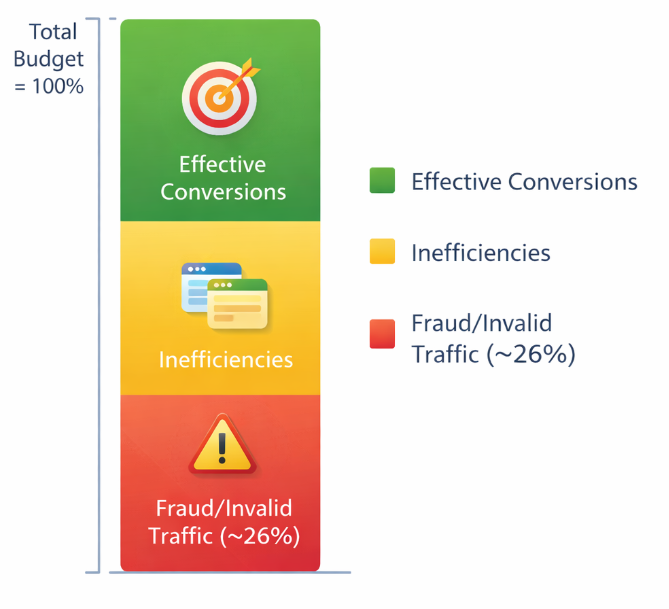
Budget losses are not caused by a single issue but by layered inefficiencies within campaign structures
Running campaigns with conflicting goals (e.g., conversions vs. traffic) within the same structure can confuse optimization algorithms.
Poor Budget Allocation Logic
Static budget allocation that does not respond to performance data leads to continuous inefficiencies.
How to Identify Budget Traps
Conduct Spend vs. Performance Analysis
Break down spend across campaigns and compare it with conversion output. Look for discrepancies where spend does not correlate with results.
Analyze Audience Overlap
Use platform tools to identify overlapping segments and quantify the extent of duplication.
Evaluate Learning Status
Identify campaigns that remain in learning phases for extended periods and investigate the causes.
Review Campaign Hierarchy
Assess whether your campaign structure supports efficient data flow and optimization.
Strategies to Eliminate Budget Traps
Consolidate Campaigns
Reduce the number of campaigns and ad sets to allow algorithms to gather sufficient data for optimization.
Implement Dynamic Budget Allocation
Shift budgets toward high-performing segments in real time instead of relying on static distributions.
Reduce Audience Overlap
Refine targeting to ensure distinct audience segments and minimize internal competition.
Align Objectives and Structure
Ensure that each campaign has a clear, singular objective aligned with its optimization strategy.
The Impact of Fixing Budget Traps
Organizations that restructure campaigns to eliminate inefficiencies often see measurable improvements:
-
Up to 30% reduction in wasted ad spend
-
15–25% increase in conversion rates
-
Faster learning phase completion
These improvements are achieved without increasing overall budget, making structural optimization one of the highest-leverage actions in digital marketing.
Additional Reading
To deepen your understanding of campaign optimization and performance scaling, consider the following articles:
Conclusion
Budget traps are rarely obvious, but their impact on performance can be substantial. By systematically analyzing campaign structures, identifying inefficiencies, and implementing strategic changes, marketers can unlock significant gains in efficiency and ROI.
Effective campaign management is not just about increasing spend—it is about ensuring that every dollar is working as efficiently as possible.