
Growth doesn’t always come from scaling what’s already working. In fact, it often comes from places you didn’t think to look.
Advertisers and marketers running Facebook and Instagram campaigns tend to focus on top-line performance. But hidden under the surface are patterns, segments, and signals that can quietly unlock real results if you know where to find them.
This guide will show you practical ways to uncover growth opportunities that may already exist inside your campaigns, audience data, and creative assets.
Start With an Audit: Where Are You Losing Ground?
Before you go looking for growth, take a close look at what’s already running. Some of the clearest signals show up when you stop focusing on scaling and start fixing what’s not working.
Look at areas where your budget might be getting wasted. These are often early indicators of untapped opportunities.
A few places to check:
-
Frequency issues
If your ads are showing too often and performance is dropping, your audience is likely tired of seeing them. Try testing new creative or opening up your targeting. -
Overlapping audiences
Running multiple ad sets that target similar users causes internal competition. Meta’s algorithm will penalize you for this. Combine similar groups or test distinct segments. If this is happening, it’s worth reviewing why audience overlap hurts delivery and efficiency in more detail. Check our article on why audience overlap is killing your Facebook ad performance for more details. -
CTR vs. ROAS mismatch
If people are clicking but not converting, the problem usually isn’t your targeting. It’s your offer, landing page, or user experience.
These aren’t just issues to fix. They’re also places where, if you make the right changes, growth can happen without adding more budget.
Rethink Retargeting: Don’t Treat All Visitors the Same
Many campaigns treat all website visitors like one audience. But not all clicks have the same intent. Some people are closer to buying than others, and they need different messages.
By breaking your retargeting into segments, you can speak more directly to what each group needs to hear.
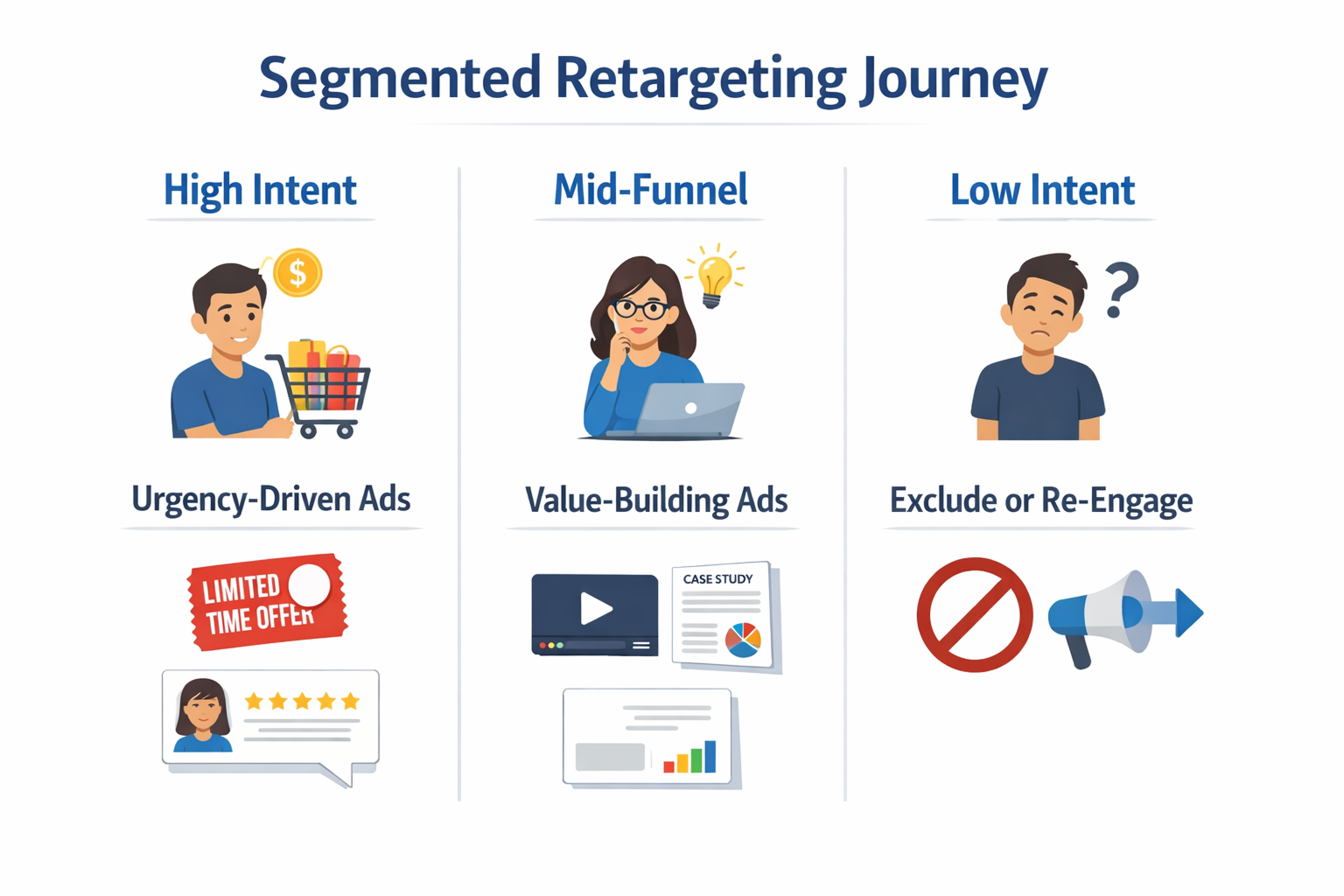
Try splitting your audience like this:
-
High-intent visitors
This includes cart abandoners or people who viewed your pricing page. Use urgency-based creative, such as limited-time offers, testimonials, or social proof. -
Mid-funnel users
These are people who engaged with content, joined your email list, or viewed several pages. Show value-driven ads like how-tos, case studies, or product benefits. -
Low-intent traffic
Some visitors just bounce quickly. Don’t waste retargeting spend here. Exclude them, or test broader awareness ads to re-engage with a different hook.
If you want more concrete ways to structure these segments, this breakdown of practical retargeting approaches expands on the idea: 4 retargeting strategies.
Adjusting your retargeting strategy this way helps you stop wasting spend and start nudging users forward based on where they actually are.
Go Smaller to Scale: Tap Overlooked Micro-Audiences
Most advertisers focus on broad audiences because they scale fast. But that’s also where competition and ad costs are highest.
Smaller, highly relevant groups may bring better returns. They’re often ignored by larger competitors, which means you can reach them more efficiently.
Try exploring:
-
Job titles or industries
If you're targeting business owners, look for interests like “Shopify store owner” or “real estate broker.” These can outperform generic “entrepreneur” targeting. -
Life stages or recent changes
Meta lets you reach people who’ve just had a baby, gotten engaged, or moved. These groups often respond well to highly specific, timing-sensitive offers. -
Hobby-based interests
Target people by what they love, such as woodworking, vintage cars, or fitness challenges. These groups tend to be deeply engaged and loyal to products that match their passions.
To target even more niche groups, use tools like LeadEnforce. You can build audiences from followers of competitors or niche community groups that don’t show up in Meta’s built-in targeting.
Don’t Scrap Old Ads — Rework Them Instead
If an ad worked well in the past, it might still have potential. You don’t always need to create something brand new to get results.
Instead of reinventing your creative, look at ways to refresh what you already know performs well.
| What You Keep | What You Change | Why It Works |
|---|---|---|
| Winning copy | New format (video, carousel) | Same message, different attention grabber |
| Visual layout | Hook or headline | Adjusting angle can speak to a different pain point |
| Audience targeting | New creative format | Great ad + wrong audience = wasted spend |
Here are a few ways to do that:
-
Change the format
Keep your copy but test it in a new visual format, such as switching a static image to a motion graphic or a feed ad to a Story layout. -
Update the hook
The core message may still be strong, but a new angle could make it hit harder. Lead with a different benefit or pain point. -
Target a different audience
If the ad worked with a broad audience, test it with a niche one, or vice versa. You may find it resonates even more.
This saves creative resources and gives you a faster path to results. Often, your next winning ad is one you've already run, just not in its best form yet.
Look Beyond Ads Manager: Spot Signals From Other Platforms
Not all valuable insights come from Meta. Sometimes, your strongest signals show up on other platforms, especially when users don’t convert directly from an ad.
Watching what users do after they see your ads can point to growth opportunities you won’t find in your campaign dashboard.
Here’s what to track:
-
Branded search traffic
Use Google Search Console to see if people are searching for your brand more after ad campaigns. A spike in searches often means your message is landing, even if they didn’t click. -
On-site behavior
Use Google Analytics or tools like Hotjar to track how different segments behave. For example, if Instagram traffic converts better than Facebook, consider shifting spend. -
Email performance
If a certain email campaign re-engaged cold leads, test that same message in your ads. It might work even better when paired with the right visual.
Think of these platforms as part of your ad ecosystem. The more you learn from them, the better your campaign strategy becomes.
Zoom Out: Patterns Hide in Plain Sight
Sometimes you find the best ideas by stepping back and looking at your account from a distance. Not just ad by ad, but across campaigns, objectives, time frames, and placements.
This is where deeper analysis often reveals growth opportunities that aren’t obvious in daily reporting: How to analyze campaign data to identify growth opportunities.
| Signal Type | What to Look For | What It Might Reveal |
|---|---|---|
| Campaign objective | Lead forms > Landing page conversions | Your top-funnel offer is frictionless |
| Time of day | Consistent evening conversions | Allocate more spend during high-converting hours |
| Placement | Stories outperforming Feed | Short-form video may be your best creative type |
| Frequency trend | Rising frequency + falling CTR | Creative fatigue — time for a refresh |
Watch for signals like:
-
Objective performance
Are lead form campaigns consistently outperforming landing page ads? That may be your ideal cold traffic strategy. -
Time-based trends
Are your best results coming mid-week? Are evenings better than mornings? Use that to schedule your ads more effectively. -
Placement breakdowns
Do Stories outperform Feed? Is Reels getting more engagement with short-form video? Let performance data guide your creative formats.
By turning account-level data into strategy, you make smarter creative, media buying, and targeting decisions and uncover growth that’s already within reach.
Final Thoughts
You don’t need a bigger budget to grow. You need better ways to see what’s already working, or close to working, and then optimize around it.
Here’s a quick summary:
-
Audit your account to spot waste and underperformance.
-
Segment retargeting based on real user behavior.
-
Explore niche audiences your competitors aren’t targeting.
-
Repackage and reuse winning creative instead of starting from scratch.
-
Use signals from outside Meta to guide decisions.
-
Find patterns across your ad account, not just inside single campaigns.
If improving results without increasing spend is your priority, this guide builds on many of the ideas covered above.
Growth opportunities aren’t always obvious. But they are always there if you know where to look.