Overfitting happens when a strategy is optimized too closely to historical data and loses the ability to perform on new or broader audiences. In marketing, this often shows up as:
-
Campaigns that perform extremely well on a narrow segment but collapse when scaled
-
Audience definitions that include dozens of micro-conditions
-
Constant creative or bid adjustments driven by small data fluctuations
In practical terms, overfitting is the difference between learning from data and memorizing it.
Why marketers are especially vulnerable
Marketing platforms generate massive volumes of granular data: clicks, impressions, conversions, device types, placements, and behaviors. While this richness is valuable, it also increases the risk of false patterns.
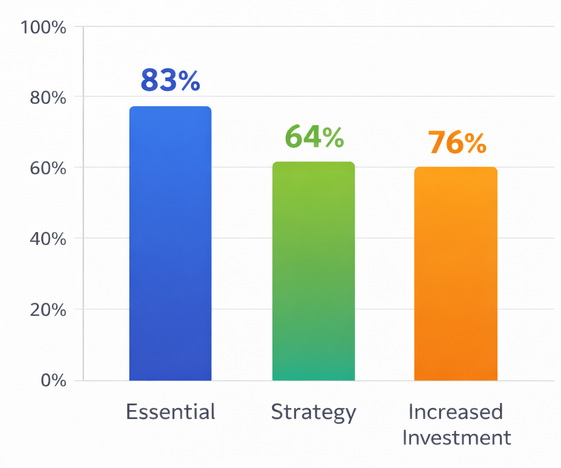
Percentage of marketers who prioritize data-driven marketing in their organization
Useful context:
-
Across digital advertising, fewer than 20–30% of tested audience segments typically produce statistically reliable improvements when scaled.
-
Campaigns optimized on samples smaller than 1,000 conversions frequently regress to the mean once budgets increase.
These numbers highlight a key truth: not all insights deserve action.
Separate signal from noise
A strong defense against overfitting is discipline in how insights are validated.
Use minimum data thresholds
Before acting on performance differences, ensure the data volume is sufficient. A common rule of thumb:
-
Conversion rate comparisons require at least 95% statistical confidence
-
Cost-per-acquisition decisions should be based on multiple conversion cycles, not short-term spikes
When data volume is low, trends are often illusions.
Test ideas, not micro-variants
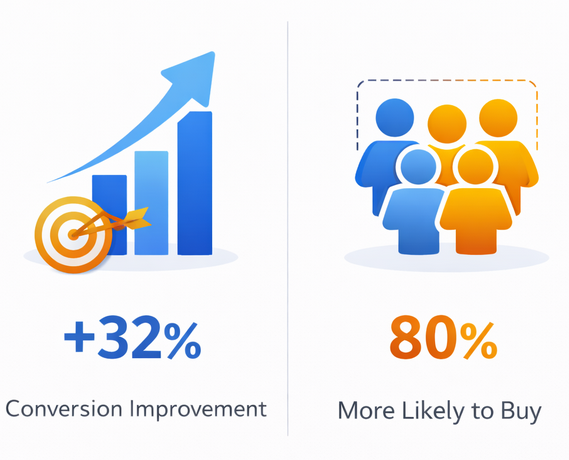
Conversion improvement and consumer preference for personalized marketing campaigns
Instead of testing dozens of narrowly defined audiences or creatives, test broader hypotheses:
-
Does professional context outperform interest-based targeting?
-
Do community-based audiences outperform demographic splits?
-
Does message framing matter more than visual variation?
This approach reduces the risk of optimizing toward randomness.
Balance precision with generalization
High-performing campaigns usually strike a balance between specificity and flexibility.
Consider these patterns:
-
Narrow audience definitions often deliver lower initial costs, but their performance degrades faster during scale
-
Broader but well-informed audiences may start 10–15% less efficient, yet remain stable as spend increases
The goal is not maximum precision, but sustainable performance.
Use validation layers
One of the most effective ways to avoid overfitting is to validate insights across independent datasets.
Practical methods include:
-
Running the same audience logic across multiple time periods
-
Testing similar logic in parallel campaigns
-
Comparing performance across different creative angles
If an insight holds under different conditions, it is far more likely to be real.
Watch for over-optimization signals
Certain behaviors are strong indicators that overfitting is already happening:
-
Performance drops immediately after scaling budgets
-
Small targeting tweaks cause large swings in reported results
-
Campaign success depends on constant manual intervention
When this happens, the solution is often simplification, not refinement.
Build systems, not one-off wins
Sustainable marketing performance comes from repeatable systems rather than perfectly tuned campaigns.
Well-designed systems:
-
Rely on core audience logic instead of endless exclusions
-
Use aggregated performance signals rather than single-metric optimization
-
Allow creative and audience learning to compound over time
In many cases, removing constraints improves results more than adding new ones.
Measuring success the right way
To avoid overfitting, success metrics should reflect long-term impact, not short-term efficiency alone.
Effective measurement includes:
-
Performance stability over time
-
Results at higher spend levels
-
Consistency across campaigns and creatives
When metrics align with durability instead of perfection, data becomes an asset rather than a trap.