Online ad campaigns don’t usually fail because of poor ad design or copy. They fail because marketers don’t know why something worked or didn’t.
To scale profitably on platforms like Facebook and Instagram, it’s not enough to find one good ad. You need to identify repeatable, scalable patterns — structured combinations of creative, targeting, and offers that consistently generate high-quality conversions.
This article will walk you through how to identify those patterns, test them properly, and scale with confidence without wasting ad budget.
What Are Scalable Campaign Patterns?
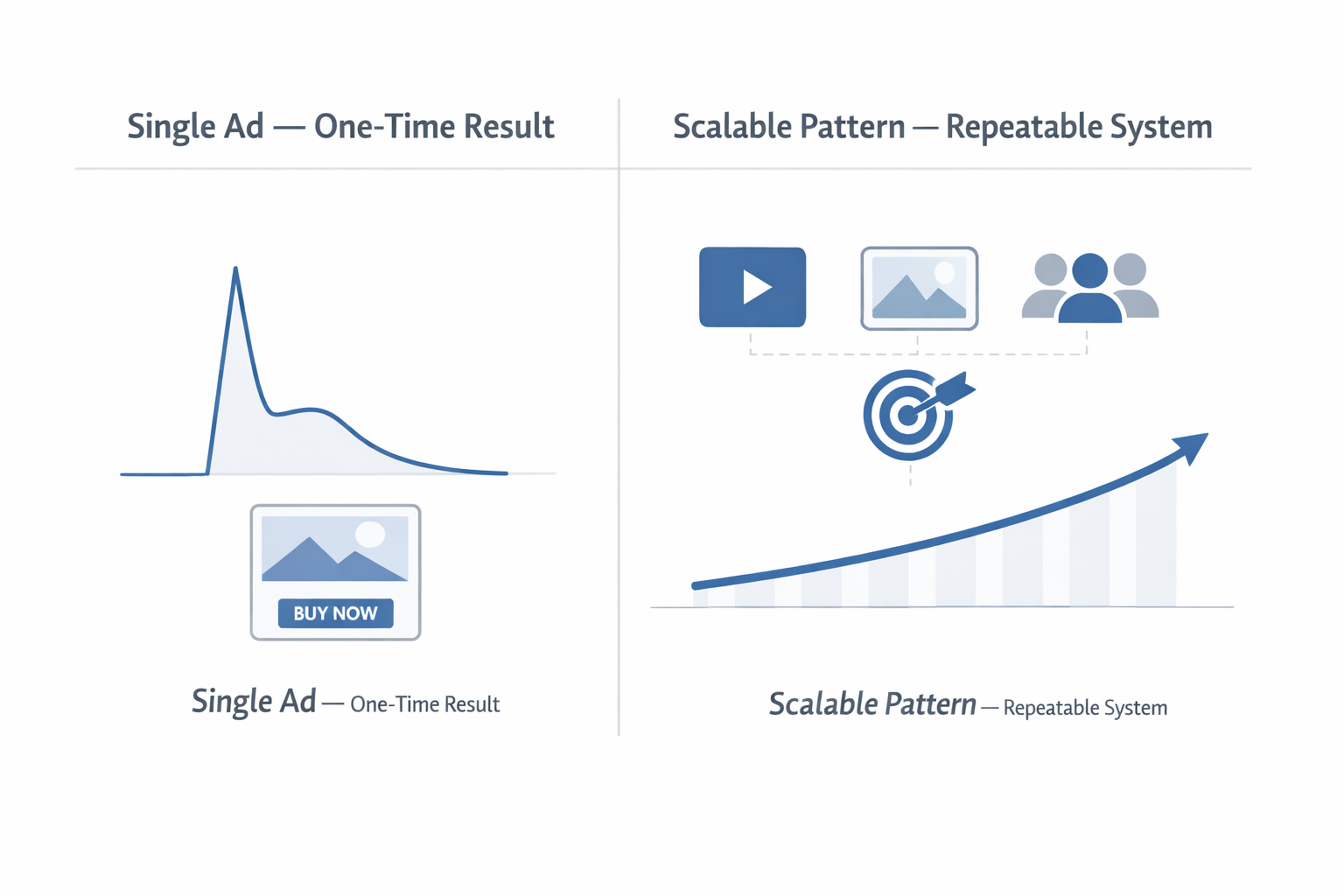
Scalable campaign patterns are structured combinations of creative, targeting, offer, and timing that reliably produce results as spend increases. They are not one-hit-wonder ads. They are frameworks — consistent systems you can adapt, evolve, and apply across campaigns.
If you’re trying to build such systems, it helps to start with a mapped customer journey — so your creative and campaign structure match each decision stage.
What Scalable Patterns Are Not
-
They’re not a single ad with a low CPL.
-
They’re not a high ROAS result from a flash sale.
-
They’re not a “trend” that worked for three days and then collapsed.
Instead, a scalable pattern works even when variables change — like when you shift audiences, increase budget, or use a new creative variation.
Examples of Real-World Scalable Patterns
-
Problem–Solution Videos for Broad Audiences
A 20-second user-generated video that opens with a strong problem (“I couldn’t sleep through the night”) followed by the solution and social proof. This format works across:-
Broad targeting;
-
Lookalikes;
-
Cold traffic with minimal learning phase.
-
-
Lead Magnet Funnel for Service Businesses
A downloadable checklist (e.g., “5 Mistakes Killing Your Funnel”) promoted via a lead-gen ad, followed by:-
Email sequence with value-based content;
-
Retargeting ad offering a call or consult;
-
Result: low CAC and high pipeline quality.
-
-
Offer–Driven Carousel with Product in Use
Carousel ad showcasing 3–5 lifestyle photos, each highlighting a use case and key feature. Works well for:-
New product launches;
-
Retargeting;
-
Purchase lookalikes.
-
To make these patterns scalable, they need to perform beyond one creative or audience. That’s where proper testing and validation come in — especially if you want to scale Facebook ads without losing profit margin.
Why Most Campaigns Don’t Scale
Many marketers chase surface-level performance — like low CPMs or CPLs — instead of identifying deeper patterns that lead to high-value actions.
This leads to scaling the wrong elements — and getting disappointed when results collapse at higher spend.
Common Mistakes That Prevent Scale
-
Over-relying on low CPL — Cheap leads that never convert drain your budget long-term.
-
Failing to group creatives thematically — Without knowing which themes work, scaling becomes guesswork.
-
Changing too many variables too fast — You lose the ability to isolate what caused the change in performance.
-
Optimizing for micro-conversions — Like clicks or engagement, instead of revenue-driving actions like purchases or qualified leads.
If your campaigns feel unstable or results fluctuate without warning, it may be time to reevaluate — or even pause or stop Facebook ads that no longer align with scalable patterns.
How to Spot Scalable Patterns in Your Data
To build repeatable success, you need to analyze the right data the right way. That means organizing, tagging, and reviewing performance across variables — not in isolation.
Identify Repeatable Conversions
-
Creative that performs across different audiences — e.g., same ad working in interest targeting, lookalikes, and broad.
-
Audiences that respond to different creatives — e.g., if a lookalike audience keeps converting across multiple offers, it may be a strong base for scale.
-
Campaigns that stay stable over time — If performance holds for at least 7–10 days, you may have a durable structure.
One of the best ways to uncover patterns is to focus on behavioral signals that predict high-value customers — not just vanity metrics like clicks or impressions.
Group Creatives by Concept and Theme
-
Format: Video, image, carousel, UGC, animation.
-
Message angle: Problem–solution, testimonial, demo, price/value, lifestyle.
-
Funnel stage: Awareness, consideration, conversion.
By tagging and organizing creatives thematically, you can spot which concepts carry performance — and which fall flat. This allows you to duplicate and evolve what works at scale.
Match Creative to Funnel Stage
| Funnel Stage | Best Creative Types | Key Objective |
|---|---|---|
| Awareness | Short UGC videos, scroll-stoppers | Grab attention, create curiosity |
| Consideration | Testimonials, “how it works” videos | Build trust, explain benefits |
| Conversion | Offer-driven ads, retargeting carousels | Overcome objections, drive action |
Understanding what works at each stage allows you to structure a campaign around real buyer behavior. For even greater impact, use buyer journey triggers that predict larger orders.
How to Validate a Pattern Before Scaling
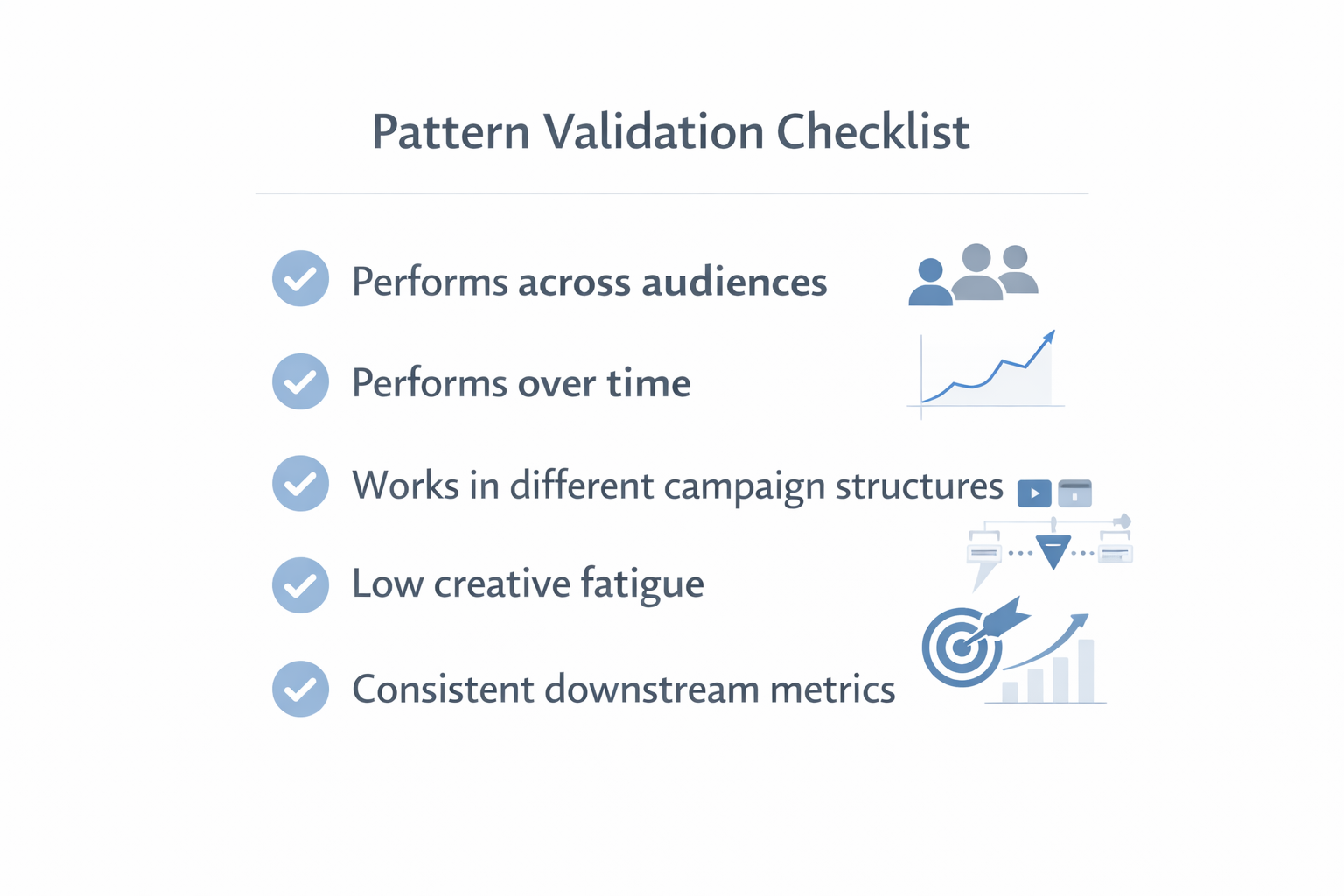
Scaling too early — before validating a pattern — often leads to wasted spend and unstable performance. Follow this sequence to test pattern stability.
Test Across Audience Types
-
Broad audiences (no interest or lookalike layers);
-
Lookalikes based on purchases or high LTV;
-
Contextual interests (specific topics or behaviors).
If an ad performs well in broad, it’s likely the creative — not the targeting — doing the heavy lifting. That’s a good signal of scalability.
Test Over Time
-
Stable CPA or ROAS for 7–10 days;
-
No early fatigue (especially in creatives);
-
Consistent downstream metrics (e.g., booked calls, repeat purchase rate).
Use a daily dashboard to monitor signs of decay or fatigue. Consistency over time beats short-lived spikes.
Test in Different Campaign Structures
-
ABO (ad set budget) vs. Advantage Campaign Budget (former CBO);
-
Mobile-only vs. all placements;
-
Lead-gen objective vs. conversion objective.
You can also explore smart use of automation to manage testing without increasing workload — learn how to scale Facebook ads with automation without sacrificing creative quality or control.
When and How to Scale
Once you’ve validated the pattern, scale slowly and systematically. Don’t just double budgets overnight.
Tips for Scaling Successfully
-
Increase by 20–30% every 3–5 days — Watch for any sudden drop in performance.
-
Use duplication scaling — Create fresh campaigns with the same structure to avoid learning phase resets.
-
Expand creative library — Add 3–5 variations to avoid fatigue as spend increases.
-
Layer new lookalikes or geos — Use the same structure in new markets or audience segments.
For an advanced breakdown of when to scale up, scale sideways, or consolidate campaigns, see when to scale, pause or stop your Facebook ads.
What Scalable Patterns Look Like in Reporting
When you’ve found a scalable pattern, your data should show:
-
Low volatility in performance metrics — CPAs, ROAS, and CTRs hold steady.
-
High volume with consistent quality — Not just more leads, but leads that convert or drive pipeline.
-
Strong performance across placements and devices — Not just desktop, not just Instagram Stories.
Use Ads Manager’s breakdown tools to isolate performance by device, age, placement, and creative — patterns often hide inside the details.
Final Thoughts
Scalable patterns are the foundation of long-term growth. A single winning ad might give you a boost, but patterns create sustainable, repeatable success.