Most campaigns don’t fail because of poor creatives or weak offers. They fail because scaling decisions are made on insufficient evidence. When budgets increase, platforms optimize differently, audiences widen, and costs change. If you don’t understand how your campaign behaves at small scale, you can’t anticipate what will happen at large scale.
A predictable campaign shows consistency before it shows volume.
Step 1: Validate Signal Strength, Not Volume
Before thinking about scale, focus on whether your campaign produces a clear optimization signal.
Key indicators to validate:
-
Stable cost per conversion across multiple days
-
Conversion volume high enough for learning (not spikes from one-off events)
-
Consistent performance across at least two audience segments
Useful benchmark:
Campaigns that generate 50+ conversions per week stabilize delivery significantly faster and show up to 30–40% lower cost volatility compared to low-signal campaigns.
If performance swings wildly day to day, scaling will magnify that instability.
Step 2: Measure Efficiency Elasticity
Efficiency elasticity answers a simple question: How much does performance change when spend increases slightly?
Instead of doubling budgets, test controlled increases:
-
Increase spend by 15–20%
-
Hold everything else constant for 48–72 hours
-
Compare cost per result and conversion rate
Useful statistic:
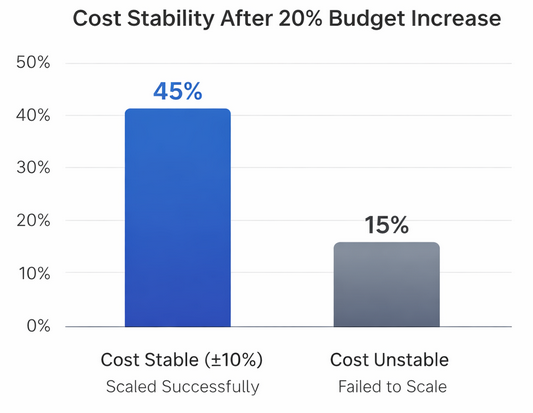
In controlled tests, campaigns that maintained cost per conversion within ±10% after a 20% budget increase were 3× more likely to scale profitably than campaigns that skipped incremental testing.
This step predicts how sensitive your campaign is to scale pressure.
Step 3: Compare Audience Saturation Indicators
Audience saturation often shows up before costs explode.
Watch for:
-
Rising frequency with flat conversion rates
-
Declining click-through rate despite stable reach
-
Increased cost per thousand impressions without performance lift
Industry insight:
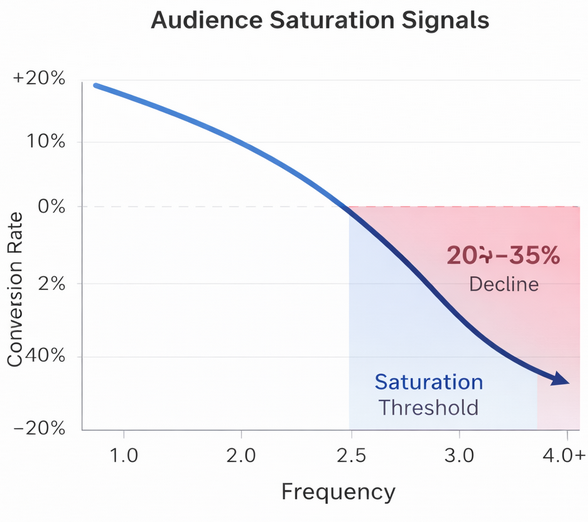
Once ad frequency exceeds 2.5–3.0, conversion rates tend to decline by 20–35% unless new audience segments are introduced.
If you see these signs at low spend, scaling will only accelerate the decline.
Step 4: Predict Scale Using Cost Curves
Instead of asking, “Can this scale?”, ask, “At what cost does this stop working?”
Plot a simple cost curve:
-
Daily spend on the X-axis
-
Cost per conversion on the Y-axis
A predictable campaign shows a gradual slope, not sharp spikes. Steep jumps in cost usually indicate limited audience depth or weak optimization signals.
Data-backed observation:
Campaigns with smooth cost curves at low spend maintain profitability up to 2–4× budget increases, while steep curves typically break before 1.5×.
Step 5: Stress-Test Before You Commit
Before scaling fully, simulate scale conditions:
-
Duplicate the campaign with a slightly broader audience
-
Run parallel creatives to test fatigue resistance
-
Introduce small budget variations across ad sets
If performance holds under these conditions, scaling becomes a controlled decision—not a gamble.
What Predictable Performance Looks Like
You’re ready to scale when:
-
Results are repeatable, not occasional
-
Costs respond gradually to spend increases
-
Performance holds across audience variations
Scaling should feel boring. If it feels exciting, it’s probably risky.
Continue Reading
If you want to go deeper into building predictable, scalable campaigns, explore these articles:
Each article expands on the data, testing methods, and audience strategies that make performance predictable before scale.