High form conversion rates can be misleading. While reducing friction increases submissions, it often results in incomplete, low-intent, or unqualified leads. According to industry benchmarks, the average B2B landing page conversion rate ranges between 2% and 5%, yet a significant portion of those leads never progress to sales-qualified status. In many organizations, up to 40%–60% of marketing-generated leads are disqualified due to insufficient or inaccurate information.
The challenge is clear: how can businesses collect richer qualification data without damaging conversion performance?
Progressive profiling provides the answer.
What Is Progressive Profiling?
Progressive profiling is a form optimization methodology that incrementally collects user data across multiple interactions instead of requesting all information at once. Rather than presenting a long, high-friction form, the system dynamically adjusts fields based on previously captured data.
For example:
-
First interaction: Name and business email
-
Second interaction: Company name and role
-
Third interaction: Company size and primary challenge
Each engagement builds a more complete lead profile while maintaining user experience efficiency.
Why Progressive Profiling Improves Lead Quality
1. Reduces Form Abandonment While Preserving Data Depth
Research shows that reducing form fields from 11 to 4 can increase conversions by as much as 120%. However, shorter forms alone reduce qualification depth. Progressive profiling balances both objectives: higher conversion rates and richer lead intelligence.
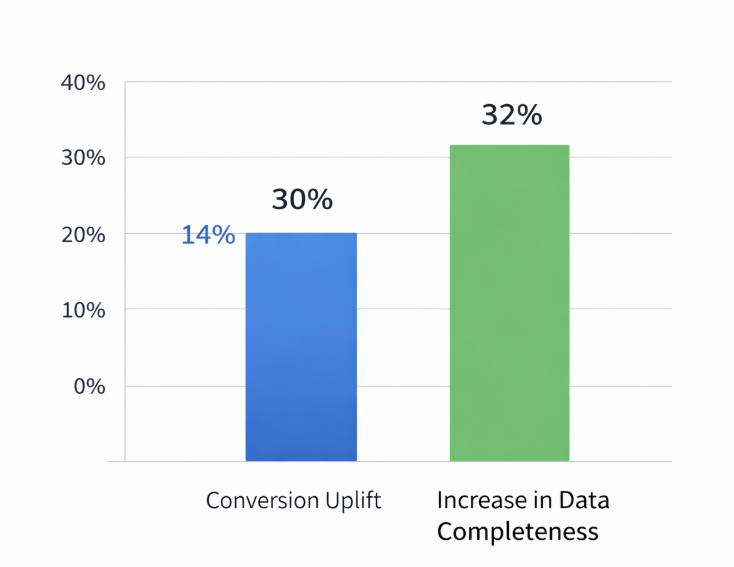
Progressive profiling implementation boosts conversion rates significantly while generating richer lead profiles
By sequencing data capture, businesses can:
-
Maintain high initial submission rates
-
Gradually gather firmographic and intent data
-
Improve marketing segmentation accuracy
2. Enhances Data Accuracy
Requesting too much information at once often leads to:
-
Fake phone numbers
-
Generic email addresses
-
Incomplete fields
When users perceive immediate value in exchange for minimal effort, they are more likely to provide accurate information. Subsequent interactions occur after trust is established, increasing response reliability.
3. Improves Lead Scoring Precision
Progressive profiling enables dynamic lead scoring models based on evolving attributes. Instead of scoring solely on email domain or job title, marketing teams can incorporate:
-
Company size
-
Industry
-
Buying timeline
-
Budget authority
Organizations using structured lead nurturing combined with progressive profiling report up to 20% increases in sales-qualified leads.
4. Supports Personalized Nurturing
The more contextual data collected, the more targeted messaging can become. Personalized campaigns can increase click-through rates by 14% and conversions by 10% or more.
When marketing automation systems integrate progressive form data, teams can:
-
Segment by industry
-
Trigger role-specific messaging
-
Deliver challenge-based content sequences
The result is stronger engagement and faster progression through the funnel.
Implementation Best Practices
Start With Essential Fields Only
The first interaction should capture only the minimum viable data required for identification and follow-up. In most B2B cases, this includes:
-
First name
-
Business email
Avoid asking for phone numbers, revenue, or detailed qualification data upfront unless required for high-intent assets.
Define a Data Collection Roadmap
Map your ideal customer profile attributes and prioritize fields based on impact:
-
Identification data
-
Firmographic qualification
-
Role and authority indicators
-
Intent and timeline insights
Each stage should align with the buyer’s journey.
Use Behavioral Triggers
Progressive profiling performs best when tied to engagement milestones such as:
-
Content downloads
-
Webinar registrations
-
Demo requests
-
Returning website visits
Dynamic forms should recognize returning users and replace previously completed fields with new qualification questions.
Integrate With Lead Scoring and CRM Systems
To maximize impact, form data must flow directly into:
-
Marketing automation workflows
-
Lead scoring models
-
CRM records
Data latency or manual enrichment reduces effectiveness. Automation ensures that each new field submission updates routing logic and segmentation rules immediately.
Monitor Key Performance Metrics
Evaluate progressive profiling success using:
-
Conversion rate by form stage
-
Marketing-qualified lead (MQL) rate
-
Sales-qualified lead (SQL) rate
-
Pipeline contribution
-
Lead-to-opportunity conversion
Improvements in SQL rate are often the clearest indicator of enhanced lead quality.
Common Mistakes to Avoid
-
Asking repetitive questions due to poor system integration
-
Introducing high-friction fields too early
-
Failing to align collected data with sales requirements
-
Overcomplicating form logic without clear scoring strategy
Progressive profiling is a strategic framework, not merely a technical feature.
Expected Performance Impact
When implemented correctly, organizations typically observe:
-
10%–30% improvement in qualified lead rate
-
15%–25% reduction in unqualified submissions
-
Faster sales response times due to improved routing
-
Higher close rates from better-informed sales conversations
The compounding effect of incremental data collection significantly strengthens pipeline predictability.
Conclusion
Improving form lead quality requires balancing user experience with qualification depth. Progressive profiling enables businesses to move beyond the tradeoff between short forms and rich data.
By collecting the right information at the right time, marketing teams can generate leads that are not only more numerous but more valuable. The outcome is stronger alignment between marketing and sales, improved pipeline efficiency, and measurable revenue growth.