Many campaigns show promising results during testing: low cost per conversion, strong click-through rates, and fast initial traction. These outcomes create the impression that the creative or message itself is the decisive factor. However, scaling reveals a different reality. Performance drops, costs rise, and previously reliable ads stop converting.
The issue is rarely that the ad suddenly became ineffective. More often, the surrounding system—audience, delivery, and data feedback—changes in ways that expose structural weaknesses.
Audience Saturation Happens Faster Than Expected
At small budgets, ads are typically delivered to the most responsive users first. These are the people most aligned with the offer, message, and timing. As spend increases, delivery expands to less relevant users.
Useful industry benchmarks show:
-
Click-through rates commonly decline by 30–50% after the first full frequency cycle
-
Conversion rates often drop by 40% or more once frequency exceeds 2.5–3.0
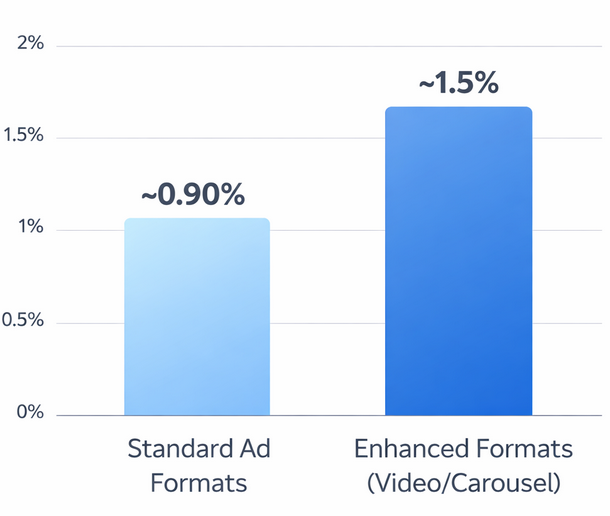
Comparison of average click-through rates (CTR) across common ad formats, showing how engagement benchmarks vary before scale
What looked like strong creative performance was, in reality, early access to the most qualified segment of the audience.
Creative Fatigue Is Not the Main Problem
Creative fatigue is frequently blamed when results fall, but it is often misdiagnosed. In many cases, the same creative continues to perform well for new users, while results decline because the campaign is repeatedly shown to the same people.
Key signals include:
-
Stable click-through rates with rising cost per conversion
-
Increasing frequency without proportional reach growth
This indicates audience exhaustion rather than creative failure.
Scaling Changes the Optimization Signal
When budgets increase, platforms shift how ads are optimized. Early on, delivery favors users most likely to convert quickly. At scale, the system prioritizes spending efficiency and reach, not precision.
Data from large-scale ad accounts shows:
-
Cost per acquisition can increase by 60–100% when budgets are doubled too quickly
-
Conversion rate volatility increases significantly once daily spend exceeds historical averages by more than 30%
The ad did not stop working—the optimization context changed.
Narrow Wins Do Not Translate Broadly
Many winning ads are highly specific. They resonate deeply with a narrow audience but fail to generalize. At scale, these messages lose relevance because they were never designed for broader interpretation.
High-performing test ads often rely on:
-
Insider language
-
Problem awareness that assumes prior context
-
Emotional triggers specific to a small group
When exposed to a wider audience, these strengths turn into limitations.
The Real Constraint: Audience Structure
Sustainable scaling depends less on individual ads and more on how audiences are structured and refreshed. Without continuous access to new, relevant users, even strong creatives degrade.
Marketers who scale successfully typically:
-
Expand through multiple audience layers rather than budget increases alone
-
Refresh targeting inputs before refreshing creatives
-
Monitor audience overlap and frequency as closely as creative metrics
What to Test Before You Scale
Before increasing spend, validate whether performance is resilient or fragile:
-
Test the same creative across multiple audience segments
-
Increase budget in controlled increments of 15–25%
-
Monitor frequency and conversion rate together, not in isolation
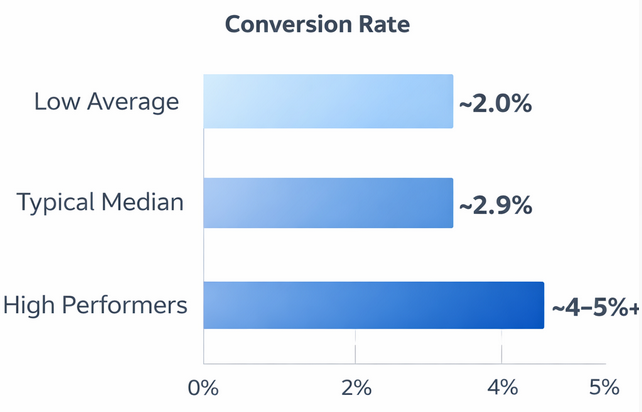
Conversion rate distribution benchmarks for typical paid campaigns, highlighting realistic performance expectations before scaling
If performance holds across these conditions, the ad is more likely to survive scale.
Conclusion
Winning ads fail at scale not because they stop being persuasive, but because they were optimized for a moment, not a system. Scaling exposes audience limits, optimization shifts, and structural weaknesses that were invisible at low spend.
True scalability comes from understanding who the ad reaches, how often, and under what delivery conditions—not just how well it performed yesterday.