If your cost per result is rising, the instinct is usually to narrow targeting or reduce spend. That feels safe. But in many cases, it damages scale and makes performance more fragile.
The real question isn’t how to pay less for fewer impressions. It’s how to improve auction efficiency so you pay less for the same reach. When you approach cost reduction structurally, you preserve delivery while improving signal quality and conversion economics.
This is where most advertisers misdiagnose the problem.
Cost Per Result Is an Auction Outcome, Not a Budget Variable
Cost per result on Facebook is determined inside a dynamic auction.
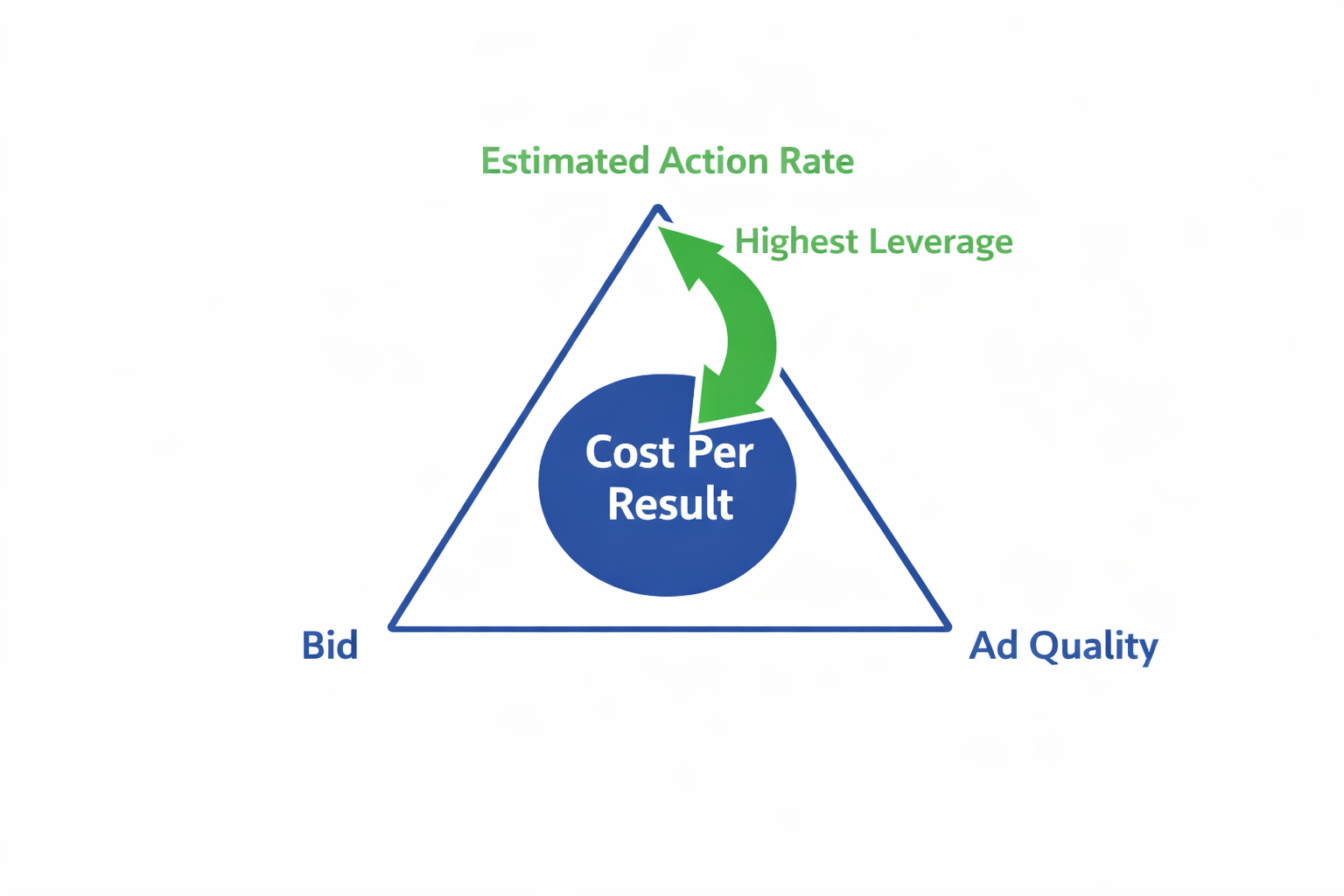
You are competing on three variables:
-
Your bid strategy. Whether you use lowest cost, cost cap, or bid cap directly influences how aggressively you enter auctions and how much volatility you tolerate.
-
Your estimated action rate. This is the platform’s prediction of how likely someone is to complete your chosen optimization event after seeing or clicking your ad.
-
Your ad quality and engagement signals. These include expected CTR, historical feedback, and behavioral engagement patterns.
If cost per result increases, it usually means one of three things:
-
Your conversion rate declined. Traffic quality may be the same, but fewer users are completing the intended action.
-
Your audience composition shifted. Delivery may have expanded into lower-intent pockets within your targeting pool.
-
Competitive pressure increased. More advertisers are bidding on the same users, which raises clearing prices.
If you want a deeper breakdown of auction mechanics and performance drivers, read What Affects Facebook Ads Performance the Most.
Reducing reach does not solve these structural drivers. It simply reduces exposure and often makes optimization less stable.
Instead, you need to increase conversion efficiency per impression so the platform predicts higher value from your ads. When predicted action rate rises, your effective CPM becomes more competitive, and cost per result improves naturally.
Diagnose Before You Optimize
Before adjusting targeting or budgets, separate the problem correctly.
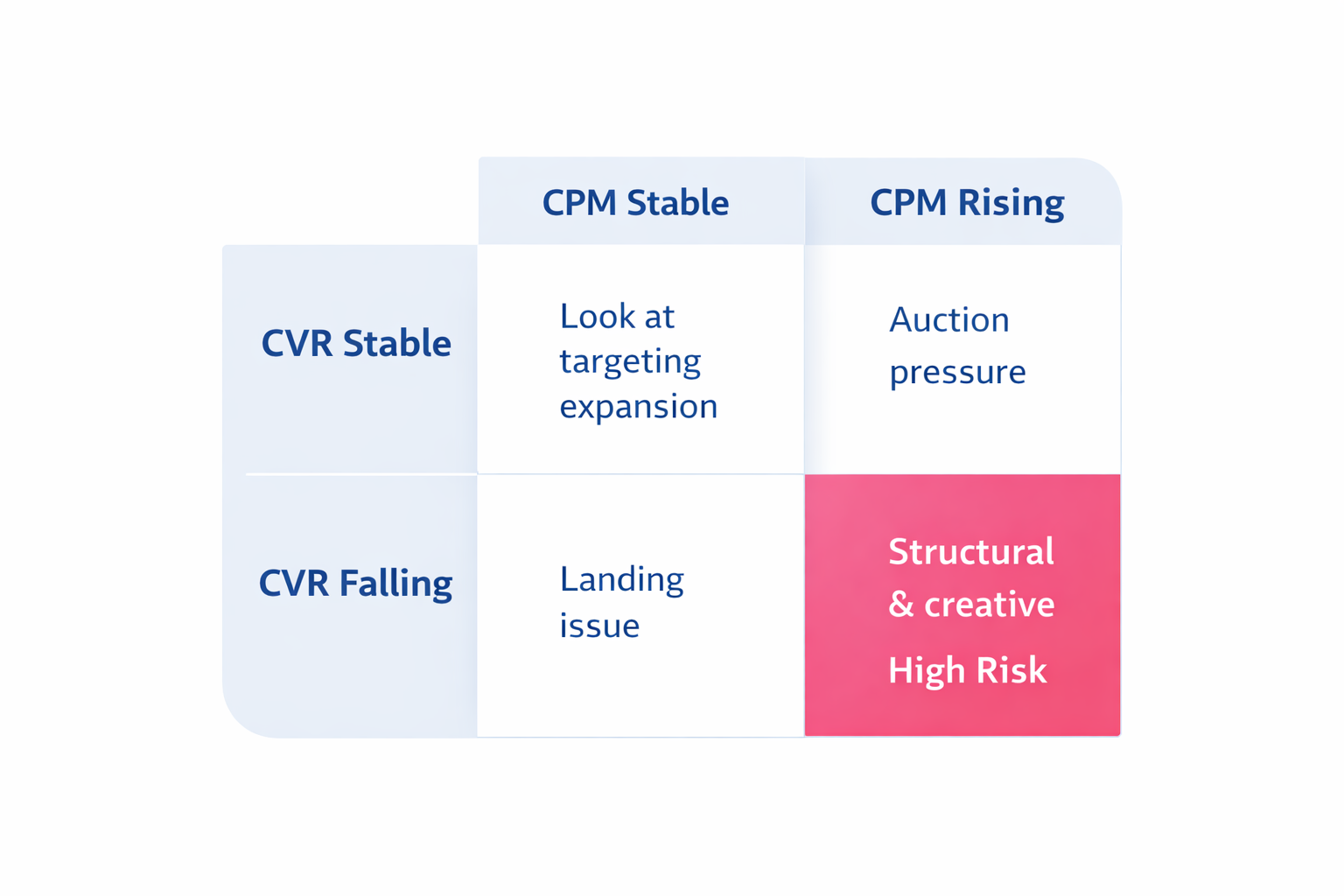
At the ad set level, review:
-
CPM trends. If CPM has increased significantly while CTR and CVR remain stable, the issue is likely auction competition rather than conversion mechanics.
-
CTR (link click-through rate). If CTR is declining, your creative may be losing relevance, or frequency may be eroding responsiveness.
-
Conversion rate (CVR). If CTR is stable but CVR drops, the bottleneck is usually post-click, such as landing page friction or misaligned intent.
For example, if CPM is stable but cost per result rises by 30%, that almost always points to conversion inefficiency rather than targeting failure.
If you need a structured troubleshooting workflow, see How to Diagnose Campaign Performance in Under 10 Minutes.
This diagnostic discipline prevents unnecessary structural changes that damage scale.
Improve Conversion Rate Without Narrowing Targeting
The cleanest way to reduce cost per result is to increase post-click efficiency. Even a modest lift in conversion rate can materially change auction outcomes because it raises predicted value.
1. Align Message and Landing Intent
Intent continuity directly affects conversion probability.
-
Ensure the primary promise in your ad headline is repeated in the landing page headline; this reduces cognitive friction and confirms relevance.
-
Match the level of specificity; if your ad targets a defined segment, your landing page should not broaden into generic messaging.
-
Maintain visual and tonal consistency; continuity reinforces trust and reduces bounce probability.
For a deeper breakdown of post-click mechanics, read Optimizing for Post-Click Experience: What Happens After.
2. Simplify the First Conversion Step
Form friction often inflates cost per result silently.
-
Reduce required fields to the minimum necessary for qualification; every additional mandatory field introduces drop-off risk.
-
Consider splitting long forms into two stages; the first stage captures commitment, and the second gathers detail.
-
Test native lead forms for top-of-funnel campaigns; platform-native environments often convert at higher rates due to reduced loading friction.
A small increase in conversion rate compounds across impressions, lowering cost per result without restricting reach.
3. Improve Page Speed and Mobile Clarity
Many advertisers underestimate technical drag.
-
Audit load times, especially largest contentful paint; delays beyond a few seconds materially increase abandonment.
-
Remove unnecessary scripts and heavy media assets; excessive JavaScript can block rendering on mobile devices.
-
Reevaluate mobile layout hierarchy; ensure the core CTA appears above the fold and remains visually dominant.
These adjustments directly increase the economic value of every click.
Increase Signal Density Per Ad Set
Fragmented account structures frequently inflate cost per result.
When you split audiences too aggressively, each ad set gathers fewer optimization events. That weakens learning stability and reduces prediction accuracy.
Consolidate where possible to ensure:
-
Sufficient event volume. Aim for at least 50 meaningful optimization events per week per ad set to maintain stable learning.
-
Clean exclusion logic. Remove unnecessary cross-exclusions that shrink pools without strategic benefit.
-
Budget concentration. Avoid spreading small budgets across many ad sets, as this dilutes signal and prolongs learning phases.
Audience overlap is one of the most common structural inefficiencies that quietly drives up costs. If you suspect internal competition, read Why Audience Overlap Is Killing Your Facebook Ad Performance.
When signal density increases and overlap decreases, the algorithm predicts outcomes more accurately. That reduces waste without shrinking reach.
Control Frequency Before It Becomes Expensive
Rising cost per result is sometimes driven by audience fatigue rather than targeting inefficiency.
Monitor:
-
Frequency trends. In prospecting campaigns, sustained frequency above 2.5–3.0 often correlates with declining responsiveness.
-
CTR trajectory. If CTR drops as frequency rises, creative fatigue is likely.
-
Conversion lag behavior. Repeated exposure without incremental conversions signals diminishing returns.
Instead of shrinking your audience, rotate creative strategically:
-
Refresh the opening hook while maintaining the same offer.
-
Present the same value proposition from a different angle.
-
Test a new visual structure to reset attention patterns.
For a deeper dive into fatigue dynamics, see Creative Fatigue: Early Signals and Fixes.
You preserve reach while restoring engagement quality.
The Structural Perspective
Reducing cost per result is rarely about paying less for exposure. It is about increasing the value the platform predicts from each impression.
When you improve:
-
Conversion efficiency through friction reduction and intent alignment.
-
Signal density by consolidating learning pools.
-
Creative responsiveness to prevent fatigue.
-
Structural simplicity to avoid internal competition.
You allow the algorithm to compete more effectively in the auction. Reach remains intact, and economics improve.
If your default reaction to rising costs is to narrow targeting, pause and diagnose first. In many cases, the solution is not contraction. It is structural refinement.