Cost per lead on Meta can feel unpredictable. One week you generate leads at $12, the next week they cost $25, even though nothing major changed. That instability makes forecasting difficult and scaling risky.
In most cases, CPL volatility is structural. When you improve structure, signal flow, and decision timing, results become far more stable.
Why Cost Per Lead Fluctuates
Meta optimizes based on behavioral signals. When signals are clear and consistent, performance stabilizes. When signals weaken or fragment, CPL starts moving.
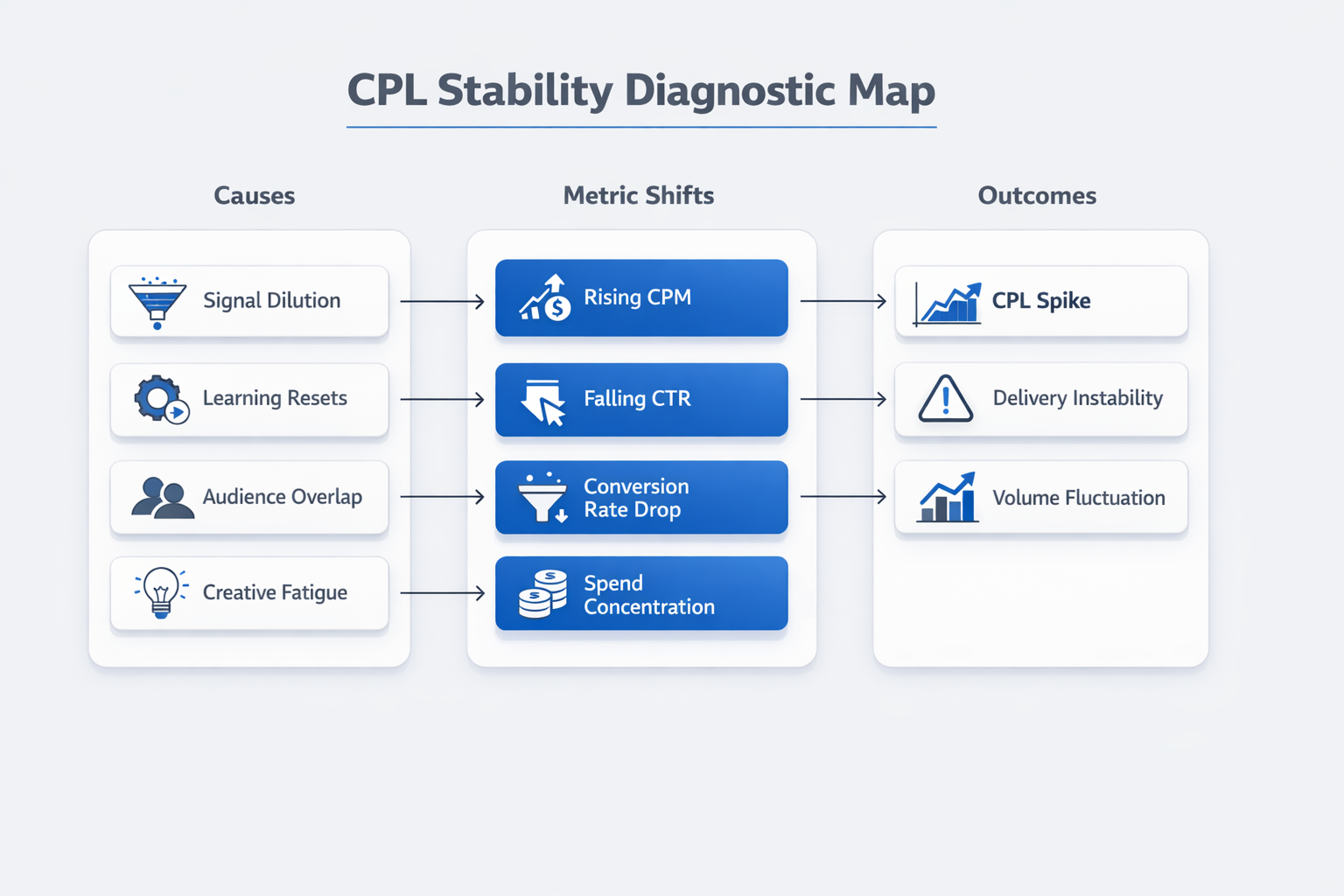
Several structural issues cause most instability.
-
Signal dilution. Expanding audiences too fast reduces intent density. For example, moving from a tight 1 percent lookalike to broad targeting without enough volume often lowers conversion rate.
-
Learning resets. Frequent edits restart optimization. If you constantly adjust budgets or targeting, the system never stabilizes. See how the learning phase works in How to Use the Facebook Ads Learning Phase to Your Advantage.
-
Audience overlap. Running similar ad sets creates internal auction competition. That increases CPM and destabilizes CPL. This is explained clearly in Why Audience Overlap Is Killing Your Facebook Ad Performance.
-
Creative fatigue. As engagement drops and frequency rises, the auction penalizes your ads. That pushes CPL higher even if targeting remains unchanged.
Stability begins by controlling these drivers.
Control Audience Signal Density
Signal density describes how concentrated your conversions are within your impression pool. When many impressions generate meaningful actions, the system learns faster and more accurately.
If you broaden targeting without increasing volume, the algorithm shifts toward cheaper impressions that often convert worse. That shift increases CPL.
Keep Prospecting Structure Simple
Over-segmentation weakens learning. Ten small ad sets feel organized, but they divide conversion data.
Instead:
-
Merge similar interests. For example, combine related business interests into one broader cluster to strengthen signal density.
-
Use wider lookalike ranges. A combined 1–3 percent audience often performs more consistently than separate micro-segments.
-
Limit the number of cold ad sets. If each ad set generates fewer than 30–50 weekly conversions, volatility increases.
Simpler structures usually produce steadier CPL curves.
If you want a deeper breakdown of audience logic, review The Complete Guide to Warm, Cold, and Custom Audiences in Meta Ads.
Separate Warm and Cold Traffic Clearly
Warm audiences convert faster and at higher rates. Mixing them with cold traffic distorts optimization.
For example, if you combine website visitors with new prospects, the algorithm prioritizes warm users. Once warm demand slows, CPL spikes unexpectedly.
Keep retargeting isolated. Stable segmentation protects cold traffic learning.
Reduce Learning Phase Disruptions
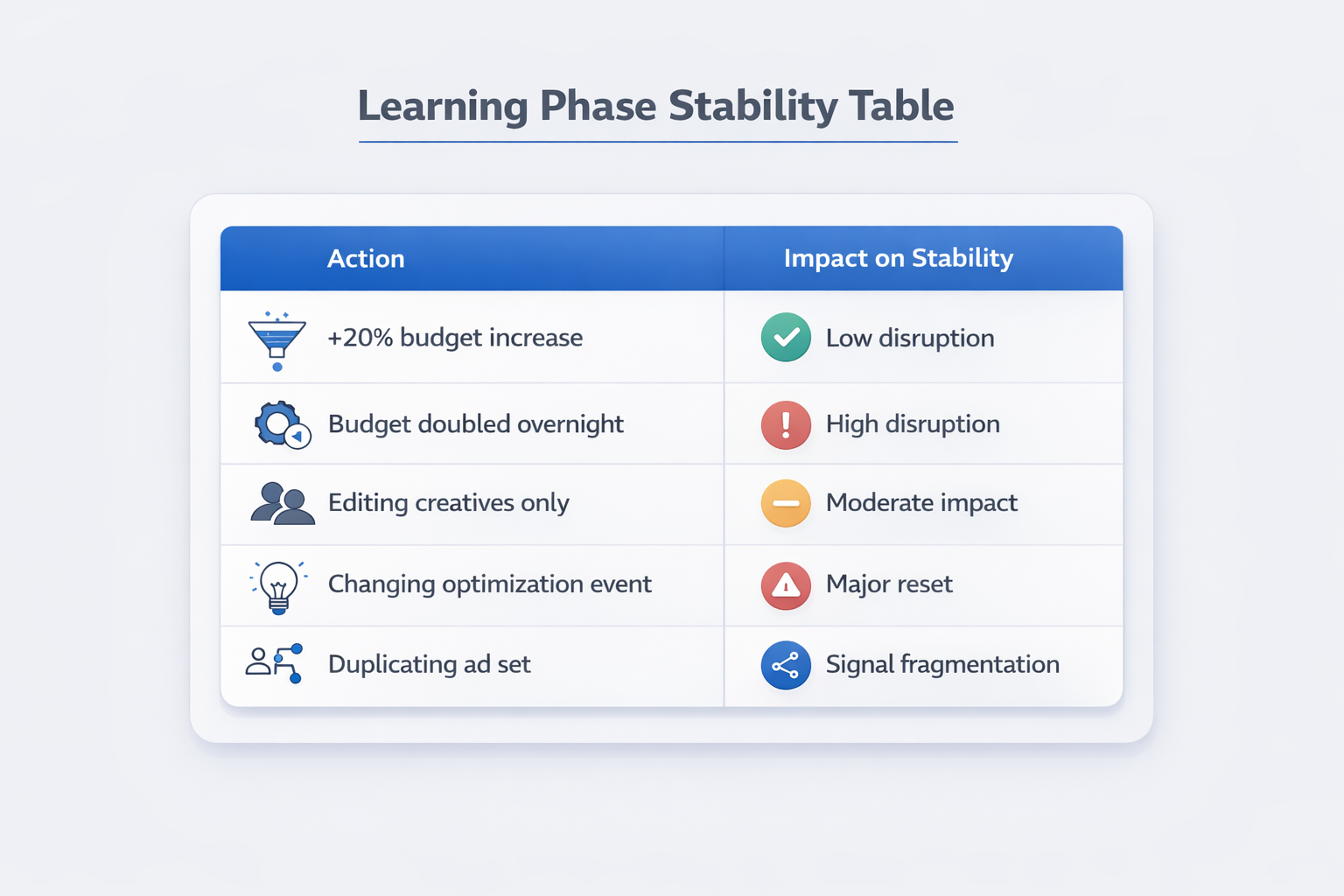
Every structural change affects delivery. Changing budget, creative, and targeting simultaneously removes historical context.
Frequent resets create artificial volatility.
Scale Gradually, Not Aggressively
Scaling should be controlled.
-
Increase budgets by 20–30 percent instead of doubling them overnight. Large jumps force the system to search for new inventory quickly.
-
Scale winning ad sets directly. Duplicating them fragments data.
-
Avoid switching optimization events mid-campaign.
If you want to scale without destabilizing performance, review The Science of Scaling Facebook Ads Without Killing Performance.
Gradual adjustments preserve learning momentum.
Monitor Budget Distribution
If one ad set absorbs most of the budget, the rest may never stabilize. Uneven spend increases volatility because too much performance depends on a single segment.
Consolidating similar segments often restores balance and smooths CPL trends.
Diagnose Conversion Rate Before Blaming CPM
CPL depends on three core variables:
-
CPM.
-
Click-through rate.
-
Landing page conversion rate.
Many advertisers focus on CPM alone. In reality, small drops in conversion rate often cause bigger CPL shifts than rising CPM.
For example, if your landing page conversion rate falls from 20 percent to 14 percent, CPL rises sharply even if traffic cost stays stable.
Audit Landing Page Consistency
Small funnel changes quietly increase CPL.
-
Page speed. Even a one-second delay on mobile increases bounce rate.
-
Form length. Adding required fields often reduces completion rates.
-
Message alignment. If your ad promises a free guide but the landing page pushes a demo call, friction increases.
For deeper funnel alignment insights, see How to Improve Lead Conversion Rates From Facebook Ads.
Stable post-click performance supports stable CPL.
Manage Creative Fatigue Without Resetting Data
Creative fatigue builds gradually. CTR declines, frequency increases, and engagement weakens. As engagement falls, CPM rises and CPL follows.
Replacing all creatives at once often resets valuable performance history.
Rotate Creatives Strategically
Refresh methodically instead of reactively.
-
Introduce one new concept at a time. Compare it against a control ad.
-
Update hooks or headlines first before changing the entire visual direction.
-
Monitor frequency trends and refresh before engagement collapses.
Controlled rotation protects historical signal while preventing fatigue-driven CPL spikes.
Use Volume to Smooth Variance
Low weekly conversion volume exaggerates fluctuations. Losing three leads in a small dataset dramatically changes CPL.
To reduce variance:
-
Broaden targeting slightly if data is too thin.
-
Increase budget gradually to support stronger signal flow.
-
Maintain consistent campaign structure instead of constant experimentation.
More conversion data creates smoother performance curves.
Evaluate Trends, Not Daily Spikes
Daily CPL swings are normal in auction systems. Reacting to every spike introduces instability.
Instead:
-
Review seven-day rolling averages.
-
Compare week-over-week trends.
-
Track blended CPL across campaigns.
If you need a structured troubleshooting approach when CPL jumps suddenly, review What to Check When Your Cost Per Lead Suddenly Spikes.
Context prevents overreaction.
Stability Comes From Structural Discipline
Meta rewards consistent signal flow. Accounts that constantly restructure create unstable data patterns.
When you simplify audiences, scale gradually, protect conversion rate, and refresh creatives strategically, cost per lead becomes predictable. Predictability allows you to scale confidently instead of reacting to volatility each week.