The learning phase is the period when Facebook’s delivery system is gathering data to understand how to show your ads most effectively. During this time, the algorithm tests different audience segments, placements, and delivery patterns to predict which users are most likely to complete your chosen optimization event.
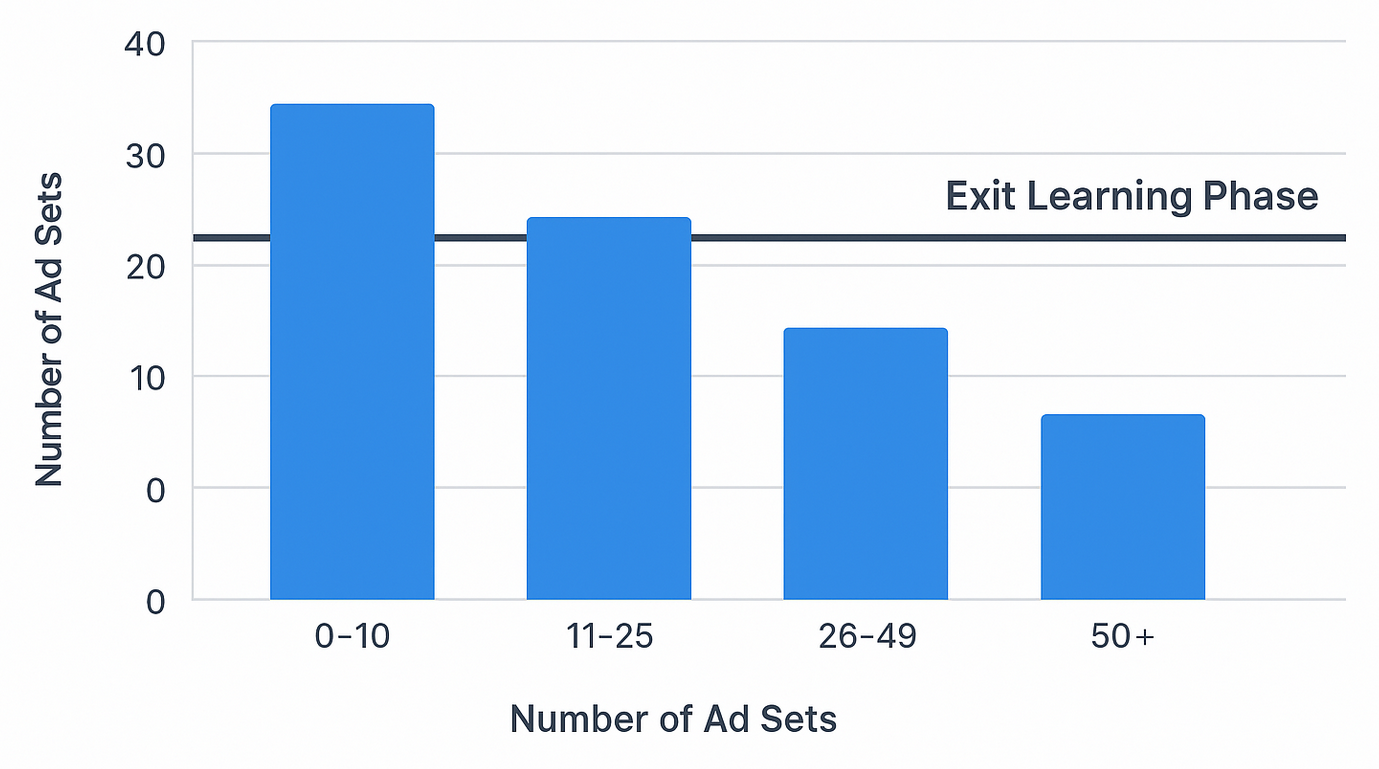
Number of Optimization Events Ad Sets Typically Need to Exit the Facebook Ads Learning Phase
An ad set typically enters the learning phase after it is created or after a significant edit. Performance can fluctuate during this period, which is normal and expected.
According to Meta’s own guidance, ad sets usually need around 50 optimization events within a 7-day period to exit the learning phase and reach more stable delivery.
Why the Learning Phase Matters
The learning phase directly affects cost efficiency and performance stability. Ads that remain in learning or frequently re-enter it often show higher cost per result and more volatile metrics.
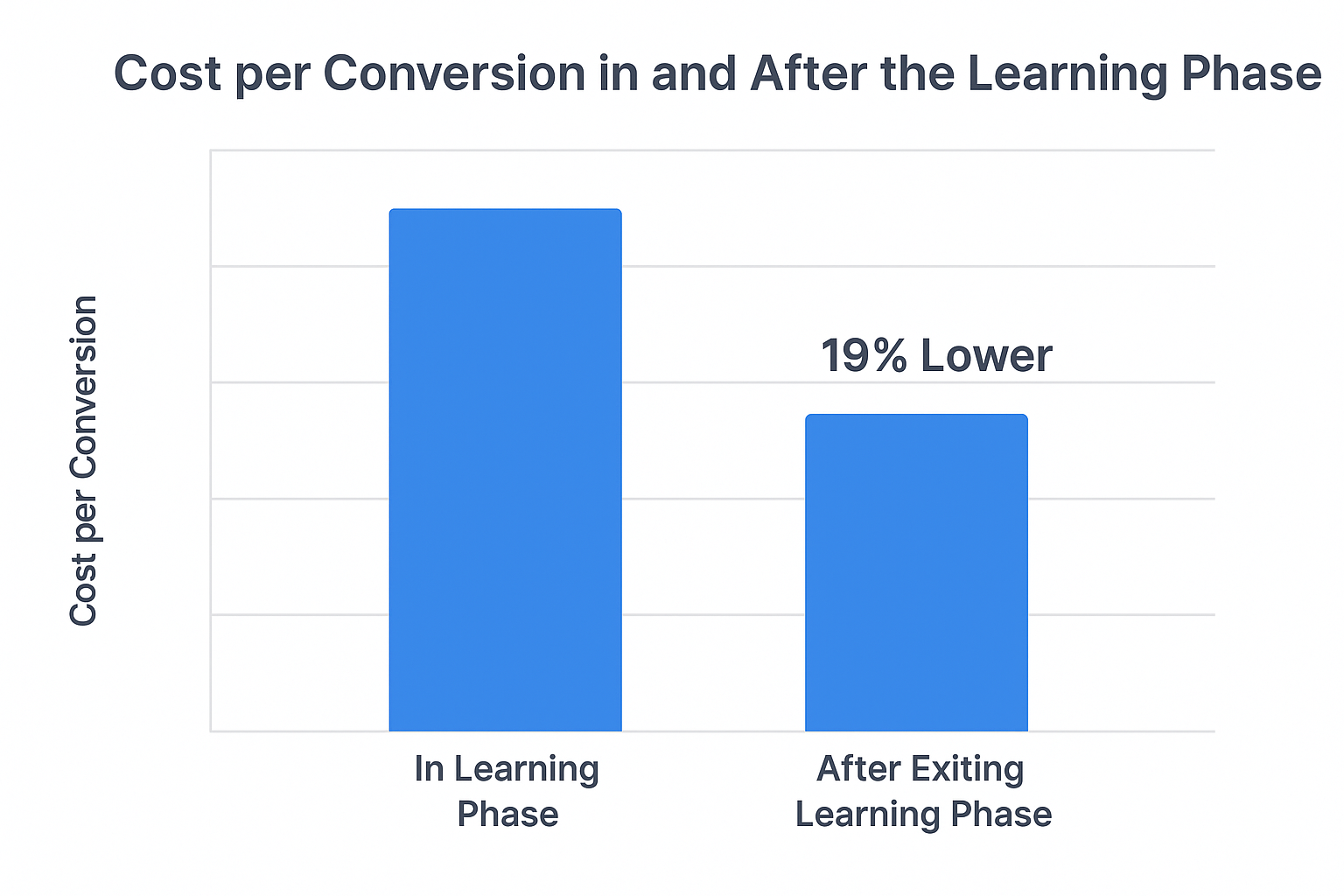
Comparison of Cost per Conversion for Ad Sets in Learning Phase vs. Post-Learning Phase
Industry benchmarks show that ad sets that successfully exit the learning phase can see cost per acquisition decrease by 15–30% compared to those that stay in learning. Stability also improves, making forecasting and scaling more predictable.
Understanding and respecting this phase allows advertisers to work with the algorithm rather than against it.
What Triggers the Learning Phase
Several actions can push an ad set back into learning:
-
Creating a new ad set or campaign
-
Changing the optimization event
-
Significant budget changes
-
Editing targeting, placements, or creative
-
Pausing and reactivating an ad set
Even small changes can accumulate and reset the learning process. Frequent edits are one of the most common reasons advertisers struggle to reach stable performance.
Budgeting to Exit Learning Faster
Budget plays a critical role in helping an ad set collect enough data. If the budget is too low to generate sufficient optimization events, the ad set may remain in learning indefinitely.
A common guideline is to set a daily budget that can realistically drive at least 50 conversion events per week. For example, if your average cost per conversion is $10, a daily budget of around $75 is often required to meet this threshold.
Data from large-scale ad accounts shows that underfunded ad sets are over twice as likely to remain in learning compared to properly budgeted ones.
Creative Strategy During Learning
Creative testing is essential, but it must be done thoughtfully. Launching too many creatives at once can fragment data and slow learning.
A more effective approach is to start with a small set of strong, differentiated creatives and allow each to gather enough impressions. Once the ad set exits learning, new creatives can be introduced gradually without destabilizing delivery.
Advertisers who limit initial creative variations to 3–5 per ad set often reach stable performance faster than those launching large creative batches.
Avoiding Common Learning Phase Mistakes
Many advertisers sabotage the learning phase by reacting too quickly. Common mistakes include:
-
Turning off ads after a day or two of weak performance
-
Making frequent small edits
-
Scaling budgets too aggressively
-
Changing optimization events prematurely
Performance during learning should be evaluated over several days, not hours. Short-term volatility does not indicate failure.
Scaling Without Resetting Learning
Once an ad set has exited learning, scaling should be done carefully. Gradual budget increases of 10–20% every 24–48 hours help maintain delivery stability.
Abrupt budget jumps can push the ad set back into learning, undoing the progress already made. Studies across performance marketing teams show that gradual scaling results in up to 25% better cost efficiency compared to aggressive scaling strategies.
Using Learning Phase Signals for Decision-Making
Even while ads are learning, valuable signals are available. Early indicators such as click-through rate, cost per click, and engagement quality can help identify promising creatives.
These signals should be used to prioritize testing and iteration, not to make immediate shutdown decisions. The goal is to guide the algorithm, not interrupt it.
Related Articles You May Find Useful
Final Thoughts
The Facebook Ads learning phase is not an obstacle to overcome but a process to manage intelligently. By budgeting correctly, limiting unnecessary changes, and allowing the algorithm time to learn, advertisers can achieve more consistent performance and lower acquisition costs over time.
Treat the learning phase as an investment in future efficiency, and it will work to your advantage rather than against you.