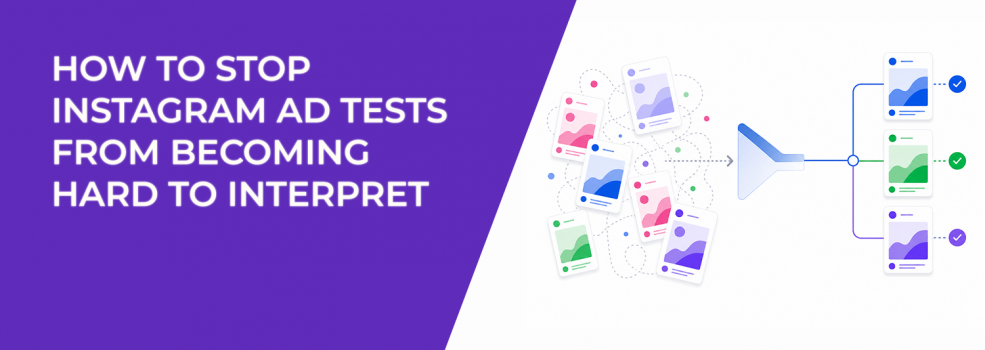
Instagram ad tests often become difficult to interpret before they completely fail.
The campaign still generates impressions, clicks, and conversions, but the reporting stops helping decision-making. Advertisers see changing metrics inside Ads Manager without understanding what actually caused the movement. One creative improves CTR while another lowers CPA, yet neither produces a clear optimization direction.
This usually happens because the testing structure itself creates noisy data.
Why messy Instagram test structures create confusing results
Many advertisers overload campaigns with too many moving parts at once.
They test different audiences, creative angles, funnel stages, and offers inside the same reporting environment. The account keeps generating data, but the signals start overlapping. At that point, performance interpretation becomes unreliable because several variables affect delivery simultaneously.
A common example looks like this:
- One ad set targets cold traffic while another mixes retargeting users.
- Several creatives use completely different hooks and value propositions.
- Budget allocation shifts daily because Meta keeps redistributing spend.
Now the advertiser cannot confidently explain whether performance changes came from:
- audience quality,
- creative strength,
- or delivery behavior.
This is why experienced teams build a repeatable testing process instead of restructuring campaigns every few days.
The hidden reason advertisers misread Instagram ad performance
Most advertisers react too quickly to isolated metrics.
A temporary CTR spike creates excitement. A short CPA increase triggers panic. But Instagram campaigns naturally fluctuate during learning because auction competition, placements, and user behavior shift constantly throughout the day.
This creates misleading short-term patterns. An ad may produce:
- strong CTR,
- low CPC,
- and high engagement,
while attracting low-intent users who never convert later. Another creative may look weaker initially but produce significantly better purchase quality after delivery stabilizes.
Without controlled comparison conditions, advertisers often scale the wrong creatives.
This becomes even more dangerous when audience quality differs between tests. A broader audience can inflate engagement metrics while lowering conversion intent, which distorts creative interpretation completely.
That is why many advertisers eventually rely on frameworks around creative testing without audience bias instead of comparing unstable traffic pools directly.
How to make Instagram ad tests easier to interpret
Readable testing depends more on structure than volume.
Most interpretation problems improve when advertisers simplify the testing environment and reduce overlapping variables. Cleaner systems produce cleaner reporting patterns because Meta receives more stable behavioral signals.
Strong advertisers usually follow several operational rules:
- Separate testing campaigns from scaling campaigns so budget shifts do not distort benchmarks.
- Keep naming conventions consistent across hooks, audiences, and funnel stages.
- Limit overlapping creative concepts that compete for the same engagement behavior.
- Compare stable time windows instead of reacting to hourly fluctuations.
These adjustments do not increase performance immediately, but they improve reporting clarity. Once advertisers trust the interpretation process, optimization decisions become much faster and safer.
This is also why disciplined advertisers rely on reliable A/B tests instead of chaotic creative rotation.
Why emotional optimization destroys test clarity
Instagram campaigns rarely behave linearly during the first days of delivery.
Meta continuously adjusts delivery patterns while evaluating engagement probability and conversion likelihood. Advertisers who constantly intervene during this period often create instability themselves.
A typical example happens after an ad generates strong CTR during the first 24 hours. The advertiser immediately increases budget, duplicates the ad set, and launches new variations before conversion patterns stabilize. Two days later CPA rises sharply because the campaign attracted curiosity clicks instead of qualified buyers.
The problem was not the creative itself. The advertiser simply interpreted incomplete data too early.
Strong media buyers protect stable comparison conditions long enough for meaningful patterns to emerge. They understand that reliable interpretation matters more than reacting quickly to every metric fluctuation.
Final takeaway
Instagram ad tests become difficult to interpret when campaigns generate too many overlapping signals at once.
Most reporting problems do not come from missing data. They come from unstable testing structures that mix audiences, creatives, budgets, and funnel stages together. Once advertisers simplify the testing environment, performance patterns become easier to trust and scale.
The advertisers who improve Instagram campaigns consistently are usually not reading more data.
They are creating cleaner data to read.