At some point, you’ll see a campaign with strong CTR, cheap CPC, and… no meaningful conversions.
The traffic looks promising on the surface. But once you check behavior — short sessions, weak scroll depth, poor retargeting performance — it becomes obvious: people are clicking out of curiosity, not intent.
You can usually recognize this pattern early through a few signals:
-
High CTR combined with weak conversion rates
→ The ad attracts attention, but the traffic doesn’t translate into action. -
Low engagement after the click
→ Users leave quickly or don’t interact meaningfully with the page. -
Retargeting audiences that don’t convert
→ Volume builds, but performance downstream remains weak. -
Stable or decreasing CPC alongside declining results
→ Efficiency improves on the surface while real outcomes deteriorate.
This is one of the most common hidden inefficiencies in Meta campaigns, and it often goes unnoticed because the top-level metrics look “good.”
What “Curiosity Clicks” Actually Mean in Practice
A curiosity click happens when someone engages with your ad because it sparks interest, not because they’re evaluating a solution.
You’ll usually notice a mismatch between engagement and outcome. For example, an ad might generate a 3% CTR, but the landing page converts at a fraction of your usual rate. In GA4 or similar tools, sessions from that campaign tend to drop off quickly, often within a few seconds.
This isn’t random traffic. It’s a specific type of user behavior — people who respond to stimuli (headlines, visuals, hooks), but aren’t aligned with your offer.
If you’ve seen campaigns where clicks look strong but sales don’t follow, the issue often overlaps with Why Clicks Don’t Equal Demand.
Meta doesn’t distinguish between those motivations. It simply learns from interaction patterns.
How Meta’s Algorithm Reinforces Curiosity Behavior
Meta’s system optimizes for the event you select. If that event sits too high in the funnel, the platform will aggressively find users who complete it most easily.
Clicks are one of the easiest actions to generate.
Once the campaign starts, early engagement data plays a disproportionate role. If a certain user cluster clicks frequently within the first delivery window, the system increases exposure to similar users in subsequent auctions. These users are often cheaper to reach and easier to win, which accelerates the bias.
At the same time, meaningful signals — purchases, qualified leads — come in later and at lower volume. That delay creates a gap between what the system learns quickly and what actually drives revenue.
Over time, the campaign drifts. It becomes highly efficient at generating interaction, but less effective at generating outcomes.
Why Performance Metrics Become Misleading
Curiosity clicks don’t just waste spend. They distort how you interpret performance.
You’ll often see campaigns where CTR improves and CPC drops, which suggests progress. But if you follow the data further down the funnel, conversion rates decline and CPA becomes volatile.
The system is optimizing correctly — just toward the wrong proxy.
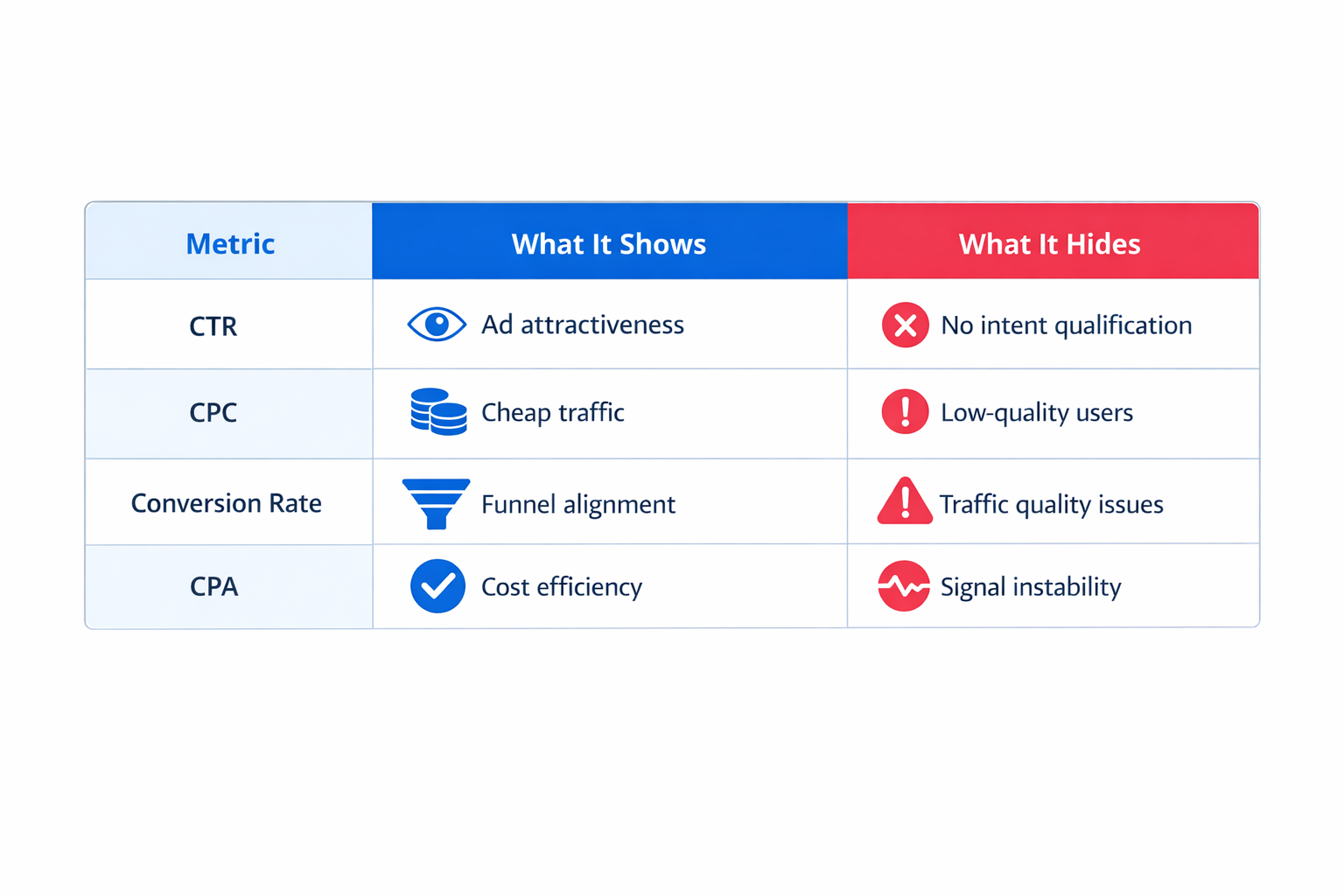
This connects directly to CTR vs Conversions: Why High CTR Doesn’t Always Mean More Sales.
This is why teams sometimes scale budgets during what looks like a strong phase, only to see performance collapse a few days later.
The Creative Patterns Behind Low-Intent Traffic
The issue usually starts at the creative level.
Certain ad structures attract attention without filtering for relevance. Vague hooks, broad problem statements, and visually intriguing but unclear creatives tend to pull in users who are simply curious.
The most damaging pattern is expectation mismatch. When someone clicks based on one interpretation of the ad and lands on something else, the drop-off is immediate.
If you want to go deeper into aligning messaging with intent, see How to Align Your Ads With Buyer Intent for Better Results.
How This Affects Optimization Over Time
Once curiosity-driven traffic enters the system, it doesn’t stay isolated.
It starts influencing how budget is allocated and which users are prioritized. The campaign identifies segments that click easily, shifts spend toward them, and gradually reduces exposure to users who are harder to engage but more likely to convert.
At that point, even strong conversion signals struggle to compete.
This is why campaigns sometimes feel “stuck.” The system is optimizing — just not toward revenue.
How to Diagnose the Problem Reliably
You don’t need complex modeling to identify curiosity-driven traffic. The signals are visible if you look at relationships between metrics instead of individual numbers.
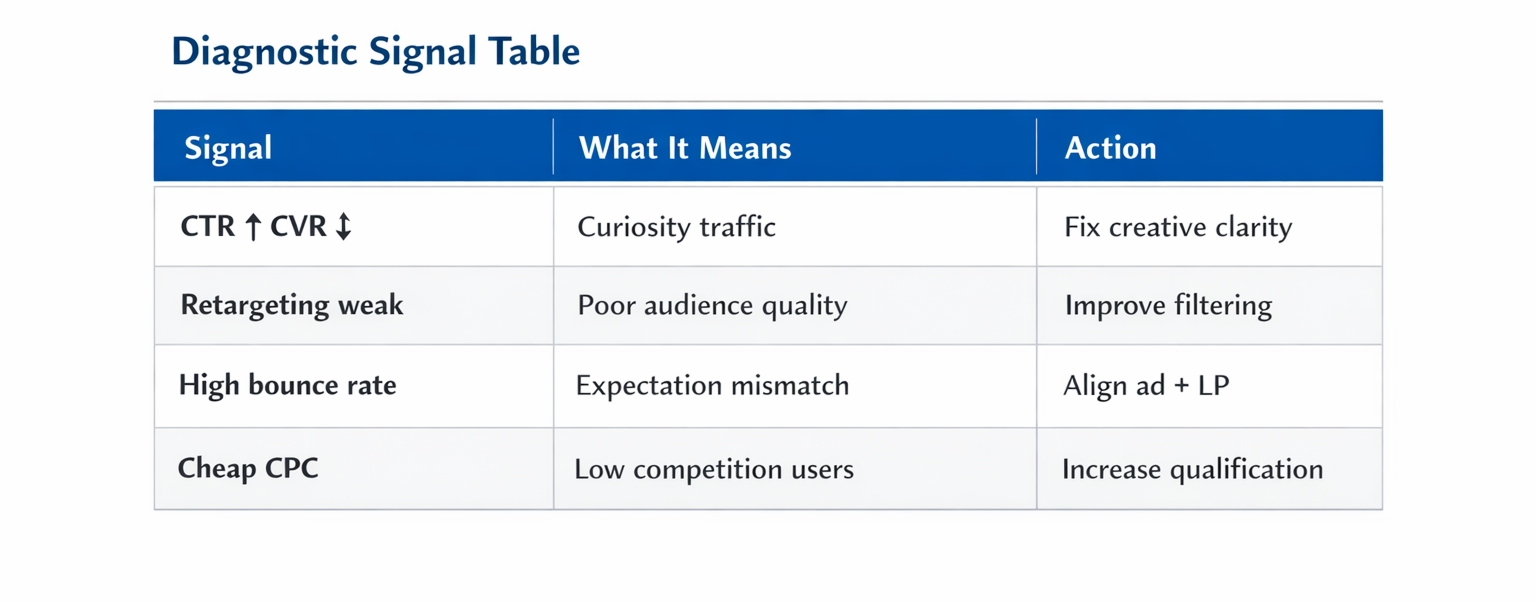
Focus on this:
-
CTR rising while conversion rate declines
→ This shows stronger attention capture but weaker intent alignment. -
Retargeting audiences growing without converting
→ Traffic volume increases, but the audience lacks buying signals. -
Clear performance gaps between creatives
→ Some ads generate cheap clicks but fail deeper in the funnel. -
Low engagement depth on landing pages
→ Users exit early instead of progressing toward conversion.
How to Reduce Curiosity Clicks Without Losing Scale
The goal is not to suppress clicks. It’s to make clicks more selective.
That means shaping expectations before the user ever lands on your site. When the ad communicates clearly, fewer people click — but the ones who do are more aligned.
To move in that direction:
-
Make the offer explicit early
→ Clearly define what you’re selling and who it’s for, so irrelevant users self-filter. -
Introduce controlled friction
→ Mention pricing context, use case, or commitment level to discourage low-intent clicks. -
Align ad messaging with the landing page
→ The transition should feel consistent, reducing confusion and drop-off. -
Optimize for deeper events when possible
→ Signals like qualified leads or purchases push the system toward intent-driven delivery.
You’ll also improve results by fixing what happens after the click, as explained here: Post-Click Optimization: Beyond the Ad.
A Structural Shift in Perspective
Clicks are not just traffic. They are training data.
Every click tells Meta what kind of user to find next. If those clicks come from curiosity, the system will scale that behavior — efficiently and consistently.
That’s why campaigns can look optimized while underperforming.
The adjustment is simple: treat clicks as a filtering mechanism, not a success metric.
Once that perspective changes, campaign performance starts aligning with actual business outcomes instead of surface-level efficiency.