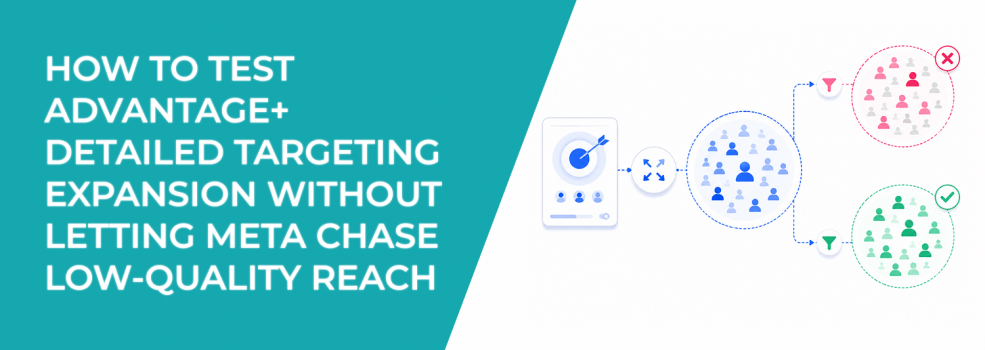
Advantage+ Detailed Targeting expansion can make a campaign look better before it actually becomes better. Meta gets more room to deliver. The campaign may reach more people. CPC may drop. Lead volume may rise.
That can look like progress. But the real question is simple: did expansion improve audience quality?
This is the core problem. Many advertisers turn on Advantage+ Detailed Targeting expansion and judge it by cheap activity. They look at lower CPC, lower CPL, or higher volume. They do not check whether the new reach brings qualified leads, purchases, booked calls, or real pipeline.
That is how Meta can start chasing low-quality reach.
Problem: Expansion Looks Successful When It Only Brings Cheaper Actions
Advantage+ Detailed Targeting allows Meta to move beyond the original audience setup. That can help when the campaign needs more room. Meta can enter more auctions and find more people likely to complete the selected conversion event.
But if the selected event is easy, expansion can move toward easy conversions.
A lead form submission may be easy. A landing page view may be easy. A click may be easy. These actions can increase without improving the quality of the people entering the funnel.
This is why the campaign can look better in Ads Manager but worse in the business. A service business may turn on expansion and see CPL drop from $42 to $29. At first, that looks like a clear win. But if fewer leads answer calls or match the offer, the lower CPL is misleading.
The campaign did not find better buyers. It found cheaper actions.
Solution: Define Audience Quality Before You Judge Expansion
Before testing expansion, decide what “better audience quality” means.
For lead generation, this may mean qualified leads, booked calls, show-up rate, sales conversations, or closed deals. For e-commerce, it may mean purchase rate, order value, repeat purchase rate, or profit after ad spend.
This keeps the test honest. If you do not define quality first, you may accept lower CPL as proof that expansion worked. That is risky because a cheaper lead can still be more expensive if it never turns into revenue.
Use one main quality metric.
Do not judge the test by ten numbers at once. Choose the metric that best connects the ad result to the business result. For lead gen, cost per qualified lead is usually stronger than CPL. For e-commerce, purchase ROAS or profit per purchase is usually stronger than add-to-cart volume.
That is why it helps to check lead quality before scaling spend when testing expanded delivery.
How To Run A Clean Expansion Test
The test should isolate expansion as much as possible.
Run one version with your original audience setup. Run another version with Advantage+ Detailed Targeting expansion. Keep the creative, offer, placement setup, budget, and conversion event as similar as possible.
Do not change everything at once. If you turn on expansion, launch new creatives, change the budget, and edit the offer, you will not know what caused the result. The test becomes noise.
A clean test should compare:
- Same offer.
- Same main creative angle.
- Same conversion event.
- Similar budget level.
- Same quality metric.
Then let the test collect enough data.
One good day does not prove expansion worked. One bad day does not prove it failed. Look for a stable pattern in quality, not just a quick drop in CPC. This is a better way to use Advantage+ Detailed Targeting more efficiently.
How To Read The Test Correctly
Read the test from the bottom of the funnel upward.
Start with the quality metric you chose. Did cost per qualified lead improve? Did purchase ROAS hold? Did booked calls increase without weaker show-up rates?
Then look at the surface metrics.
If CPC dropped and qualified CPA also improved, expansion is probably helping. If CPC dropped but qualified CPA got worse, expansion is likely chasing cheaper low-intent users.
This is the difference advertisers often miss. Lower traffic cost is only useful when the traffic still has enough intent. Higher volume is only useful when quality holds.
For example, a campaign may bring 40% more leads after expansion. But if qualified lead rate drops by half, the business may end up paying more for every useful lead.
That is not a scaling win.
When To Keep Expansion On
Keep Advantage+ Detailed Targeting expansion when the quality metric improves or stays stable while volume grows.
That means Meta is not just finding cheaper reach. It is finding more people who can become useful business outcomes.
For a lead campaign, expansion is worth keeping if more leads still become qualified conversations. For an e-commerce campaign, it is worth keeping if more purchases come in without damaging ROAS or margin.
The front-end metrics do not need to be perfect.
CPC may rise slightly if the new buyers are stronger. CPL may stay flat while booked calls improve. CPM may increase if Meta is entering more competitive auctions for better users.
That can still be a good result. Judge expansion by business quality first.
When To Turn Expansion Off Or Retest It
Turn expansion off, or retest it, when Ads Manager improves but quality drops. The warning sign is simple: more activity, weaker outcomes.
CPL drops, but sales rejects more leads. Clicks rise, but purchases do not follow. Demo requests increase, but fewer people attend or qualify.
That means Meta may be following the easiest conversion path, not the best buyer path. Do not scale that result just because the dashboard looks more efficient.
Pause the expanded version, review the conversion event, and check whether the campaign is giving Meta a strong enough success signal. If the event is too soft, expansion may keep finding soft conversions.
This is also where it helps to tell if AI ad optimization is actually working, because automation should be judged by useful outcomes, not activity.
Final Takeaway
The problem is not Advantage+ Detailed Targeting expansion itself. The problem is turning it on and judging success by cheap activity instead of audience quality.
Expansion is useful when it brings more qualified leads, buyers, booked calls, purchases, or pipeline at a cost the business can accept. It is risky when it only lowers CPC, lowers CPL, or increases volume while quality drops.
Test expansion before scaling it. Keep it when quality holds. Pull back when Meta only finds cheaper low-intent reach.