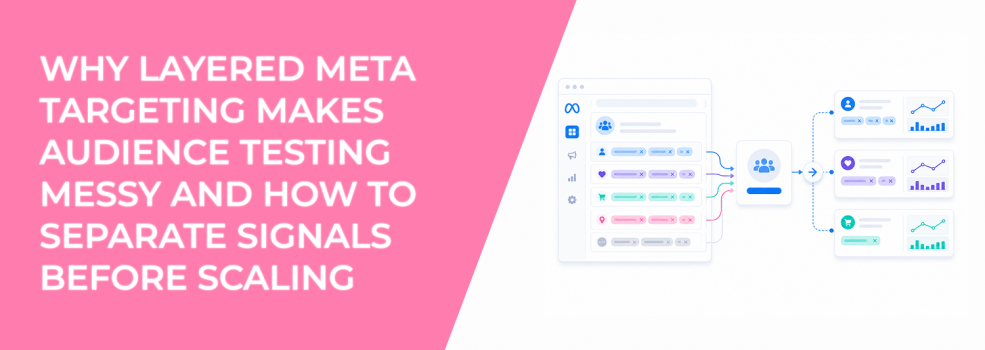
Layered targeting can make a Meta campaign look more controlled than it really is.
You add one audience layer, then another. You narrow delivery with extra filters. You add exclusions to avoid waste. The setup feels more precise.
Then the campaign starts running, and the results are hard to explain.
CPA rises, but you do not know which layer caused it. Lead quality improves, but you cannot tell which signal helped. Volume drops, but it is unclear whether the audience is too small, too restricted, or simply too mixed.
That is the core problem: stacked targeting layers make audience testing harder to diagnose.
Why Stacked Targeting Layers Make Test Results Hard To Read
A clean audience test should answer one question. Did this audience signal improve performance or not?
Layered targeting makes that question messy. When several audience rules are active at the same time, each result comes from the combined setup. You cannot clearly see which part helped and which part hurt.
This is common when advertisers add layers too quickly.
They may combine a customer profile, a behavior assumption, a location limit, exclusions, and an Advantage+ expansion setting in one ad set. If performance changes, the test does not give a clear answer.
Meta may still deliver. Ads Manager may still show conversions. But the learning is weak because the signal is mixed. The campaign gives you results, but not clean information.
How Layered Targeting Hurts Campaign Decisions
Messy targeting leads to messy decisions.
If CPA is high, you may remove the wrong layer. If volume is low, you may increase budget instead of fixing the audience. If lead quality is poor, you may blame creative when the real issue is the audience mix.
This slows optimization. For example, a B2B advertiser might combine job-related assumptions, company-size assumptions, location limits, and several exclusions in one test. The campaign gets a few leads, but they are inconsistent. Some look qualified. Others are clearly wrong.
The team cannot tell whether the useful leads came from one strong signal or from random delivery inside a crowded setup.
So the next decision becomes guesswork. That is why it helps to use audience layering without confusing test results instead of stacking controls before you know what each one does.
How To Separate Audience Signals Before Scaling
Start with one main audience signal.
That signal should be the thing you want to test. It may be a buyer situation, a customer segment, a warm audience source, a location group, or another clear targeting idea.
Keep the first test simple enough to read.
Do not add extra layers just because they seem logical. Every added condition makes the result harder to understand. If the test works, you need to know why it worked. If it fails, you need to know what failed.
A cleaner setup can look like this:
- Test one main audience idea at a time.
- Keep the same offer and creative across the test.
- Avoid adding new exclusions unless they are necessary.
- Compare results using the same conversion event.
This does not mean the final campaign must stay simple forever. It means the testing stage should stay simple until you know which signal is worth scaling.
How To Read A Clean Audience Test
A clean test should show whether one audience signal improves the result.
Do not judge only by CPC or CTR. Those metrics can be useful, but they do not tell the full story. A targeting signal can bring cheap clicks and still bring weak buyers.
Look at the metrics that match the campaign goal.
For lead generation, check cost per qualified lead, booked calls, sales conversations, and lead-to-sale rate. For e-commerce, check purchase rate, CPA, ROAS, average order value, and repeat purchase behavior.
The key question is simple. Did this audience signal improve the business outcome?
If yes, keep testing around it. If not, remove it or test a different signal. This is where it helps to read the right metrics when testing new audiences.
How Advantage+ Detailed Targeting Fits Into A Clean Test
Advantage+ Detailed Targeting can add another layer of complexity.
It gives Meta more room to move beyond the original setup. That can help delivery, but it also makes the test harder to read if you turn it on too early.
If you are testing a specific audience signal, first check how that signal performs on its own. Then test expansion separately.
Otherwise, you will not know whether performance came from the original audience or from Meta’s expanded delivery.
A simple test order works better:
- First, test the main audience signal.
- Then test the same setup with Advantage+ Detailed Targeting expansion.
- After that, compare qualified outcomes, not only reach or CPC.
This gives you a cleaner answer. Expansion may still be useful. But it should be tested as its own variable, not hidden inside a crowded ad set.
How To Scale Only The Signals That Prove They Work
Scaling should come after the signal is clear.
If one audience signal produces qualified leads or profitable purchases, you can give Meta more room around that signal. If the result only looks good because several layers are mixed together, scaling becomes risky.
You may increase budget and see performance break because the real winning signal was smaller than you thought.
Before scaling, ask:
- Which audience signal produced the useful result?
- Which metric proves it helped?
- Did quality hold after the click?
- Can Meta get more volume from this signal without too many restrictions?
If you cannot answer those questions, the test is not ready to scale. It needs cleaner separation first. For campaign testing, it is useful to structure reliable paid traffic tests before spending more budget.
Final Takeaway
Layered Meta targeting is not always wrong. The problem is stacking too many layers before you know which signal actually matters. That makes performance harder to diagnose and scaling harder to trust.
Test one audience signal at a time. Keep the setup simple enough to read. Add Advantage+ expansion only after you understand the starting signal.
Clean testing gives you better decisions. Messy targeting only gives you more numbers to argue about.