Ad platforms reward relevance. When your creatives reflect what your audience is responding to right now, performance improves across the funnel. Delays in creative iteration often mean:
-
Wasted spend on fatigued ads
-
Missed momentum after a strong signal appears
-
Slower learning cycles
According to industry benchmarks, ad creatives typically lose 20–30% of their click-through rate after the first 10–14 days of exposure. Teams that refresh creatives weekly maintain significantly more stable performance than those updating monthly.
Turning Raw Data into Actionable Insights
Insights are only valuable when they are specific enough to guide creative decisions. Instead of reviewing dashboards at a high level, focus on patterns that directly inform what to change.
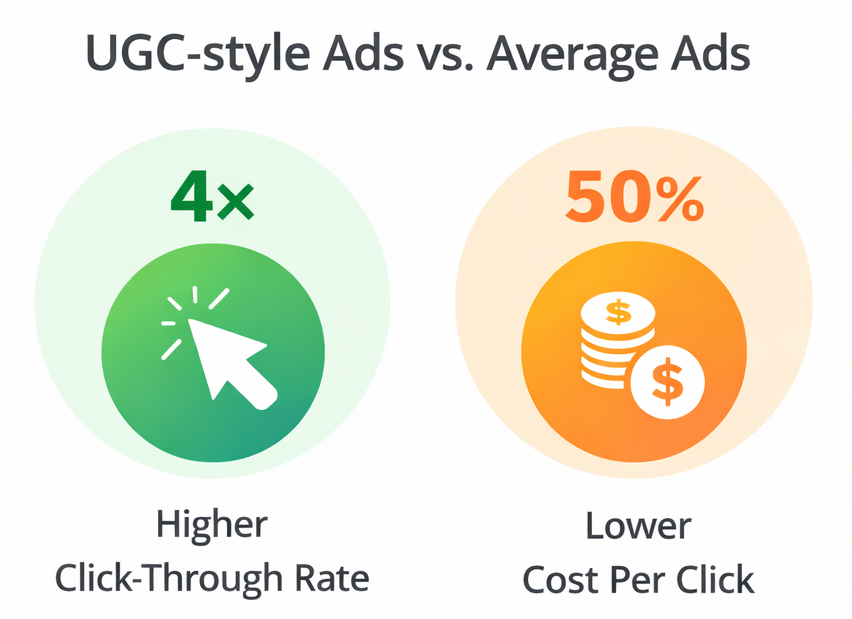
Comparison of click-through rate uplift and cost per click reduction for UGC-style ads versus average ads
Key insight categories to prioritize:
-
Audience signals: Which segments convert at a higher rate or lower cost
-
Message resonance: Hooks, value propositions, or offers that drive above-average engagement
-
Format performance: Static vs. video, short vs. long copy, UGC-style vs. polished ads
Campaign analyses show that ads aligned with high-performing audience segments can achieve up to 40% higher conversion rates compared to creatives built on generic assumptions.
A Faster Creative Feedback Loop
To move faster, creative and performance teams need a shared system. A simple but effective loop looks like this:
-
Detect the signal — Identify statistically meaningful performance changes (not noise).
-
Translate the insight — Convert numbers into a clear creative hypothesis (e.g., “Benefit-driven hooks outperform discount-focused hooks for this segment”).
-
Produce variations — Create multiple lightweight variations instead of one “perfect” ad.
-
Test immediately — Launch small tests to validate the hypothesis.
-
Scale what works — Only invest production time once performance is proven.
Brands using structured creative testing frameworks report up to 2× faster learning cycles and 25% lower cost per acquisition over time.
Designing Creatives for Rapid Production
Speed is not only a process issue; it’s a design decision.
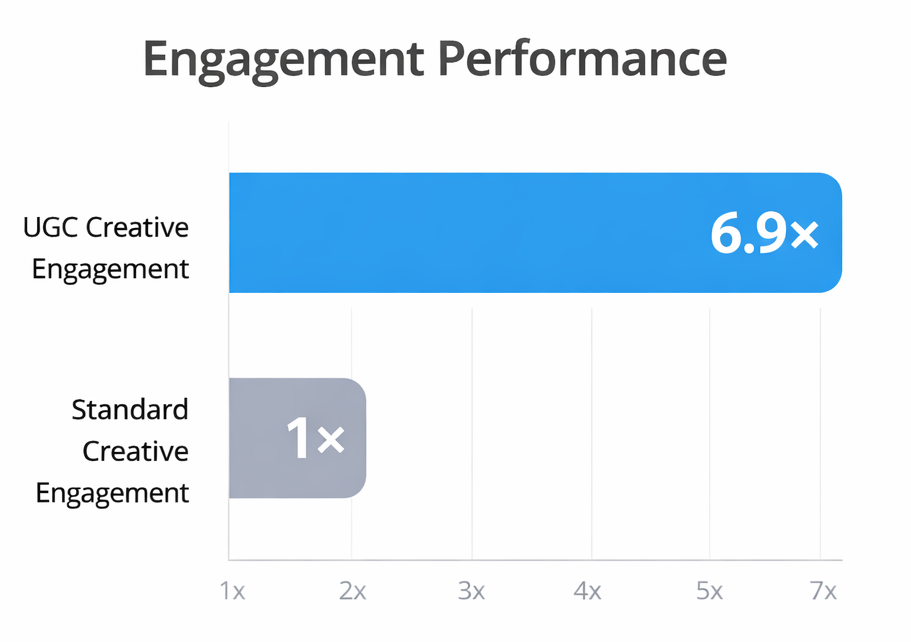
Engagement performance of user-generated creatives compared with standard ad formats
To enable faster turnaround:
-
Build modular templates for headlines, visuals, and CTAs
-
Reuse proven creative elements across multiple variations
-
Prioritize clarity over polish in early tests
Data from paid social campaigns shows that simplified creatives often outperform highly produced ones, with UGC-style ads generating 3–4× higher engagement rates in many verticals.
Aligning Teams Around Insights
One of the biggest bottlenecks is misalignment between analysts, marketers, and designers. The fastest teams share insights in a format creatives can immediately use.
Effective insight briefs include:
-
The exact audience segment
-
The performance metric that triggered the insight
-
A clear creative direction (what to emphasize or remove)
When insight sharing is standardized, teams reduce back-and-forth and cut creative turnaround time by as much as 35%.
Measuring Creative Velocity
Faster creative output should still be measured and optimized.
Key metrics to track:
-
Time from insight discovery to live creative
-
Number of creative variations tested per month
-
Performance lift from new creatives vs. old ones
High-performing teams typically test 3–5× more creatives per month than average advertisers, giving them a consistent competitive edge.
Suggested Reading
If you want to go deeper into improving performance through better targeting and testing, these articles may also be useful:
Final Thoughts
Turning insights into new creatives faster is not about working harder—it’s about building systems that remove friction. When insights are clear, feedback loops are tight, and production is modular, speed becomes a natural advantage. In competitive ad environments, that advantage often makes the difference between plateauing and scaling.