Many marketers believe successful optimization requires massive volumes of historical data. In reality, early-stage campaigns, new products, and niche markets rarely have that luxury. The key is not more data, but better decision-making frameworks that extract meaningful signals from limited inputs.
According to industry benchmarks, nearly 60% of new advertising campaigns operate with fewer than 100 conversions in their first month, yet those that apply structured optimization methods outperform reactive campaigns by up to 35% in cost efficiency.
This article explores how to optimize campaigns effectively when data is scarce, focusing on prioritization, signal amplification, and disciplined testing.
1. Start With Fewer Variables
When data is limited, complexity becomes your enemy. Each additional variable—audience segments, creatives, placements—dilutes the learning signal.
Best practices:
-
Limit initial campaigns to one audience hypothesis per ad set
-
Use 2–3 creatives max instead of dozens
-
Keep placements consolidated unless there is a strong reason to split
Platforms require sufficient volume to exit the learning phase. Studies show that ad sets with fewer than 5 variables reach statistical confidence up to 42% faster than heavily segmented ones.
2. Optimize for Micro-Conversions First
Waiting for purchase data can stall optimization for weeks. Instead, use early engagement signals as directional indicators.
High-signal micro-conversions include:
-
Landing page views
-
Content scroll depth
-
Time on site exceeding 30 seconds
-
Add-to-cart or form start events
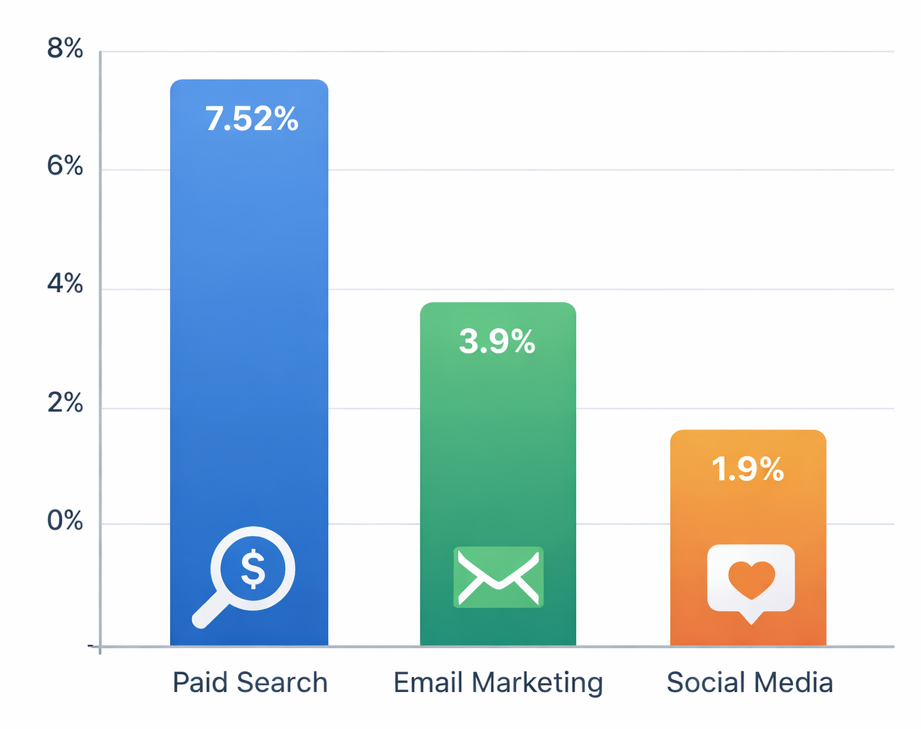
Comparison of average conversion rates across key marketing channels
Campaigns optimized on early engagement metrics see up to 2.1× faster stabilization than those waiting exclusively for final conversion data.
The goal is not to replace purchase optimization, but to bridge the learning gap until enough hard conversions accumulate.
3. Use Controlled Budget Scaling
Aggressive budget changes distort learning when data is limited. Small, consistent adjustments preserve signal integrity.
Recommended approach:
-
Increase budgets by no more than 15–20% every 48–72 hours
-
Avoid duplicating ad sets prematurely
-
Let performance stabilize before interpreting trends
Data from paid media audits shows that campaigns with gradual scaling experience 28% lower volatility in CPA compared to campaigns with sudden budget spikes.
4. Aggregate Data Intelligently
While splitting data reduces clarity, intelligent aggregation strengthens insights.
Tactics include:
-
Consolidating similar audiences into a single ad set
-
Grouping creatives by message angle instead of format
-
Analyzing performance over rolling 7-day windows instead of daily snapshots
Marketers using aggregated analysis models report 31% higher confidence in optimization decisions during low-volume periods.
5. Run Fewer, Better Experiments
Limited data means every test must count. Replace broad experimentation with focused hypotheses.
A strong test framework:
-
One clear hypothesis per test
-
One variable changed at a time
-
Minimum 7-day test duration
Even with small datasets, structured testing improves outcomes. Research indicates that hypothesis-driven tests outperform exploratory tests by 24% in measurable lift.
6. Extend Learnings Across Channels
If one channel lacks data, borrow insights from others.
Examples:
-
Use high-performing messaging from email campaigns in paid ads
-
Apply organic content engagement trends to ad creative direction
-
Mirror landing pages that convert well in direct traffic
Cross-channel insight reuse can reduce early-stage CPA by up to 19%, according to multi-channel performance studies.
Common Mistakes to Avoid
-
Making decisions based on single-day performance
-
Pausing campaigns too early
-
Over-segmenting audiences
-
Chasing platform-recommended changes without context
These mistakes are responsible for an estimated 40% of underperforming low-data campaigns.
Recommended Articles
To deepen your understanding of campaign optimization and audience strategy, explore these related articles:
Final Thoughts
Limited data does not mean limited performance. With disciplined structures, focused testing, and intelligent signal interpretation, marketers can build efficient, scalable campaigns from day one.
Optimization is not about reacting faster—it is about deciding better, even when information is incomplete.