Advertisers often feel pressure to make daily tweaks — especially when early results look weak or unclear. But Facebook and Instagram ads need time to stabilize before they reveal their true potential.
Making edits too early doesn’t just slow down learning — it can quietly kill campaigns that were on the verge of working.
This guide explains when to leave ads alone, how to read early signals correctly, and why restraint often leads to better results.
Let the Algorithm Do Its Job First
When you launch a new Facebook or Instagram campaign, it enters the Learning Phase. The system needs time and volume to figure out who to show your ad to — and how to do it efficiently.
If you want to understand this stage in more depth, read: How to Use the Facebook Ads Learning Phase to Your Advantage.
Avoid making any changes during this phase if:
-
The campaign has run for fewer than 7 days;
-
The ad set has received fewer than 50 conversion events (e.g. leads, purchases, registrations);
-
You're seeing gradual improvement in cost per result, CTR, or conversion rate — even if it’s still unprofitable.
These are not ideal times to interfere. Instead, wait until performance stabilizes.
What counts as a "change"?
-
Editing copy, creative, or headlines;
-
Shifting the budget (even small increases);
-
Changing optimization event (like “Add to Cart” → “Purchase”);
-
Switching placements or targeting;
-
Pausing and unpausing ad sets.
Example: If you launch a lead generation campaign targeting cold audiences with a $50/day budget, and get only 7 leads in the first 3 days — don’t panic. Wait for at least 50 leads or 7–10 full days before reviewing or editing.
Match the Run Time to the Campaign Type
Not every campaign deserves the same timeline. Judging too quickly — especially based on objective or funnel stage — leads to misleading conclusions.
For conversion campaigns
Give these at least 7–10 days or 50 conversions before judging.
Example: If you're running a “Free Trial” sign-up campaign for a SaaS product, wait until 50 people sign up. Early data might show high cost per trial, but Meta’s delivery often improves after more events are recorded.
For traffic or engagement campaigns
These can be evaluated after 3–5 days, assuming you're spending consistently.
Example: You promote a blog post for $30/day to warm audiences. If CTR is improving and bounce rate is low after 3–4 days, you can start optimizing or testing new angles.
When You Should Leave an Ad Completely Alone
Intervening too soon breaks the system's momentum. There are situations when staying hands-off is not just safe — it’s the smarter move.
Let your ad keep running untouched if:
-
CPM is flat or improving, and you're gaining reach steadily;
-
CTR is rising slowly, even by 0.1% per day;
-
You haven’t spent more than 1.5x your target CPA yet;
-
Frequency is under 2.5, meaning most users are still seeing the ad for the first time.
Example: A $20/day ad gets 2 purchases per day with a $12 CPA goal. Even if it's slightly above target on Day 3 ($15 CPA), you should wait — small increases in performance can make it profitable by Day 6.
If you’re unsure what actually counts as a red flag, this guide breaks it down: How to Spot Early Warning Signs of Underperforming Facebook Ads.
Expert Mistakes That Ruin Good Ads
Some of the worst outcomes happen not because the ad was bad but because the marketer judged it too early.
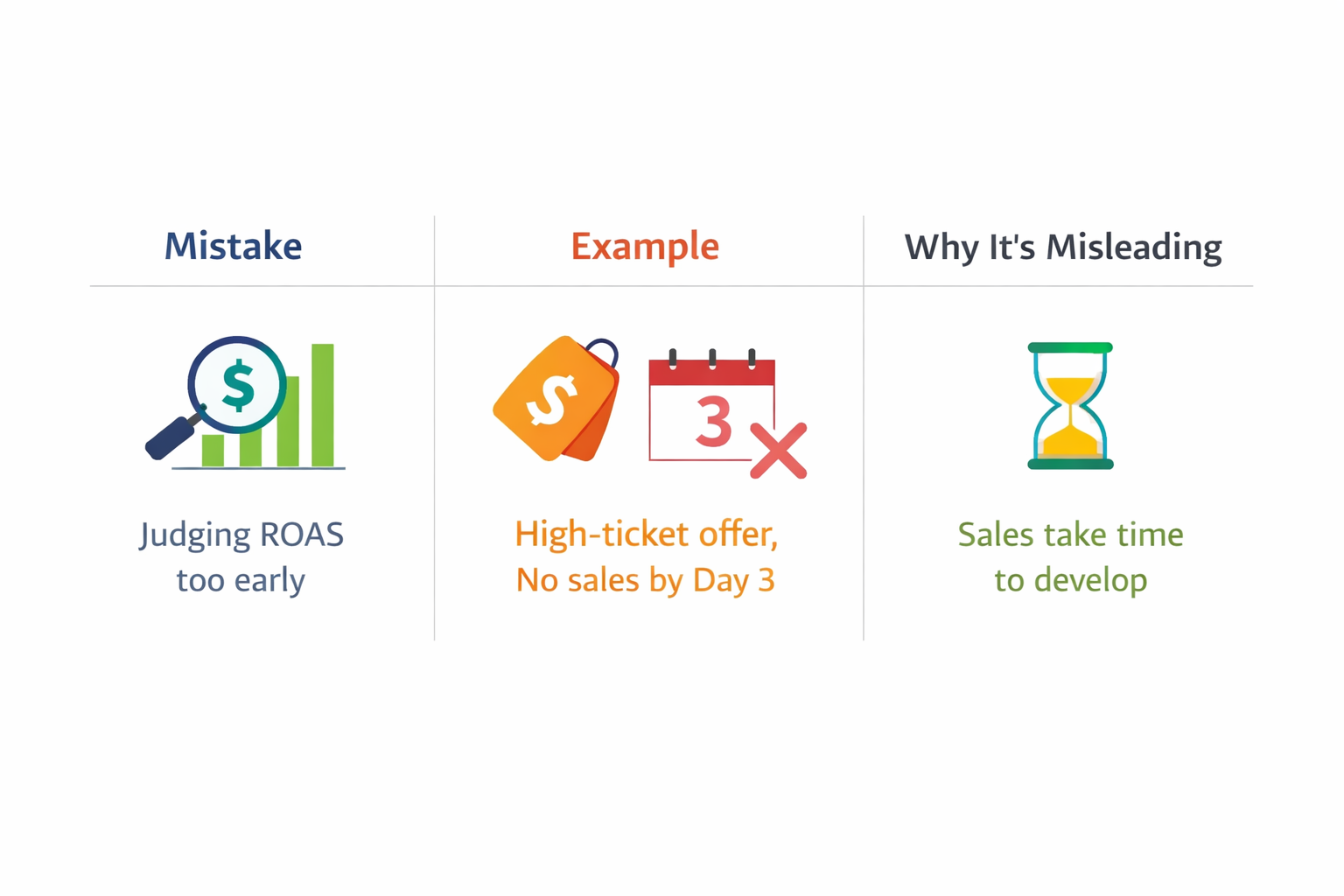
Mistake 1: Evaluating ROAS too early
If you sell high-ticket services (like $500+ coaching programs), most conversions won’t happen on Day 1. ROAS will look negative for days. Instead of reacting to low initial numbers, track cost per lead and calendar bookings.
Example: You’re running a $100/day campaign for a $1,200 course. Day 3 shows no sales. Instead of panicking, check lead quality or booking rates — and keep running it until you pass the breakeven point.
Mistake 2: Editing ads just to stay busy
Daily tweaks feel productive, but Meta needs time to optimize. Changing audiences or creatives without strong justification slows delivery and inflates CPM.
Example: You change the image in your ad because performance dipped for one day. The result? The ad restarts the learning phase, and results drop even further.
Mistake 3: Making decisions on weak data
It’s tempting to analyze early results, but small sample sizes don’t tell the truth. Wait for statistically meaningful data — at least 30–50 events.
Example: An ad gets 12 clicks on a $15 budget. One of those clicks bounced. That doesn’t mean your landing page is broken — it means you don’t have enough data yet.
When an Ad Is Working — Just Let It Work
If you have an ad that performs reliably, resist the urge to touch it. These ads may not look flashy, but they deliver.
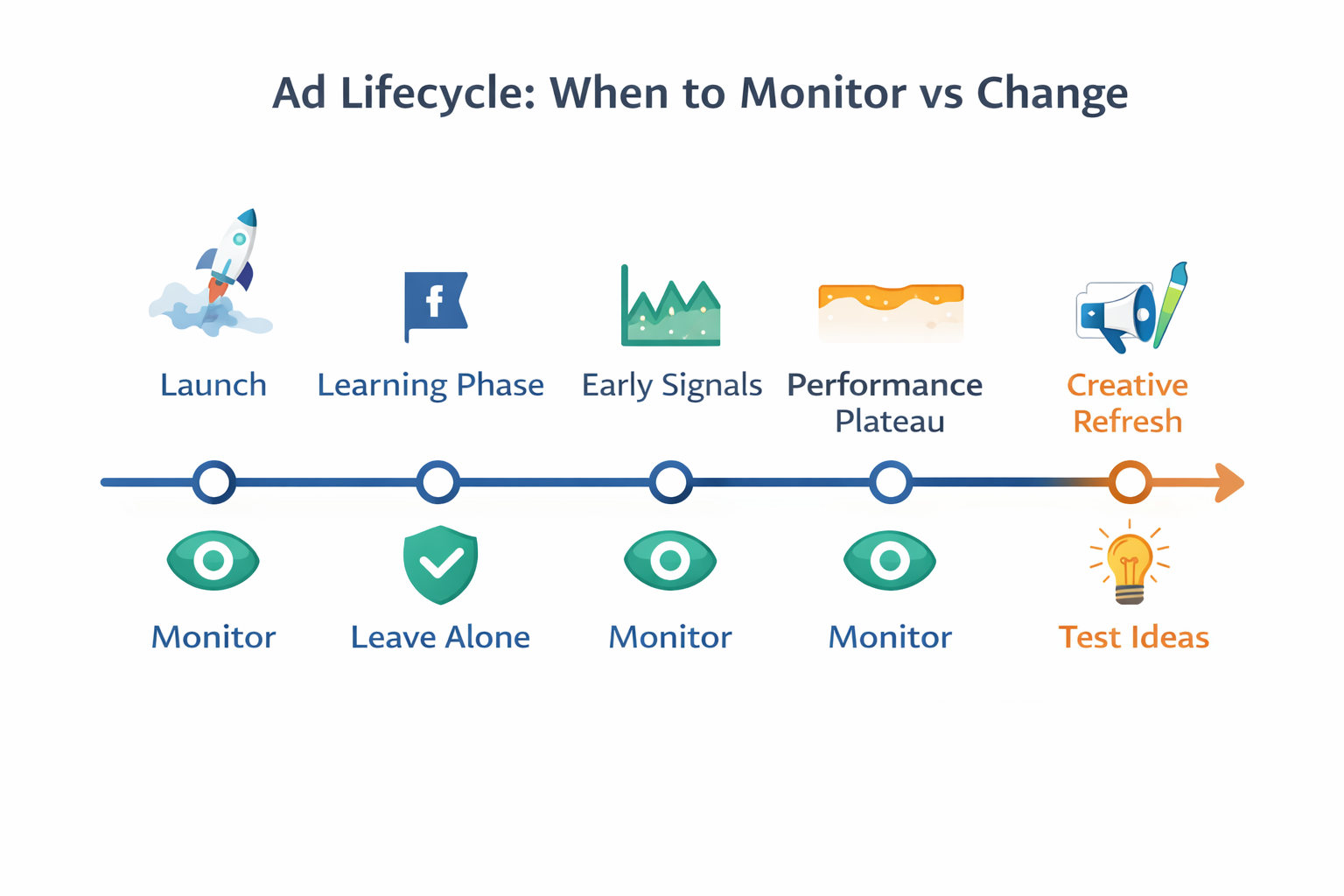
Leave your ad running if:
-
It consistently hits your cost per result;
-
It beats other variants you've tested in the same campaign;
-
Ad fatigue is low (frequency under 3, quality ranking still average or above);
-
You're scaling budget gradually and performance stays steady.
Example: One ad creative consistently brings in leads at $4.80 each, below your $6 target. You tested 3 other versions that couldn’t beat $7.20. Keep the winning one live — even if it’s been running for 3 weeks.
If performance starts to dip later, this is a helpful read: Why Facebook Ads Performance Declines Over Time (and How to Prevent It).
How to Track Ads Without Disrupting Them
Monitoring performance is different from reacting to it. You should always review your data — but not all changes need action.
What to monitor while staying hands-off:
-
3-day CTR average — this shows short-term trend better than single-day spikes;
-
Conversion volume — not just cost per result, but actual completed events;
-
CPM trend — if it's stable or decreasing, delivery is healthy;
-
Frequency growth — if it jumps too fast, ad fatigue may be coming;
-
Quality ranking — watch for drops below “Average” (this can hurt reach).
Example: Your ad has a 1.4% CTR on Day 1, 1.6% on Day 3, and 1.8% on Day 5. The upward trend means Meta is finding better users — don't interfere.
Final Takeaway: Small Changes Can Break Big Momentum
Leaving your ads untouched isn’t laziness — it’s discipline. Every campaign goes through early turbulence. The best results come from campaigns that are allowed to mature.
By holding steady, you give Meta’s algorithm the space to optimize. Many campaigns that start slow end up delivering the most efficient returns — if they’re not interrupted too soon.
If the campaign does require changes, make sure you're doing it for the right reasons: When to Pause, Kill, or Scale an Ad Set.
The key is knowing the difference between an ad that needs help and one that simply needs time.