Paid social advertising delivers reach, precision targeting, and scalable traffic. Marketing automation delivers structured nurturing, behavioral tracking, and measurable pipeline impact. When these two systems operate in isolation, performance gaps emerge: leads go cold, targeting becomes static, and attribution remains incomplete.
Integrating marketing automation with paid social transforms campaigns from isolated acquisition efforts into full-funnel revenue engines. Instead of optimizing solely for clicks or form fills, teams can optimize for pipeline contribution and customer lifetime value.
Why Integration Matters
The modern buyer journey is nonlinear. Research shows that:
-
76% of consumers expect personalized interactions from brands.
-
Companies using advanced personalization generate 40% more revenue from those activities than average competitors.
-
Organizations that automate lead management see a 10% or greater increase in revenue within 6–9 months.
-
Nurtured leads make 47% larger purchases than non-nurtured leads.
Paid social campaigns generate engagement and conversions at scale, but without automation:
-
Follow-ups are delayed.
-
Messaging lacks behavioral context.
-
Sales teams receive unqualified or poorly scored leads.
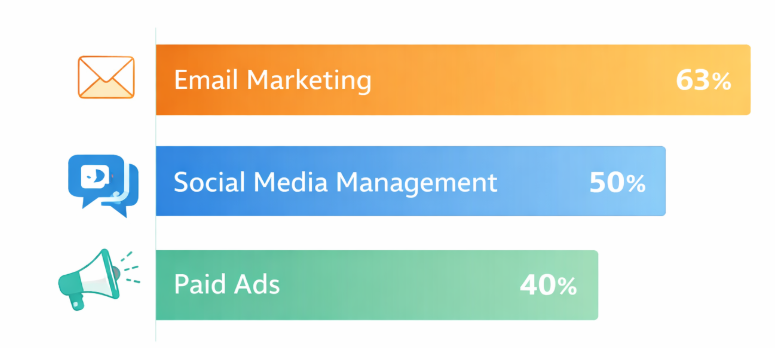
Return on investment and lead growth reported by companies using marketing automation
Integration closes these gaps by syncing audience data, engagement signals, and lifecycle stages.
Core Benefits of Connecting Automation and Paid Social
1. Smarter Audience Segmentation
Automation platforms collect behavioral data such as email engagement, website visits, content downloads, and CRM activity. Syncing this data with paid social platforms enables:
-
Retargeting based on lifecycle stage
-
Exclusion of converted customers
-
Upsell and cross-sell campaigns
-
High-value lookalike audience creation
This reduces wasted spend and improves relevance.
2. Automated Lead Nurturing After Ad Conversion
Paid social often captures top-of-funnel leads. Automation ensures immediate:
-
Welcome sequences
-
Educational drip campaigns
-
Behavioral triggers
-
Sales notifications based on scoring thresholds
Speed matters. Studies indicate that responding to a lead within the first five minutes makes conversion up to 9x more likely compared to slower follow-ups.
3. Closed-Loop Attribution
Without integration, paid social reporting ends at the platform level. Automation allows teams to track:
-
Campaign influence on pipeline
-
Multi-touch attribution paths
-
Revenue by audience segment
-
Customer acquisition cost by lifecycle stage
This enables budget allocation based on revenue contribution rather than surface metrics like CTR.
4. Lead Scoring and Budget Optimization
When automation scores leads based on behavioral depth and firmographic data, paid campaigns can prioritize:
-
High-intent audiences
-
Specific industries or roles
-
Accounts showing buying signals
As a result, ad spend shifts toward segments statistically more likely to convert.
Implementation Framework
To effectively integrate marketing automation with paid social, follow this structured approach.
Step 1: Align Lifecycle Definitions
Ensure marketing and sales agree on definitions for:
-
Marketing Qualified Lead (MQL)
-
Sales Qualified Lead (SQL)
-
Opportunity
-
Customer
Automation rules and paid retargeting audiences must reflect these shared definitions.
Step 2: Sync Audience Data
Connect automation lists with paid social platforms to enable:
-
Dynamic retargeting
-
Suppression lists
-
Stage-based messaging
-
Sequential advertising
Data hygiene is critical. Regularly audit syncing accuracy and list refresh frequency.
Step 3: Build Behavioral Triggers
Develop automation workflows triggered by:
-
Ad form submissions
-
Ad engagement without conversion
-
Landing page revisit behavior
-
Content downloads originating from paid traffic
These workflows should adapt messaging depth according to user behavior.
Step 4: Implement Revenue-Based Reporting
Move beyond cost-per-lead reporting. Instead, measure:
-
Cost per opportunity
-
Cost per closed deal
-
Pipeline value generated by campaign
-
Customer lifetime value by acquisition source
Organizations that align marketing metrics with revenue are 1.6x more likely to report higher marketing effectiveness.
Common Mistakes to Avoid
-
Optimizing ads for low-quality leads without downstream scoring.
-
Failing to exclude existing customers from acquisition campaigns.
-
Over-segmenting audiences without sufficient volume.
-
Ignoring CRM feedback loops when refining targeting.
Integration is not just technical; it requires operational alignment across teams.
Example Scenario
Consider a B2B company running paid social campaigns targeting decision-makers. After integrating automation:
-
Retargeting focused only on leads with repeated site visits.
-
Automated nurturing educated prospects over a 14-day sequence.
-
Sales alerts triggered once engagement scores exceeded thresholds.
Within one quarter, the company reduced cost per opportunity by 28% and increased marketing-sourced pipeline by 35%, while maintaining the same ad budget.
Conclusion
Integrating marketing automation with paid social is no longer optional for performance-driven teams. It elevates advertising from isolated acquisition tactics to measurable revenue systems.
By connecting audience intelligence, behavioral triggers, and lifecycle reporting, organizations achieve higher conversion rates, improved budget efficiency, and clearer attribution across the buyer journey.
The competitive advantage lies not in running more ads, but in orchestrating smarter systems.
Recommended Reading
To deepen your strategy, explore these additional resources: