Landing pages remain one of the most critical conversion points in digital marketing. According to industry benchmarks, the average landing page conversion rate across all industries is around 9–10%, while top-performing pages exceed 20%. This gap is rarely caused by traffic quality alone. In most cases, conversion losses come from unclear messaging, friction-heavy forms, or poor alignment between visitor intent and page content.
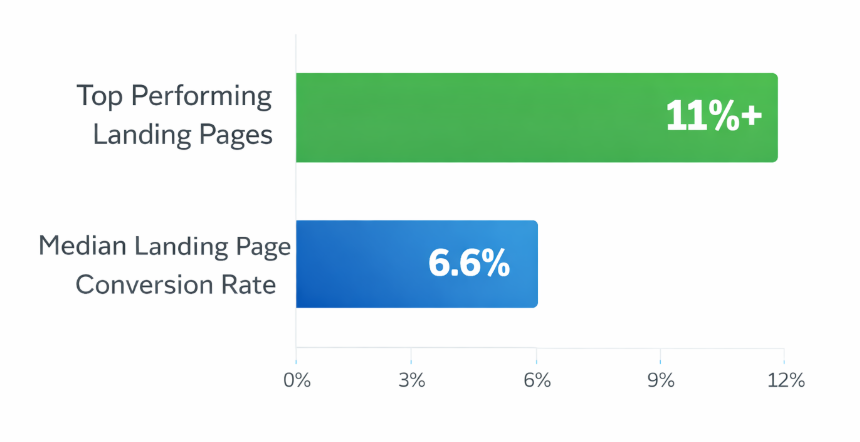
Median landing page conversion rate is 6.6%, with top-performing pages converting at 11% or higher
Even small improvements can have an outsized impact. A one-second delay in page load time can reduce conversions by up to 7%, and simplifying a landing page form from 5 fields to 3 has been shown to increase completion rates by over 20%.
1. Match the Message to Visitor Intent
The first rule of effective landing pages is relevance. Visitors should instantly recognize that they are in the right place. When the headline closely matches the ad copy or email subject line that brought the visitor in, conversion rates increase significantly.
Best-performing landing pages typically:
-
Use a single, clear value proposition above the fold
-
Eliminate competing messages and navigation distractions
-
Reinforce the promise made in the traffic source
Studies show that landing pages with a clear, benefit-driven headline can improve conversion rates by up to 30% compared to generic messaging.
2. Design for Skimming, Not Reading
Users rarely read landing pages word by word. Eye-tracking research consistently shows F-pattern and Z-pattern scanning behavior. Pages that respect this behavior perform better.
To optimize for scanning:
-
Use short paragraphs and bullet points
-
Highlight key benefits with bold or visual separation
-
Place the primary call to action where it naturally aligns with the scan path
Landing pages that clearly surface their main benefit within the first 5 seconds of viewing see bounce rates drop by as much as 25%.
3. Reduce Friction in Forms
Forms are often the highest-friction element on a landing page. Each additional field increases hesitation and abandonment.
Data-backed form optimization principles include:
-
Asking only for information required to complete the next step
-
Using inline validation instead of error messages after submission
-
Clearly explaining what happens after the form is submitted
Research shows that multi-step forms can outperform single-step forms by up to 40% when the perceived effort is reduced and progress is clearly indicated.
4. Make the Call to Action Unambiguous
High-converting landing pages leave no doubt about what the visitor should do next. Generic CTAs like “Submit” or “Send” consistently underperform compared to action-oriented language.
Effective CTAs:
-
Focus on the outcome, not the action
-
Use first-person or benefit-driven phrasing
-
Stand out visually from the rest of the page
In A/B tests, personalized or benefit-based CTAs have increased click-through rates by 10–15% compared to neutral alternatives.
5. Use Social Proof Strategically
Social proof reduces perceived risk and increases trust, especially for first-time visitors. However, more is not always better. Relevance matters more than volume.
High-impact social proof includes:
-
Short testimonials tied to a specific outcome
-
Logos from recognizable customers or partners
-
Usage or performance statistics placed near the CTA
Landing pages that include relevant testimonials close to the conversion point can improve conversions by up to 34%.
6. Optimize for Speed and Mobile Experience
Over half of landing page traffic now comes from mobile devices. Yet many pages are still designed primarily for desktop users.
Key mobile optimization principles:
-
Keep page load time under 3 seconds
-
Ensure CTAs are thumb-friendly and visible without scrolling
-
Avoid large image files that slow down performance
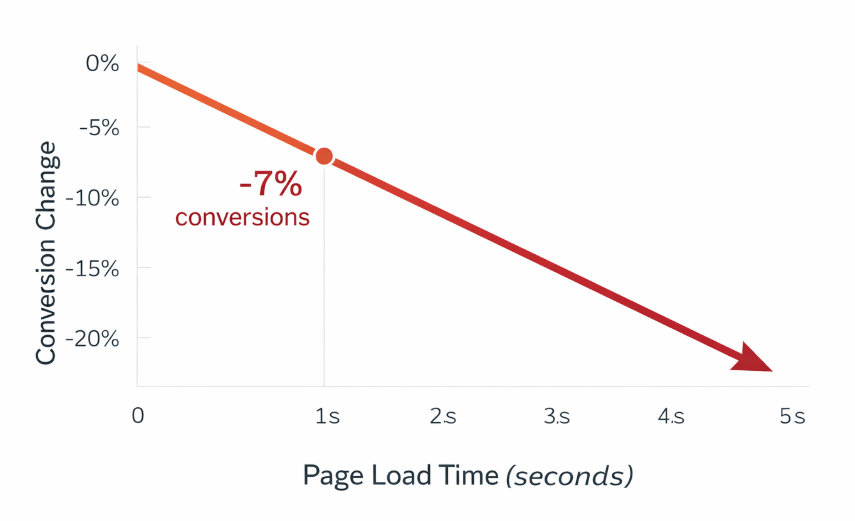
Conversion rate drops by around 7% with each 1-second increase in page load time
Mobile-optimized landing pages convert up to 27% better than pages that rely on responsive design alone without mobile-first considerations.
7. Test Continuously, Not Occasionally
High-performing landing pages are never finished. Continuous testing is one of the strongest predictors of long-term conversion growth.
Focus testing efforts on:
-
Headlines and value propositions
-
CTA copy and placement
-
Form length and layout
Companies that run structured A/B tests on landing pages are more than twice as likely to see consistent year-over-year conversion rate improvements.
Key Takeaways
Landing page best practices that actually work are grounded in clarity, relevance, and user experience. By aligning messaging with intent, reducing friction, and committing to ongoing testing, marketers can unlock meaningful gains without increasing traffic spend.
Small changes, when applied systematically, can turn an average landing page into a reliable conversion engine.
Recommended Reading
If you want to go deeper into conversion optimization and lead generation strategies, consider exploring these related articles: