Advantage+ Shopping Campaigns represent a shift from manual control to algorithm-driven performance marketing. Instead of advertisers deciding audiences, placements, and bidding structures, Facebook’s system makes most of those decisions automatically. Understanding what is being optimized clarifies why these campaigns sometimes outperform traditional setups—and why they sometimes fail.
At its core, Advantage+ is not a new ad format. It is a bundled optimization framework that combines conversion modeling, creative selection, budget allocation, and audience expansion into a single system.
1. Conversion Probability, Not Clicks
The primary optimization goal inside Advantage+ Shopping Campaigns is conversion probability. Facebook predicts which users are most likely to complete a purchase, not just click an ad.
The system evaluates thousands of signals per user, including:
-
Past purchase behavior
-
Interaction with similar products
-
Device, time of day, and platform usage
-
Historical conversion data from your pixel and Conversion API
According to Meta’s internal benchmarks, campaigns optimized for purchases generate up to 18% higher return on ad spend compared to campaigns optimized for lower-funnel events when sufficient conversion data is available.
2. Budget Allocation Across Audiences
Although Advantage+ appears to use a single broad audience, Facebook dynamically segments traffic internally. Budgets are continuously shifted between:
-
Existing customers
-
High-intent prospects
-
Cold audiences with predicted purchase signals
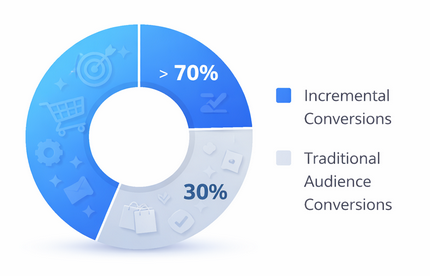
Share of incremental conversions driven by algorithmic audience expansion in Advantage+ Shopping Campaigns
Meta reports that more than 70% of incremental conversions in Advantage+ campaigns come from users who would not have been targeted using traditional interest-based audiences. This explains why manual exclusions and interest stacking are no longer required—and often counterproductive.
3. Creative Performance Optimization
Creative selection is one of the most aggressive optimization layers in Advantage+. Facebook tests combinations of:
-
Primary text variations
-
Creative formats (image, video, carousel)
-
Product catalog items
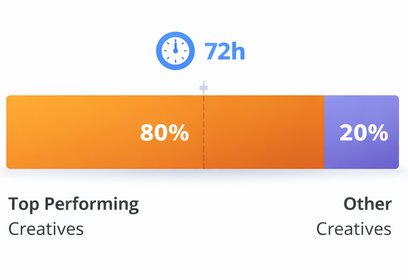
Distribution of ad spend to top-performing creatives in the first 72 hours of Advantage+ Shopping Campaigns
Ads with early engagement and post-click performance signals are automatically scaled, while underperforming creatives are suppressed.
Data from large-scale ecommerce accounts shows that top-performing creatives receive up to 80% of total spend within the first 72 hours once statistically significant performance differences are detected.
4. Placement and Delivery Optimization
Advantage+ campaigns default to automatic placements. Facebook evaluates placements in real time based on:
-
Cost per purchase
-
Conversion rate by placement
-
Cross-platform attribution modeling
Rather than optimizing each placement independently, the system optimizes across placements to maximize total purchases. This is why some placements with lower click-through rates may still receive spend—they drive assisted or view-through conversions.
Meta performance data indicates that advertisers using automatic placements see an average of 12–15% lower CPA compared to manual placement selection.
5. Learning Phase and Signal Weighting
During the learning phase, Advantage+ prioritizes exploration over efficiency. The system tests:
-
New audience pockets
-
Creative combinations
-
Delivery patterns
Once stable performance is achieved, signal weighting shifts toward proven conversion paths. Disrupting campaigns during this phase—by changing budgets or creatives too frequently—resets the optimization process and reduces efficiency.
Meta recommends achieving at least 50 purchase events per week to allow Advantage+ to exit learning and stabilize performance.
6. Incrementality Modeling
A less visible but critical optimization is incrementality. Advantage+ attempts to identify conversions that would not have occurred without ad exposure. This is especially relevant when targeting existing customers or warm audiences.
Internal tests shared by Meta show that Advantage+ Shopping Campaigns deliver up to 25% higher incremental lift compared to standard conversion campaigns when run with broad targeting and sufficient creative variety.
Common Misconceptions
-
“There is no audience targeting.” Targeting exists, but it is algorithmic rather than rule-based.
-
“Creative doesn’t matter.” Creative quality matters more because the system scales winners faster.
-
“Manual control improves results.” In most cases, manual constraints reduce the system’s ability to find new converting users.
When Advantage+ Works Best
Advantage+ Shopping Campaigns perform best when:
-
Conversion tracking is accurate and stable
-
There is enough purchase volume for learning
-
Multiple creatives are available for testing
-
Budget changes are gradual
They are less effective for new accounts with limited data or highly niche products with long consideration cycles.
Conclusion
Advantage+ Shopping Campaigns optimize far more than just ads—they optimize probability, budget flow, creative exposure, and incrementality simultaneously. Advertisers who understand these mechanisms can make better decisions about when to trust the system and when to intervene. The key is not more control, but better inputs: clean data, strong creatives, and patience during learning.