At first glance, paid social and pay-per-click (PPC) advertising appear similar: both rely on bidding systems, audience targeting, creatives, and conversion tracking. Yet in practice, paid social ads are significantly harder to optimize than PPC search campaigns. The challenge is not a lack of tools, but fundamental differences in user intent, algorithmic behavior, creative fatigue, and attribution reliability.
Understanding these differences is critical for setting realistic KPIs, allocating budgets effectively, and avoiding common optimization mistakes.
1. Intent Gap: Discovery vs. Demand Capture
PPC search campaigns are built around explicit user intent. When someone searches for a keyword like "CRM software pricing" or "enterprise cybersecurity vendor," they are already signaling a problem and a readiness to evaluate solutions. This makes optimization relatively straightforward: improve keyword relevance, Quality Score, landing page experience, and bid efficiency.
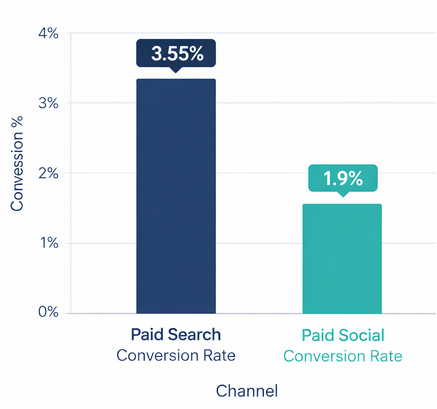
Average conversion rates: paid search campaigns convert at ~3.7–3.8%, whereas paid social averages around 1.5–2.1%
Paid social ads operate in a discovery environment. Users are scrolling through feeds to consume content, not to solve a problem. According to industry benchmarks, search ads convert at 2–3× higher rates than paid social on average, largely due to this intent mismatch. As a result, paid social optimization must focus on influencing behavior rather than capturing it, which introduces more variability and noise into performance data.
2. Creative Volatility and Fatigue
Creative is the dominant performance lever in paid social, whereas PPC relies more heavily on keywords and landing pages. On social platforms, the same ad can experience rapid fatigue after reaching frequency thresholds of 2–3 impressions per user, leading to declining click-through and conversion rates within days or weeks.
By contrast, well-structured PPC ads can remain effective for months with incremental copy testing. Paid social requires constant creative production, testing, and rotation just to maintain baseline performance. This makes optimization less about fine-tuning and more about continuous reinvention.
3. Algorithmic Learning Phases Are More Fragile
Paid social platforms rely heavily on machine learning models that require sufficient conversion volume to stabilize. Most platforms recommend 50+ conversion events per week per ad set for reliable optimization. Any meaningful change—budget shifts, creative swaps, audience edits—can reset the learning phase and temporarily degrade performance.
PPC algorithms are generally more resilient. Bid strategies such as Target CPA or ROAS can tolerate incremental changes without fully resetting historical learning. This difference makes paid social optimization slower and riskier, especially for smaller budgets or longer sales cycles.
4. Audience Signal Degradation
Privacy changes and platform-level restrictions have disproportionately affected paid social. The reduction in third-party cookies and mobile tracking signals has led to weaker audience modeling and attribution gaps. Industry reports estimate that 15–25% of paid social conversions are now unattributed or delayed, compared to significantly lower rates in search.
PPC search ads rely primarily on first-party intent signals (queries), making them less vulnerable to signal loss. Paid social optimization must increasingly work with aggregated or probabilistic data, reducing precision and confidence in decision-making.
5. Attribution Windows and Conversion Lag
Paid social often influences users earlier in the funnel, with conversion lags of 7–30 days common in B2B and high-consideration B2C markets. This delayed feedback loop complicates optimization, as performance decisions are made before full results are visible.
PPC conversions, especially in non-enterprise use cases, tend to occur within minutes or hours of the click. Faster feedback allows for quicker bid, keyword, and landing page adjustments with clearer causality.
6. Budget Sensitivity and Scaling Risk
Scaling PPC is usually linear: increasing budget on profitable keywords generally increases volume with predictable efficiency loss. Paid social scaling is non-linear. Increasing budget too quickly can push ads into less relevant inventory, driving up CPMs and lowering conversion rates.
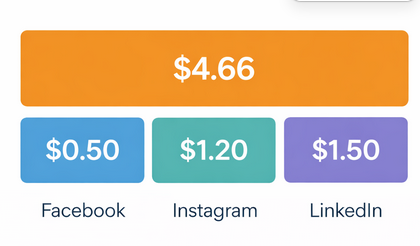
Average cost-per-click benchmarks: search CPC around $4.66 versus social ad CPC typically between $0.50–$1.50
Data from multi-platform advertisers shows that paid social CPAs can increase by 30–60% during aggressive scaling phases, while PPC CPAs often rise more gradually. This makes optimization under growth pressure particularly challenging for social campaigns.
Conclusion
Paid social ads are harder to optimize than PPC not because they are less powerful, but because they operate under fundamentally different conditions. Lower user intent, creative dependency, fragile learning systems, degraded audience signals, delayed attribution, and non-linear scaling all contribute to increased complexity.
Successful paid social optimization requires a shift in mindset: from precision tuning to probabilistic testing, from short-term efficiency to creative iteration, and from deterministic attribution to directional performance analysis.