Landing page optimization (LPO) is often approached as a sequence of isolated experiments: button colors, headline tweaks, or layout variations. However, data consistently shows that structural and strategic changes produce significantly larger gains than minor visual adjustments.
According to industry benchmarks:
-
The average landing page conversion rate across industries ranges between 2% and 5%.
-
Top-performing landing pages convert at 10% or higher.
-
Pages with 10–15 landing pages generate up to 55% more leads than companies with fewer than 10.
-
A 1-second delay in page load time can reduce conversions by up to 7%.
These figures demonstrate a wide performance gap — and that gap is usually driven by fundamentals, not surface-level tweaks.
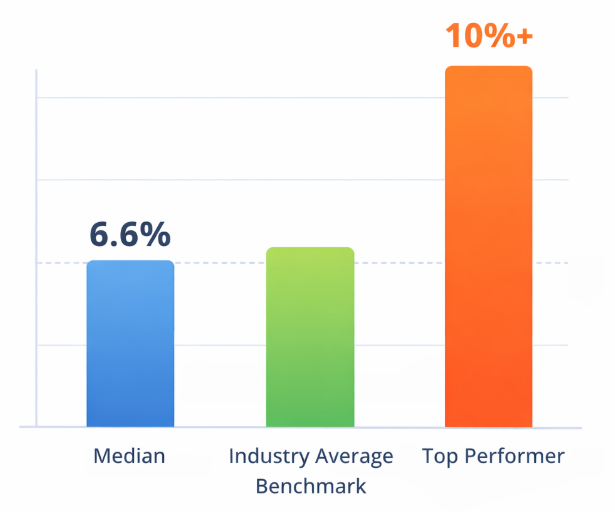
Median landing page conversion rate across industries versus top performers
If resources are limited, the question becomes: where should optimization begin?
Below are the five highest-impact areas to focus on first.
1. Value Proposition Clarity
Why It Comes First
If visitors cannot immediately understand what you offer, who it is for, and why it is better than alternatives, no design improvement will compensate for that confusion.
Research shows that users form an impression of a page in under 1 second. That means your value proposition must be instantly clear above the fold.
What to Audit
-
Does the headline clearly communicate the primary benefit?
-
Is the target audience explicitly defined?
-
Is the outcome measurable or specific?
-
Is jargon avoided unless your audience expects it?
Quick Optimization Wins
-
Replace generic headlines (“Powerful Business Solution”) with outcome-driven statements (“Automate B2B Lead Generation in Minutes”).
-
Add a short subheadline clarifying the use case.
-
Remove internal terminology that only your team understands.
Clarity consistently outperforms cleverness.
2. Page Speed and Technical Performance
The Data Is Clear
-
53% of mobile users abandon a page that takes more than 3 seconds to load.
-
Improving load time by just 0.1 seconds can increase conversion rates by up to 8% in some sectors.
Before optimizing copy or layout, ensure the page loads fast and reliably.
What to Check
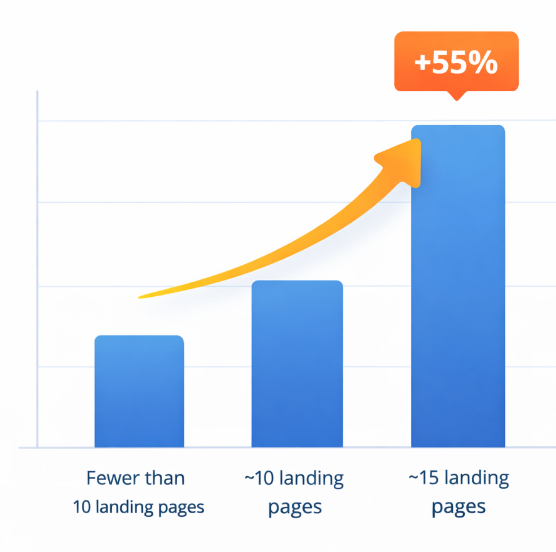
Increase in leads when landing page count grows from ~10 to ~15
-
Core Web Vitals performance
-
Image compression
-
JavaScript load blocking
-
Hosting performance
Speed improvements frequently produce immediate and measurable conversion lifts.
3. Message Match and Traffic Intent Alignment
Conversion rate depends heavily on intent alignment.
If a user clicks an ad promising “accurate B2B email data,” the landing page must reinforce that exact promise in the headline and supporting copy.
Poor message match creates cognitive friction, increasing bounce rates.
Optimization Priorities
-
Mirror the language used in ads or outreach campaigns.
-
Segment landing pages by audience or use case.
-
Avoid sending mixed-intent traffic to one generic page.
Intent alignment often drives higher gains than any design refinement.
4. Conversion Friction Reduction
Friction is anything that slows or complicates the user’s next step.
Common friction points include:
-
Long forms
-
Too many required fields
-
Vague CTAs
-
Lack of trust signals
-
Competing calls to action
Data Insights
-
Reducing form fields from 11 to 4 can increase conversions by up to 120%.
-
Adding trust indicators can increase conversions by 10–42% depending on industry.
Where to Focus
-
Remove non-essential form fields.
-
Use action-oriented CTAs (“Start Free Trial” vs. “Submit”).
-
Add social proof near the conversion point.
Friction removal often produces faster ROI than redesign efforts.
5. Social Proof and Trust Architecture
Users evaluate credibility quickly.
If your page lacks authority indicators, visitors hesitate.
Effective Trust Elements
-
Client logos
-
Testimonials with names and roles
-
Quantified results
-
Data security statements
-
Case study snippets
Landing pages with testimonials can see conversion increases of up to 34%.
Place social proof strategically:
-
Near CTAs
-
After objections are addressed
-
In scroll-triggered reinforcement sections
Trust should not be an afterthought — it should be integrated into the decision flow.
6. Call-to-Action Optimization (After Fundamentals)
CTA optimization is important, but it should come after structural improvements.
Focus Areas
-
Specificity (“Get 500 Verified Leads” vs. “Learn More”)
-
Visibility and contrast
-
Single primary CTA per page
Multiple competing CTAs dilute attention and reduce conversion focus.
A Structured Order of Optimization
If starting from scratch, prioritize in this sequence:
-
Clarify value proposition
-
Improve load speed and technical stability
-
Align message with traffic intent
-
Reduce conversion friction
-
Strengthen trust signals
-
Refine CTAs and microcopy
This order maximizes impact while minimizing wasted experimentation.
Common Mistakes to Avoid
-
Redesigning before diagnosing performance gaps
-
Running A/B tests without sufficient traffic volume
-
Copying competitor layouts without understanding audience differences
-
Overloading pages with features instead of benefits
Optimization should be hypothesis-driven and data-informed.
Final Thoughts
Landing page optimization is not about isolated improvements — it is about systematically increasing clarity, reducing friction, and reinforcing trust.
When prioritization is correct, even modest adjustments can produce disproportionate gains.
Focus on fundamentals first. Design refinements and micro-optimizations should follow structural improvements.
Suggested Articles for Further Reading
Continuous refinement, backed by performance data, is what separates average landing pages from high-converting assets.