Paid social channels have evolved into complex performance ecosystems. With advanced targeting, automation, and creative formats, brands have more tools than ever to drive results. Yet, industry data shows that a significant portion of paid social budgets is wasted due to preventable strategic errors. According to recent marketing benchmarks, advertisers lose up to 26% of paid media spend annually due to inefficient strategy and execution.
Understanding where paid social strategies break down is essential for sustainable growth. Below are the most common mistakes that limit performance and scalability.
1. Optimizing for the Wrong Objective
One of the most damaging mistakes in paid social is selecting campaign objectives that do not align with business goals. Optimizing for clicks instead of conversions, or impressions instead of qualified leads, often inflates surface-level metrics while suppressing real revenue impact.
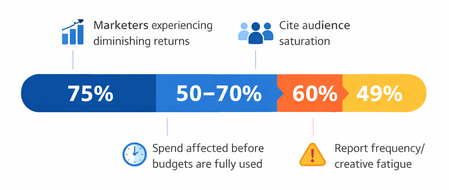
Most performance marketers see diminishing returns on paid social ad spend before budgets are fully deployed
Platform data shows that campaigns optimized for lower-funnel events can generate up to 3x higher return on ad spend compared to traffic-focused campaigns. Growth stalls when optimization signals do not reflect true business value.
2. Over-Reliance on Narrow Audience Targeting
Highly granular targeting may seem efficient, but overly narrow audiences restrict delivery and learning. As privacy regulations reduce third-party data availability, platforms rely more on algorithmic optimization and broader signals.
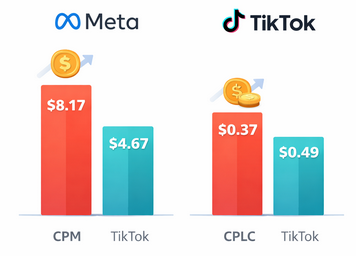
Comparison of average cost-per-thousand impressions (CPM) and cost-per-click (CPLC) across major social ad platforms
Research indicates that campaigns using broader audience strategies can reduce cost per acquisition by 20–30% once sufficient conversion data is available. Growth is limited when algorithms are constrained by excessive exclusions and micro-segmentation.
3. Weak Creative Testing Frameworks
Creative is the primary performance driver in paid social, yet many advertisers rely on limited variations or subjective creative decisions. Without a structured testing framework, learning stagnates.
Industry studies suggest that creative accounts for over 50% of paid social performance outcomes. Brands that refresh creatives every 2–4 weeks and test multiple messaging angles consistently outperform those with static assets.
4. Ignoring Full-Funnel Measurement
Focusing exclusively on last-click conversions hides the true impact of paid social across the customer journey. Awareness and consideration campaigns influence downstream conversions that may not be immediately attributed.
Data from multi-touch attribution models shows that upper- and mid-funnel social campaigns can contribute to up to 40% of eventual conversions, even when they are not the final interaction. Growth slows when these touchpoints are undervalued or eliminated.
5. Scaling Budget Too Quickly—or Not at All
Sudden budget increases can disrupt algorithmic learning, while under-scaling prevents campaigns from reaching efficiency thresholds. Both scenarios limit growth.
Performance benchmarks show that gradual budget increases of 10–20% every few days maintain stability and protect efficiency. Sustainable growth requires controlled scaling rather than reactive budget shifts.
6. Treating Automation as a Set-and-Forget Solution
Automation tools and AI-driven bidding strategies are powerful, but they are not autonomous growth engines. Without proper inputs—clean conversion data, consistent creative testing, and strategic oversight—automation amplifies existing inefficiencies.
Advertisers that actively guide automated systems with clear performance signals achieve significantly better outcomes than those who rely on default settings alone.
Conclusion
Paid social growth is rarely limited by platform potential. Instead, it is constrained by strategic misalignment, incomplete measurement, and underdeveloped testing processes. By correcting these mistakes, advertisers can unlock more predictable performance, stronger efficiency, and scalable growth.