
Digital advertising costs continue to climb across major platforms. According to recent industry benchmarks, average B2B cost per click has increased by more than 15% year-over-year in competitive industries, while conversion rates remain flat or decline slightly due to broader targeting and automation.
The result is predictable: more budget is being spent on users who are unlikely to convert.
Low-intent users are not necessarily "bad" traffic. They may simply be early-stage researchers, competitors, students, job seekers, or individuals outside your ideal customer profile (ICP). However, allocating paid media budget to audiences with minimal purchase probability creates inefficiency, distorts reporting, and reduces return on ad spend (ROAS).
Smart exclusions are a strategic solution. Instead of only focusing on who to target, high-performing teams focus equally on who not to target.
Understanding Low-Intent Traffic
Low-intent users typically fall into several categories:
-
Early-stage researchers with no active buying project
-
Students or academic researchers
-
Competitors monitoring the market
-
Job seekers exploring company pages
-
Non-decision-makers outside buying committees
-
Companies below minimum revenue or headcount thresholds
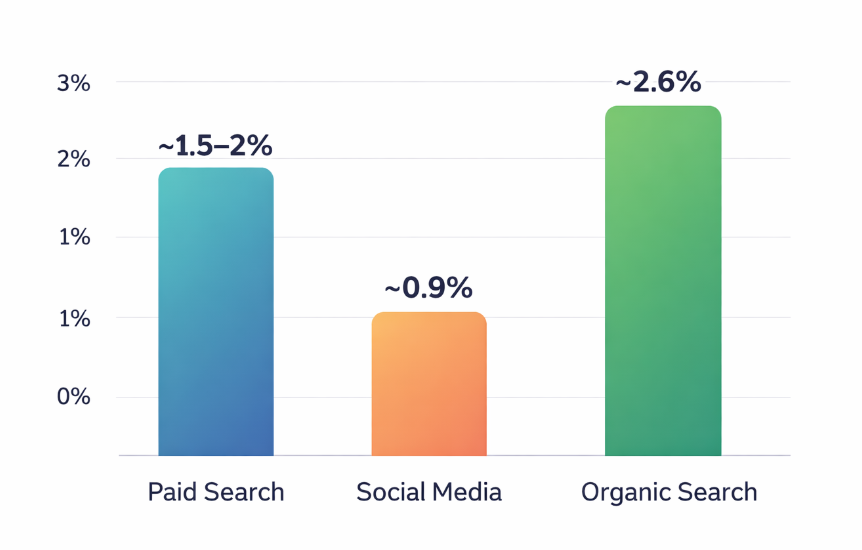
B2B conversion rates differ notably by traffic source: social media and paid channels lag behind higher-intent organic traffic
Research shows that in complex B2B environments, only 5–10% of in-market accounts are actively evaluating vendors at any given time. This means up to 90% of paid impressions may reach audiences not currently ready to buy.
Without exclusion mechanisms, campaigns over-index on visibility rather than efficiency.
The Financial Impact of Poor Exclusion Strategy
Consider a campaign targeting 100,000 accounts with broad filters. If only 8% are truly in-market and aligned with your ICP, then 92% of impressions risk being allocated to low-intent audiences.
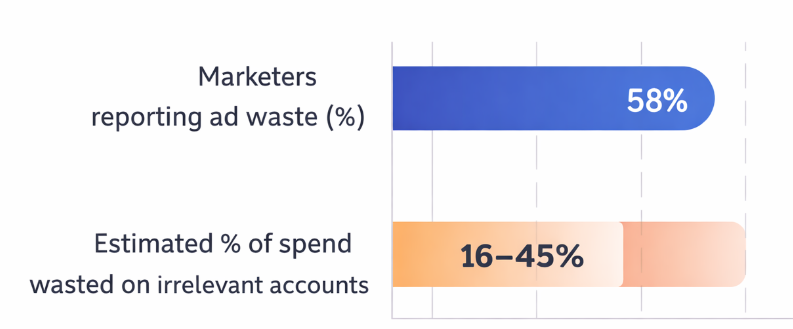
Majority of B2B marketers experience significant ad spend waste, with 16–45% of budget often allocated to irrelevant audiences
If monthly spend is $50,000 and even 40% of that reaches irrelevant segments, that represents $20,000 in inefficient allocation per month.
Over a year, that becomes $240,000 in potential budget leakage.
Even modest improvements in exclusion precision can significantly impact pipeline efficiency and customer acquisition cost (CAC).
What Are Smart Exclusions?
Smart exclusions are structured filtering mechanisms that remove non-qualified users or accounts from advertising visibility before spend occurs.
They operate across several dimensions:
1. Demographic and Firmographic Exclusions
Exclude accounts based on:
-
Company size below threshold
-
Revenue band misalignment
-
Non-target industries
-
Geographic regions outside sales coverage
In B2B campaigns, narrowing firmographics alone can improve conversion rates by 20–40% when aligned with historical win-rate data.
2. Role-Based Exclusions
Buying committees are complex, but not every title has equal influence.
Excluding:
-
Interns
-
Students
-
Entry-level roles
-
Unrelated departments
prevents spend on users unlikely to influence purchasing decisions.
3. Behavioral Exclusions
Modern data platforms allow exclusion of:
-
Existing customers
-
Recently closed-lost accounts
-
Unqualified leads
-
Accounts with disqualifying attributes
This ensures budget focuses on net-new or high-propensity segments.
4. Intent-Based Suppression
If intent data indicates declining research activity or irrelevant topic engagement, those accounts can be deprioritized or excluded.
Since only a small portion of your total addressable market shows active buying signals at any time, layering intent suppression protects budget from passive browsers.
Balancing Reach and Precision
Over-exclusion can shrink reach excessively and increase CPM due to tight audience pools. The objective is not minimal audience size but optimal efficiency.
A practical framework:
-
Define strict ICP baseline
-
Apply historical win-rate filters
-
Layer real-time intent data
-
Continuously analyze performance by excluded vs included segments
Campaign diagnostics should evaluate:
-
Conversion rate by firmographic segment
-
Cost per opportunity by role
-
Pipeline contribution by industry
-
Engagement depth by intent tier
Data-driven exclusion refinement typically improves marketing-qualified lead (MQL) to opportunity conversion rates by 15–25% within two to three optimization cycles.
Operationalizing Smart Exclusions
To implement exclusions effectively:
Step 1: Audit Historical Closed-Won Data
Identify patterns among successful deals:
-
Minimum employee count
-
Revenue thresholds
-
Industry clusters
-
Geographic concentration
-
Decision-maker seniority
Translate negative patterns into exclusion criteria.
Step 2: Align Sales and Marketing Definitions
If sales routinely disqualifies certain account types, those segments should not receive paid media investment.
Budget alignment across teams reduces friction and improves pipeline predictability.
Step 3: Integrate Suppression Lists
Upload CRM-based suppression lists including:
-
Customers
-
Disqualified leads
-
Competitors
-
Internal domains
Step 4: Monitor Exclusion Impact
Track performance before and after exclusion updates. Key metrics include:
-
Cost per lead (CPL)
-
Cost per opportunity
-
Opportunity creation rate
-
Pipeline velocity
Even a 10% reduction in irrelevant spend can translate into measurable CAC improvements.
Common Mistakes
-
Excluding too broadly without testing
-
Ignoring sales feedback
-
Failing to update suppression lists regularly
-
Over-relying on automation without manual validation
-
Measuring clicks instead of revenue impact
Smart exclusions should be dynamic, not static.
Strategic Advantage of Exclusion-First Thinking
Most teams focus primarily on audience expansion. However, in high-cost B2B ecosystems, efficiency gains often come from subtraction rather than addition.
When exclusions are strategically deployed:
-
Budget efficiency improves
-
Sales acceptance rates increase
-
Pipeline quality rises
-
Reporting clarity improves
-
Customer acquisition cost decreases
In competitive markets, protecting budget is as important as generating demand.
Conclusion
Smart exclusions transform campaign economics. By systematically removing low-intent users, organizations can reallocate budget toward accounts with genuine purchase probability.
In environments where less than 10% of the market is actively buying, precision is not optional. It is a competitive necessity.
Effective demand generation is not just about reaching more people. It is about reaching the right people and deliberately avoiding the rest.