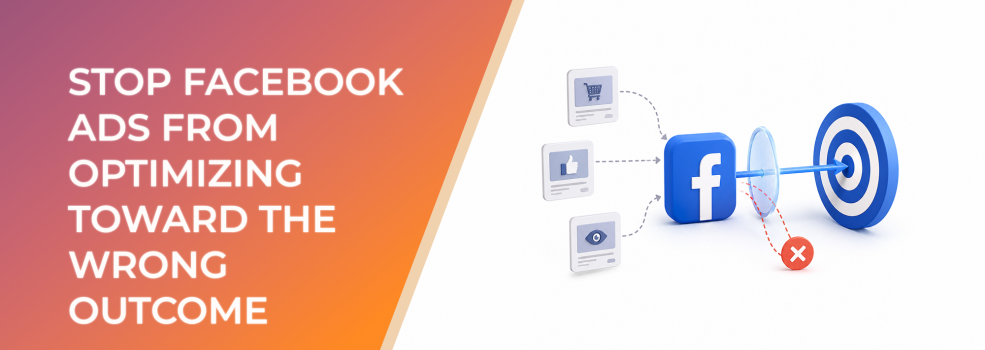
Sometimes Facebook ads do not look broken at first.
They spend. They generate clicks. They bring in leads. They collect engagement. Ads Manager shows activity.
But the business result does not improve.
This usually means the campaign may be optimizing toward the wrong outcome. Meta is finding the result it was instructed to find, or the result that appears easiest to produce, while the advertiser actually needs something deeper: qualified leads, purchases, booked calls, pipeline, revenue, or profitable customer acquisition.
Meta’s own performance-goal guidance describes the selected performance goal as a way of telling the ad delivery system what result to get efficiently. That makes the quality of the chosen goal and signal critical.
The Problem
The problem is optimization misalignment.
This happens when the campaign setup, optimization event, audience, creative, or KPI points Meta toward an action that does not match the business outcome.
A campaign may be built to get traffic when the business needs leads. It may optimize for basic form submissions when the sales team needs qualified opportunities. It may chase engagement when the goal is booked appointments. It may optimize for a shallow conversion event when the real value happens later in the funnel.
The result is a campaign that looks efficient at the platform level but weak at the business level.
Why This Problem Hurts Performance
Wrong-outcome optimization wastes budget because Meta gets better at finding the wrong people.
If the campaign optimizes for link clicks, it may find users who click many ads but rarely buy. If it optimizes for low-friction leads, it may find users who submit forms casually. If it optimizes for engagement, it may find users who like or comment without purchase intent.
That can lower CPC or CPL while raising true CPA and CAC.
It can also damage lead quality. Sales teams spend time on poor-fit contacts. Ecommerce teams see product page activity without revenue. Agencies struggle to explain why the campaign “performed” but did not meet the client’s real objective.
Wrong optimization also makes scaling risky. More budget does not fix misalignment. It amplifies it.
Common Scenarios Where This Happens
A B2B company runs a traffic campaign to a demo page. The campaign gets affordable visits, but very few demo requests because Meta is optimizing for click behavior.
A service business uses a message-based campaign but does not define what a qualified inquiry looks like. The campaign creates conversations, but most are price shoppers or poor-fit requests.
An ecommerce brand optimizes for add-to-cart because purchase volume is low. Add-to-carts increase, but purchases remain weak because the event does not strongly predict revenue.
An agency inherits a campaign with strong CTR and low CPC. After reviewing CRM data, it discovers that most leads are unqualified.
An affiliate marketer optimizes toward the cheapest landing page views. Traffic grows, but conversion rate drops and payout economics stop working.
Why the Problem Happens
The first cause is choosing the wrong objective for the funnel stage.
Traffic, engagement, leads, and sales objectives can all be useful, but each gives Meta a different instruction. If the instruction does not match the campaign’s real job, delivery drifts.
The second cause is using a weak optimization event. A form open, landing page view, or add-to-cart may be easier to generate than a qualified lead or purchase. But easier does not always mean better.
The third cause is judging performance inside Ads Manager only. Ads Manager can show the action Meta produced, but it may not show downstream quality clearly enough for sales, retention, margin, or pipeline.
The fourth cause is noisy audiences. If the audience includes too many low-intent users, early signals can push Meta toward people who are easy to reach but unlikely to create value.
The Solution
The solution is to fix the outcome signal before trying to optimize harder.
Start by defining the true business outcome. Is the goal qualified pipeline, booked calls, profitable purchases, trial starts, repeat purchases, or high-intent inquiries?
Then identify the platform action that best predicts that outcome. The best signal is usually the deepest reliable action. “Deepest” means close to business value. “Reliable” means it happens often enough for Meta to learn.
For ecommerce, purchase is usually stronger than add-to-cart, but add-to-cart may be useful if purchase volume is too low and it predicts future purchases well.
For lead generation, a qualified lead or booked call is stronger than a basic form submit, but the business must have a way to verify quality consistently.
Next, align the campaign objective with that signal. Do not use a traffic setup when the real goal is sales qualification. Do not use an engagement setup when the real goal is consultations. Do not use a shallow event just because it produces more volume.
Then review the audience. Ask whether the campaign is giving Meta enough relevant people to learn from. If the audience is too broad, the system may find cheap actions from low-intent users. If it is too narrow, delivery may struggle.
Finally, change reporting. Measure the platform result and the business result together. A lead campaign should be judged by lead quality, response rate, qualified-call rate, and eventual revenue. A sales campaign should be judged by CPA, ROAS, AOV, margin, and repeat purchase potential.
How LeadEnforce Helps
LeadEnforce helps with the audience-quality side of wrong-outcome optimization.
If Meta is learning from low-intent users, improving the objective alone may not be enough. The campaign also needs better audience inputs. LeadEnforce can help advertisers build custom audiences from relevant Facebook groups, Instagram profiles, followers, engagers, LinkedIn-derived professional data, and custom social-profile sources.
For a B2B campaign, that might mean building audiences around professionals, communities, or profiles that better reflect the buyer profile. For a niche ecommerce campaign, it might mean targeting people connected to relevant Instagram accounts or category communities. For an agency, it can help test more specific audience hypotheses instead of relying only on broad platform interests.
LeadEnforce does not fix the wrong conversion event, attribution setup, landing page, or offer. Those still need to be handled separately. Its role is to reduce audience noise after the campaign goal and optimization signal are aligned.
Risks and Considerations
The biggest risk is switching signals too aggressively.
If the deepest event has very little volume, Meta may struggle to learn. In that case, use a higher-volume event only if it has a proven relationship to the final business outcome.
Another risk is mistaking audience quality for offer quality. A precise audience will not save an offer that does not match user intent.
Creative also matters. If the ad attracts curiosity clicks but not qualified intent, Meta may learn from the wrong behavior even with a reasonable objective.
If LeadEnforce is used, source selection matters. A community or profile should be chosen because it reflects buyer intent, not just topical similarity.
Prerequisites and Dependencies
You need a clearly defined business outcome, a campaign objective that matches that outcome, a reliable conversion or lead signal, and reporting that checks downstream quality.
You also need enough budget and event volume for learning. If volume is too low, optimization may be unstable.
For LeadEnforce-supported audience building, you need relevant source groups, Instagram profiles, follower or engager pools, LinkedIn-derived professional data, or custom social-profile data that genuinely match the ICP.
Practical Recommendations
Audit the campaign in this order:
First, check the stated business goal.
Second, check the selected objective.
Third, check the optimization event.
Fourth, compare Ads Manager results with downstream quality.
Fifth, review whether the audience reflects real intent.
Sixth, decide whether to edit, duplicate, or relaunch.
If the campaign has learned from the wrong action for too long, rebuilding may be cleaner than making small edits. Use the relaunch to give Meta a clearer instruction, cleaner audience, stronger offer, and better KPI.
When LeadEnforce fits the workflow, use it after the signal audit. The priority is not simply “more targeting.” The priority is better audience relevance behind the correct outcome.
Final Takeaway
Facebook ads optimize toward the outcome they are instructed to pursue, not necessarily the outcome the business cares about most.
To stop wrong-outcome optimization, define the real business result, choose the objective and event that best represent it, verify quality outside Ads Manager, and improve audience relevance before scaling.
To give Meta cleaner audience inputs after your optimization signal is fixed, join the free 7-day LeadEnforce trial period.
Related LeadEnforce Articles
- How to Stop Meta From Optimizing for the Wrong Result — Directly related to fixing the signal Meta learns from.
- How to Tell If Facebook Ads Are Optimizing for the Wrong Goal — Helps diagnose whether the campaign is chasing the wrong result.
- When Meta Ads Optimize for the Wrong Conversion Event — Focuses on misaligned conversion events and revenue impact.
- Stop Letting the Default Facebook Boost Goal Define Your Results — Useful for advertisers relying on simplified or default campaign goals.
- What Meta’s Updated Ad Objectives Mean for Campaign Setup and Performance — Explains how Meta objective choices affect campaign setup and performance.