
Many Facebook campaigns struggle even when the creative is strong and the targeting seems logical. The issue often sits deeper in the account setup — a campaign structure that fragments learning and creates internal competition between ad sets.
This mistake usually appears when advertisers split similar audiences into too many ad sets. At first glance, the structure looks organized. In practice, it prevents the algorithm from gathering enough signals to optimize efficiently.
The Structural Mistake Most Advertisers Don’t Notice
Meta optimizes delivery primarily at the ad set level.
Each ad set builds its own prediction model based on conversion signals. When similar audiences are separated across multiple ad sets, those signals become fragmented.
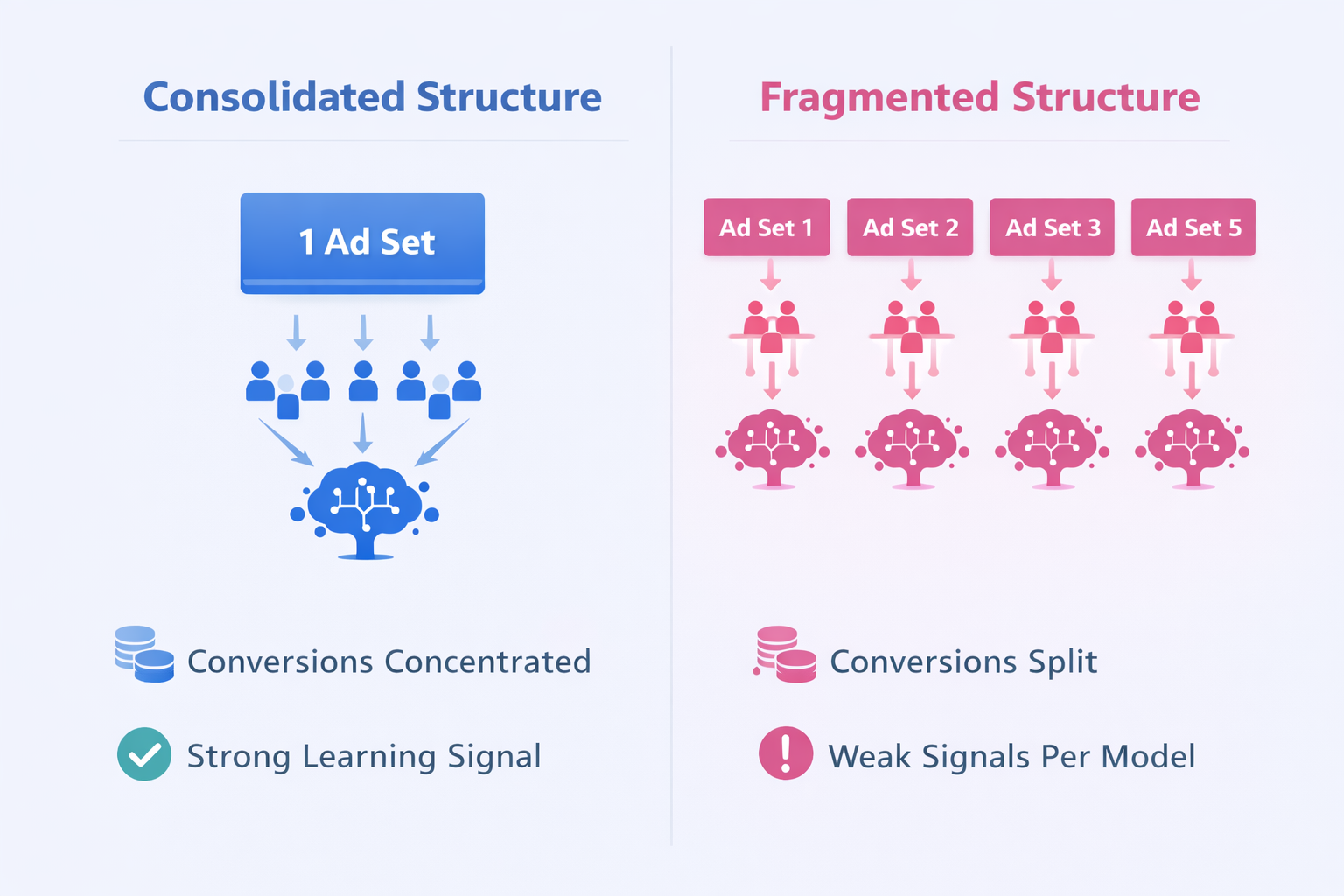
Instead of one model learning from a strong stream of conversions, the system attempts to optimize several smaller datasets simultaneously.
This leads to several performance problems:
-
Fragmented learning signals — conversions spread across multiple ad sets rather than strengthening one model.
-
Lower optimization confidence — fewer events per ad set slow algorithm learning.
-
Internal auction competition — overlapping audiences cause your ads to compete against each other.
-
Diluted budgets — spend spreads across too many ad sets that individually lack enough data.
Audience overlap is a major factor behind this issue, which is explored in more detail in Why Audience Overlap Is Killing Your Facebook Ad Performance.
How Over-Segmentation Happens in Real Campaigns
Many advertisers create multiple prospecting ad sets for slightly different audiences.

For example:
Campaign: Prospecting
- Ad Set 1 — Lookalike 1% Purchasers
- Ad Set 2 — Lookalike 2% Purchasers
- Ad Set 3 — Lookalike 3% Purchaser
- Ad Set 4 — Interest targeting
- Ad Set 5 — Broad targeting
Although these audiences appear distinct, Meta’s delivery system often pushes ads toward similar user clusters. This results in overlapping auctions.
If you check Ads Manager, you may notice:
-
similar CPM levels across several ad sets,
-
nearly identical conversion rates between audiences,
-
unstable daily spend distribution.
These patterns usually indicate that the audiences are not meaningfully different from the algorithm’s perspective.
Why Your Ads End Up Competing Against Each Other
Meta does not always prevent ads from the same account entering the same auction.
When multiple ad sets target overlapping audiences, the platform may allow both ads to compete. The system simply chooses the ad with the highest predicted performance.
This creates several side effects:
-
Artificial CPM inflation
Your ads increase competition inside the same auctions. -
Slower performance discovery
Budget spreads across several similar audiences instead of scaling the strongest one. -
Longer learning cycles
Each ad set gathers fewer conversion signals, delaying optimization.
Understanding how auction mechanics influence delivery helps explain these dynamics — see Facebook Ad Auction: Do Ad Sets Compete Against Each Other?
Why Simpler Campaign Structures Often Perform Better
Many high-performing accounts rely on fewer ad sets with broader audiences.
Instead of splitting audiences excessively, advertisers consolidate them so the algorithm receives stronger learning signals.
A simplified prospecting structure might look like this:
Campaign: Prospecting
Ad Set 1 — Broad targeting
Ad Set 2 — Combined lookalike audiences (1–3%)
Ad Set 3 — Retargeting
This structure provides several advantages:
-
Higher conversion density per ad set
-
Less internal auction competition
-
Clearer budget allocation toward winning audiences
If you're unsure how many ad sets to run, How Many Ad Sets Should You Run per Campaign on Facebook? provides practical guidelines.
When Audience Segmentation Still Makes Sense
Segmentation is still useful when ad sets truly represent different auction environments.
Examples include:
-
separating retargeting vs prospecting audiences,
-
targeting different countries or regions,
-
running distinct creative strategies for separate customer segments.
However, segmentation should only exist when it changes delivery conditions. Otherwise, it simply divides learning signals.
Campaign structures that support scaling are discussed further in Meta Campaigns Explained: How to Structure High-Performance Campaigns.
The Structural Change That Often Fixes Performance
When campaigns struggle to scale, the problem is frequently not the ad creative or targeting idea.
It is the structure of the account itself.
Simplifying campaigns, consolidating audiences, and concentrating conversion signals allow Meta’s algorithm to learn faster and allocate budget more efficiently.
In many cases, reducing the number of ad sets is the simplest way to restore stable Facebook ad performance.
