Many marketers assume that when campaign performance drops, it must be due to audience fatigue. While audience fatigue does occur, it is not always the primary cause. In many cases, creative performance declines because of internal factors such as repetition, lack of variation, or poor testing strategies.
According to multiple advertising studies, creative quality accounts for up to 49% of the impact on sales lift in digital campaigns. This means that even small creative inefficiencies can significantly affect campaign results.
The Hidden Causes of Creative Performance Decline
1. Creative Repetition
When teams rely on a limited set of visual formats, messaging structures, or concepts, performance tends to decline over time. Even if the audience has not fully seen the same ads repeatedly, platforms' delivery algorithms may reduce exposure when engagement metrics start to drop.
A Meta analysis found that campaigns using fewer than five creative variations experienced up to 32% lower performance compared with campaigns using diverse creative assets.
2. Algorithmic Optimization Effects
Modern advertising platforms optimize delivery toward ads that initially perform well. However, this can lead to over-delivery of a small subset of creatives, which eventually causes diminishing returns.
Research shows that 60–70% of impressions in many campaigns are often allocated to only two or three creatives. Once those creatives begin losing marginal effectiveness, the entire campaign performance declines.
3. Lack of Systematic Creative Testing
Many teams test creatives inconsistently or too slowly. Without structured testing frameworks, marketers cannot identify which creative components drive performance.
According to Nielsen research, campaigns that continuously test new creative variants generate approximately 30% higher return on ad spend compared to campaigns that rarely update creative assets.
4. Creative Concept Saturation
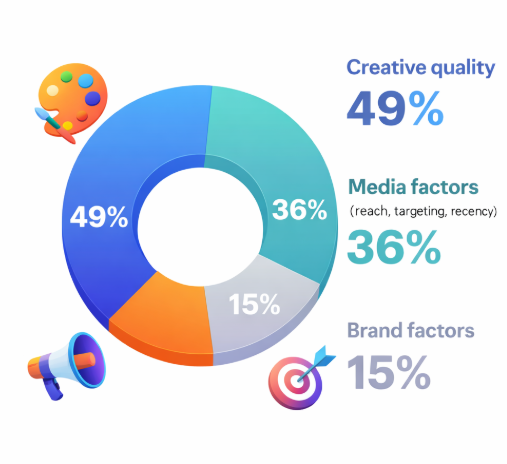
Creative quality is the largest driver of advertising effectiveness, accounting for nearly half of incremental sales
Creative concepts often have a lifecycle. A concept that initially generates high engagement eventually reaches a point where incremental improvements produce little impact.
Marketing analytics studies indicate that most high-performing ad concepts begin to plateau after 3–5 weeks of heavy distribution, even without audience-level fatigue.
Signs That Creative Performance Is Declining
Several indicators can signal creative performance decline before audience fatigue becomes evident:
-
Gradual drop in click-through rate despite stable reach
-
Increasing cost per acquisition without targeting changes
-
Declining engagement rates on previously strong creatives
-
Algorithm concentrating impressions on fewer assets
Monitoring these signals allows teams to refresh creative assets before performance drops significantly.
Strategies to Maintain Creative Performance
Expand Creative Volume
Campaigns with larger creative libraries consistently outperform campaigns with limited assets. Industry benchmarks suggest that campaigns should include at least 8–12 active creatives to maintain stable performance.
Rotate Creative Concepts Regularly
Instead of adjusting small visual elements, marketers should develop multiple conceptual directions for campaigns. This extends the lifespan of creative strategies and reduces saturation.
Implement Structured Creative Testing
Testing frameworks should isolate variables such as messaging angle, visual style, and value proposition. Structured testing enables teams to identify which components drive performance improvements.
Organizations that adopt systematic creative experimentation can improve campaign efficiency by up to 25–35% according to marketing analytics reports.
Conclusion
Creative performance declines are often incorrectly attributed to audience fatigue. In reality, internal creative limitations—such as repetition, algorithmic concentration, and insufficient testing—are frequently responsible.
By expanding creative volume, rotating concepts, and implementing structured testing, marketers can sustain campaign performance for longer periods and achieve more consistent results.
Recommended Articles