Many advertisers assume that more precise targeting automatically leads to better Facebook Ads performance. In reality, targeting has structural limits. After a certain point, adding interests, exclusions, or demographic filters stops improving delivery and can even harm performance.
To understand why this happens, you need to look at how Meta’s ad delivery system actually works.
Targeting Is a Starting Boundary, Not a Precision Filter
When you select interests or behaviors in Ads Manager, it feels like you are defining exactly who will see the ad. In practice, targeting only defines the initial candidate pool.
After a campaign begins delivering, the algorithm evaluates users based on predicted conversion probability. Delivery gradually shifts toward people who resemble converters behaviorally, even if they do not perfectly match the original targeting.
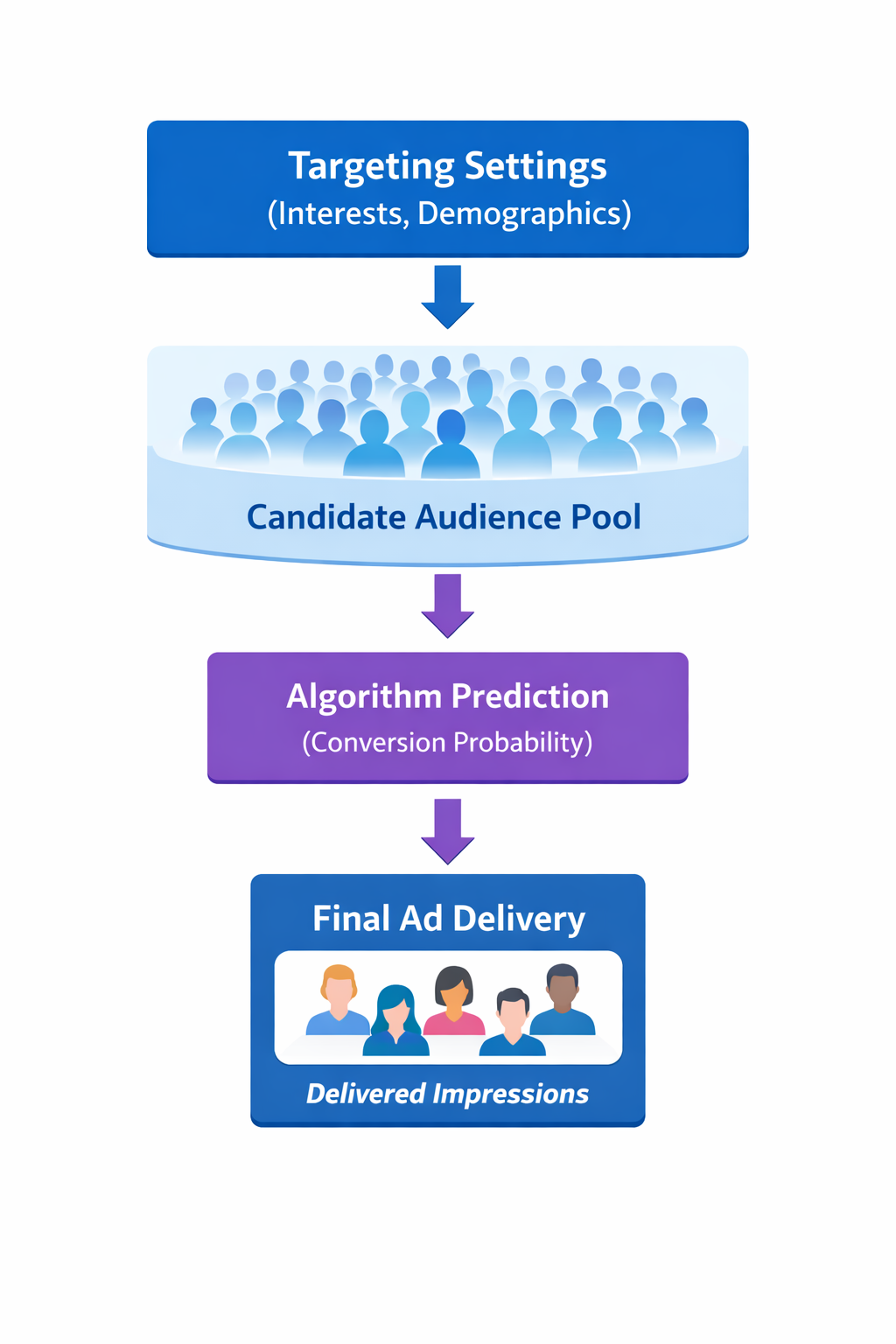
This is one reason advertisers sometimes notice impressions appearing outside their expected audience definitions. The system prioritizes predictive signals over strict targeting rules.
For a deeper look at how interest categories behave in real campaigns, see Facebook Interest Targeting Expansion.
Interest Categories Represent Behavioral Clusters
Interest targeting looks extremely granular in Ads Manager. Thousands of categories appear available, which creates the impression of precise segmentation.
However, these interests are generated from behavioral clustering, not exact personal attributes.
A user may enter a “digital marketing” interest cluster because they:
-
Frequently read articles about marketing tools or advertising trends.
-
Interact with posts or ads related to marketing software.
-
Follow industry pages or professional groups on Facebook.
-
Engage with content that historically attracts marketers.
None of these signals confirm that the person currently intends to buy a marketing product. They only indicate that the user shares activity patterns with others in the cluster.
As a result, two advertisers targeting the same interest often reach different subsets of people.
Auction Competition Shapes Who Actually Sees the Ad
Even if two campaigns target identical audiences, their ads will rarely reach the same users.
The reason is the Facebook ad auction.
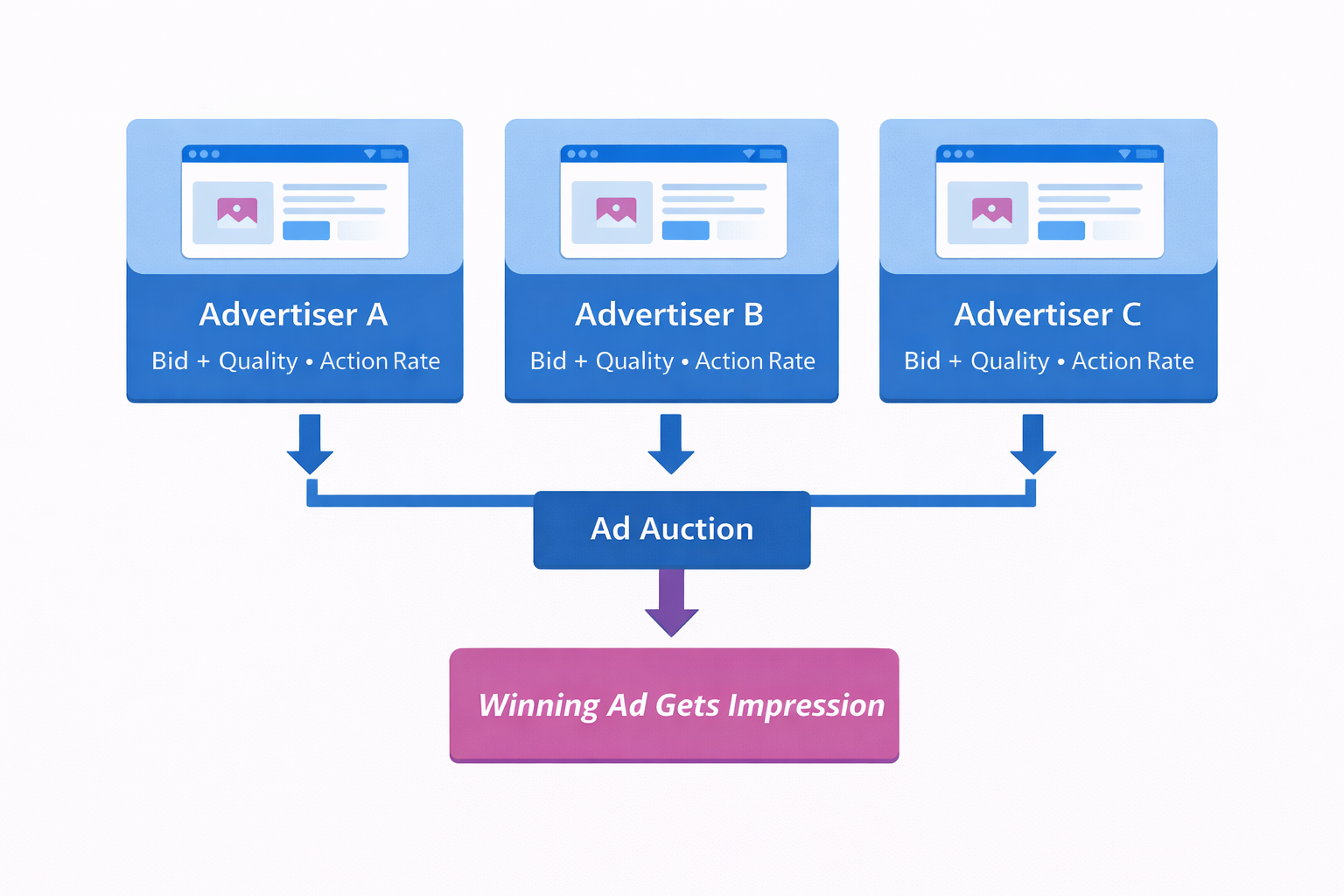
Every time a user opens the platform, many advertisers qualify to show an ad to that person. The system evaluates those ads based on several signals:
-
Estimated action rate, predicting the likelihood of conversion.
-
Advertiser bid, which determines the maximum price for the impression.
-
Ad quality signals, including past engagement and negative feedback.
The ad with the highest predicted value wins the impression.
This means targeting alone does not determine delivery. Auction dynamics and predicted outcomes matter more.
A detailed explanation of this mechanism can be found in Facebook Ad Auction: Do Ad Sets Compete Against Each Other?
Narrow Targeting Can Restrict the Algorithm
Advertisers often stack multiple targeting filters in an attempt to improve precision:
-
Detailed interest layers.
-
Demographic restrictions.
-
Device filtering.
-
Placement exclusions.
-
Extensive audience exclusions.
Each layer reduces the pool of eligible users.
This creates two delivery problems:
-
The campaign repeatedly enters the same auctions.
With fewer eligible users, ads compete for impressions within a smaller set of auctions. -
The algorithm receives fewer learning signals.
Smaller audiences generate fewer conversion events, which weakens the model’s ability to detect patterns.
A common sign of this issue is rising frequency combined with increasing CPM. The audience appears large in Ads Manager, but real delivery concentrates within a narrow segment.
This issue is closely related to what happens when advertisers build audiences that are too restricted. See When Your Audience Is Too Small for a deeper explanation.
Lookalike Audiences Also Have Structural Limits
Lookalike audiences rely on patterns found inside the seed dataset.
When the seed audience contains diverse behaviors — different purchase histories, browsing patterns, and device usage — the algorithm can identify multiple user clusters and expand delivery efficiently.
However, problems appear when the seed becomes too homogeneous.
For example, a seed list made entirely of recent purchasers from a single campaign often contains nearly identical signals:
-
The same creative interaction.
-
Similar time of conversion.
-
Overlapping interests and browsing patterns.
With limited behavioral diversity, the algorithm struggles to identify new users who match the same signal combination. Delivery concentrates in fewer auctions, which typically pushes CPM upward and slows scaling.
For a practical overview of how lookalike modeling works, see What Is Lookalike?
What Targeting Actually Does in Modern Meta Ads
Targeting still matters, but its role is narrower than many advertisers assume.
Instead of precisely controlling who sees an ad, targeting mainly defines where the algorithm begins searching for potential buyers.
Within that space, Meta’s system uses behavioral signals, conversion data, and auction outcomes to determine which users receive impressions.
Campaigns tend to perform better when targeting is structured to support algorithmic learning rather than restrict it. In practice, that usually means:
-
Using broader interest clusters to give the algorithm a larger exploration pool.
-
Maintaining diverse seed audiences for lookalike modeling.
-
Avoiding unnecessary demographic or device restrictions.
-
Allowing the system to collect sufficient conversion data before refining targeting.
These adjustments do not increase targeting precision. They increase the algorithm’s ability to identify profitable behavioral patterns across auctions.
The Key Takeaway
Facebook Ads targeting is not designed to function as a surgical filter. It is a boundary-setting mechanism inside a predictive auction system.
Once campaigns begin generating conversion signals, the delivery algorithm reshapes distribution according to behavioral similarity and auction outcomes. Advertisers who attempt to force extreme targeting precision often limit the system’s ability to find converting users.
Strong campaigns therefore focus less on narrowing the audience and more on creating clear signals the algorithm can learn from. That is where consistent performance usually emerges.