When a campaign begins producing profitable conversions, the instinctive move is simple: increase the budget.
In theory, that should scale results. In practice, many advertisers see the opposite. CPM rises, CPA climbs, and the campaign suddenly becomes unstable.
The problem is not the budget itself. The issue is how quickly the ad system must adjust its delivery behavior.
In many cases, duplicating a campaign produces more stable scaling than raising the budget inside a single campaign.
Understanding why requires looking at how Meta’s delivery system distributes spend across auctions and how its learning model reacts to sudden structural changes.
Budget Increases Can Disrupt Delivery Stability
A campaign that suddenly doubles its budget must spend more money immediately.
The system therefore starts searching for additional impressions beyond the auction segments where the campaign originally performed well.
Inside Ads Manager, the effects usually appear quickly:
-
CPM increases shortly after the budget change.
The campaign begins entering auctions with stronger advertiser competition. -
Conversion rate drops while reach expands.
Delivery shifts into user segments that have weaker purchase signals. -
Delivery becomes volatile.
Rapid structural changes can destabilize the learning process.
This pattern often surprises advertisers because the campaign looked healthy before the budget change.
A related explanation of how auction pressure affects ad costs appears in Factors That Influence the Cost of Facebook Ads.
Why Campaign Duplication Scales More Gradually
Duplicating a campaign changes the scaling mechanism.
Instead of forcing a single delivery model to absorb more spend, duplication creates multiple campaigns entering the auction environment independently.
Each campaign develops its own pacing behavior and learning signals.
This produces a slower and often more stable expansion of delivery.
Several mechanisms explain the difference:
-
Independent pacing models.
Each campaign controls its own spending rate and auction participation. The system does not need to aggressively accelerate delivery. -
Separate learning loops.
Each campaign collects its own conversion signals. Instead of one model adapting rapidly, several models adapt gradually. -
Controlled exploration of auctions.
Smaller budgets allow campaigns to stay longer within high-confidence auction segments.
This approach resembles adding new bidders to the system rather than forcing one bidder to dramatically increase spending.
Scaling mechanics like these are also discussed in The Science of Scaling Facebook Ads Without Killing Performance.
Auction Behavior Changes When Budgets Jump
Meta’s auction system allocates impressions based on predicted conversion probability and advertiser competition.
When a campaign’s budget increases sharply, the system must enter a broader range of auctions.
Three changes typically follow:
-
More auction entry attempts.
The campaign begins competing for impressions across more placements and time segments. -
Higher competition tiers.
Some auctions contain advertisers bidding aggressively for the same users, which increases CPM. -
Lower prediction confidence.
The model has less historical data for these new auctions, reducing the accuracy of conversion predictions.
The result is a familiar pattern: higher spend but weaker efficiency.
Advertisers who want to test scaling strategies systematically often rely on structured experiments such as those described in
What Is A/B Test and How to Run Split Test on Facebook?
Delivery Pressure vs Delivery Distribution
Increasing a campaign’s budget concentrates delivery pressure on one campaign.
Duplicating campaigns distributes delivery across several campaigns.
The structural difference matters.
| Budget Increase | Campaign Duplication |
|---|---|
| One campaign absorbs all additional spend | Multiple campaigns absorb smaller increases |
| Delivery expands quickly into new auctions | Delivery expands gradually |
| Learning model adjusts aggressively | Learning models remain stable |
| CPM volatility increases | CPM usually stays closer to baseline |
When delivery pressure rises too quickly, the system must search for impressions rapidly.
Gradual expansion usually allows the algorithm to maintain efficiency longer.
When Campaign Duplication Often Performs Better
Duplicating campaigns tends to work best under specific conditions.
1. Campaigns already performing near audience saturation
If a campaign already captures most profitable impressions in its audience segment, raising the budget forces delivery into weaker auctions.
Duplicating the campaign allows additional spend to compete for similar impressions without forcing aggressive audience expansion.
2. Campaigns generating consistent conversion signals
Stable conversion signals help the algorithm identify patterns among buyers.
Large budget increases can disrupt those patterns.
Running duplicates preserves the learning environment while additional campaigns build their own signal streams.
3. High-competition advertising periods
During peak advertising seasons, aggressive budget increases can push campaigns into expensive auctions.
Duplicated campaigns usually maintain steadier pacing and therefore compete in similar auction environments as the original campaign.
The Tradeoff: Internal Competition
Campaign duplication is not always beneficial.
If multiple campaigns target identical audiences, they may compete against each other in the same auctions.
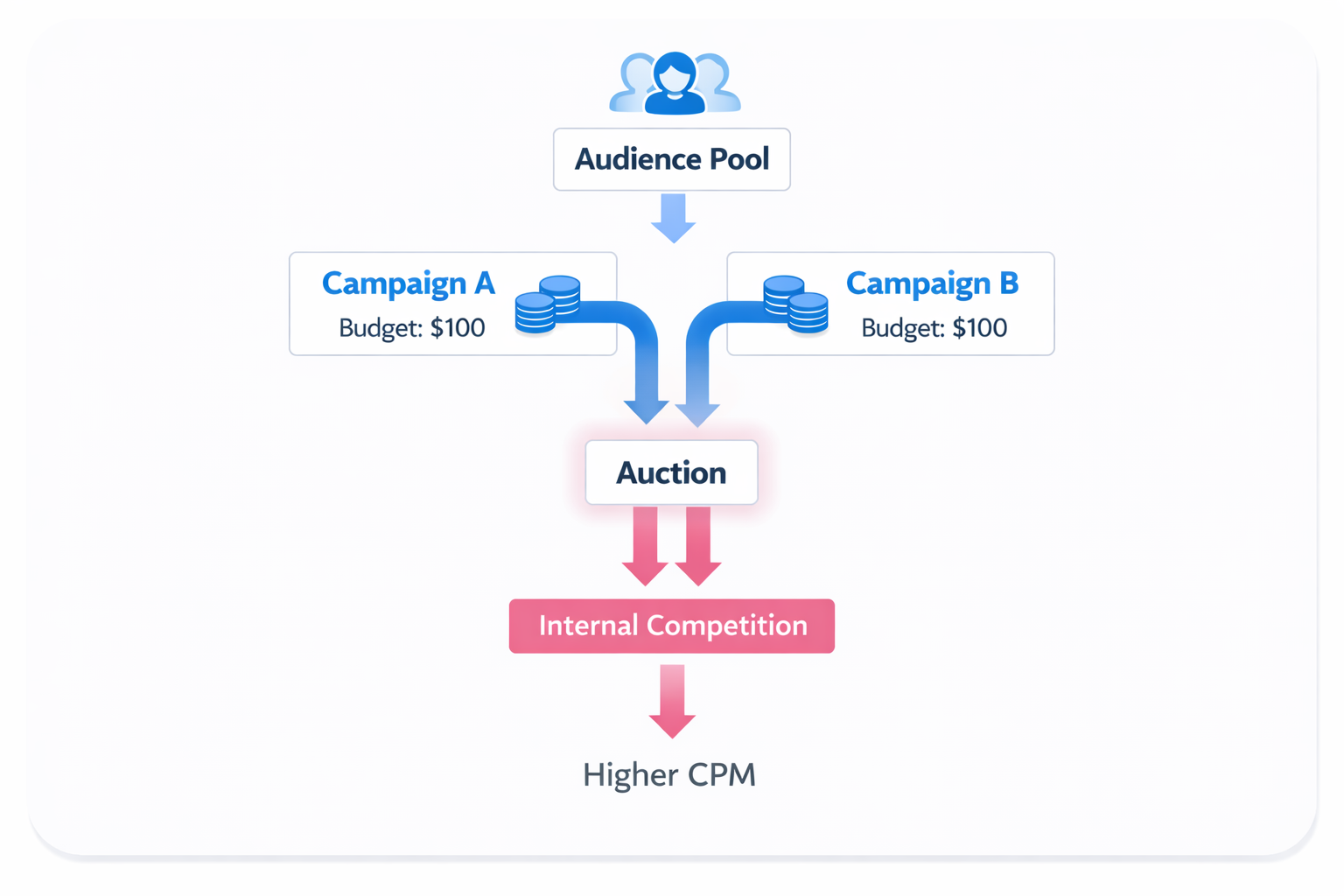
This internal competition often appears through:
-
rising CPM despite unchanged external competition,
-
overlapping audience delivery across campaigns,
-
increasing frequency across duplicated campaigns.
The dynamics behind this issue are explained in detail in Facebook Ad Auction: Do Ad Sets Compete Against Each Other?
Without careful structure, duplication can simply redistribute impressions between campaigns.
A Practical Scaling Perspective
Increasing budgets appears simpler, but it often forces the system to explore unfamiliar auctions too quickly.
Duplicating campaigns changes how scaling occurs.
Instead of pushing one campaign to expand aggressively, the system distributes spend across multiple pacing models.
That structural difference explains why duplication sometimes produces more stable results.
For many advertisers, the most reliable scaling process combines both approaches:
-
duplicate profitable campaigns to extend delivery gradually,
-
increase budgets only after performance stabilizes,
-
monitor CPM, frequency, and conversion rate during expansion.
Scaling works best when spend increases at a pace the learning system can absorb.
When growth matches the algorithm’s learning rhythm, performance tends to remain stable.