Scaling fails most often not because of weak creative or insufficient budget, but because targeting lacks structure. As brands grow, small inefficiencies compound quickly. A targeting system that works at $5,000 per month can collapse at $500,000.

Most consumers prefer personalized experiences, even as a majority express discomfort with behavioral targeting
Industry research consistently shows that relevance drives performance. Campaigns aligned with clear audience intent deliver conversion rates up to 2× higher than broad, untargeted campaigns. At the same time, overly narrow targeting limits delivery and increases costs. The blueprint behind scaling brands sits precisely between these two extremes.
Step 1: Build a Tiered Audience Framework
High-performing teams organize audiences into clear tiers instead of running isolated experiments.
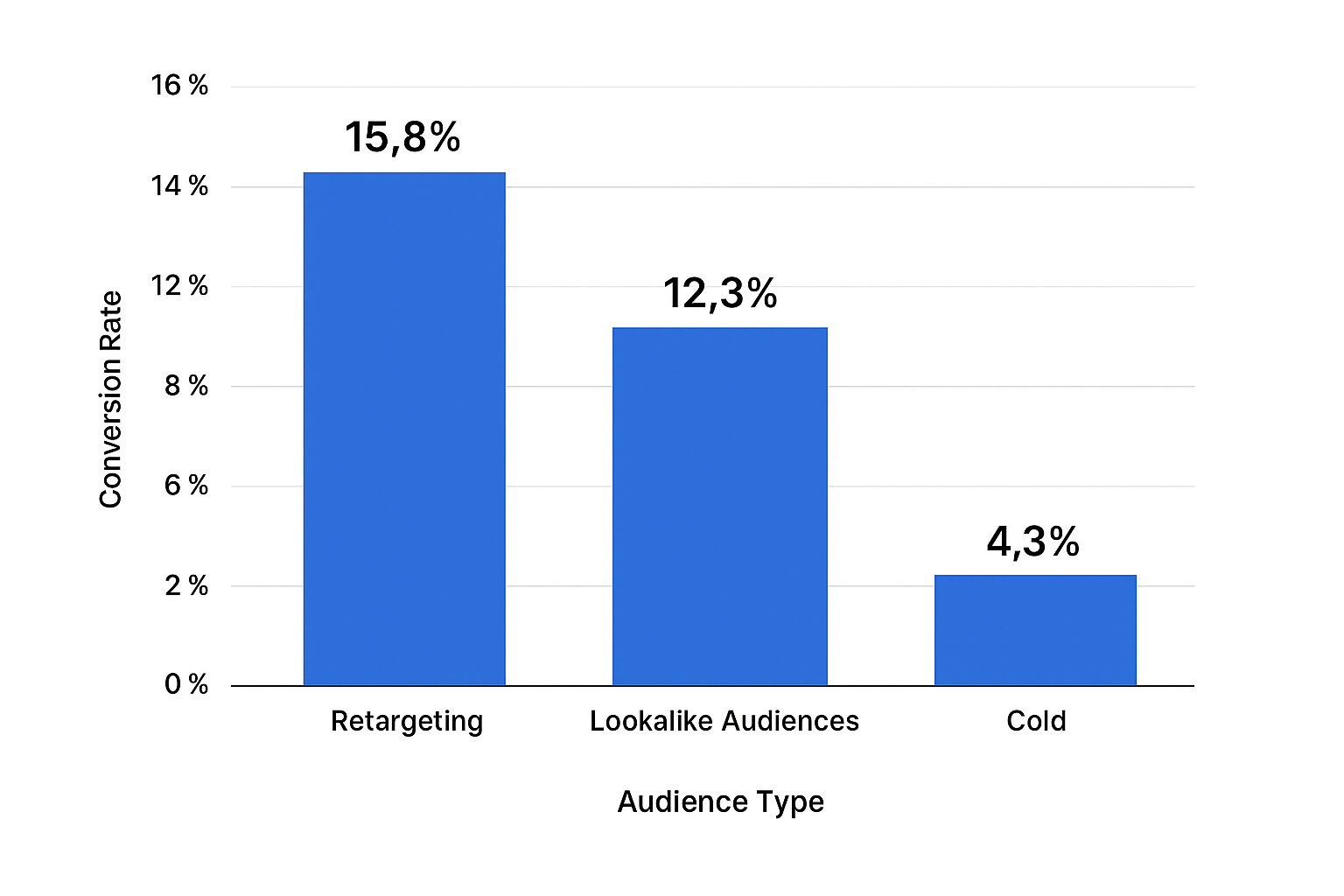
Conversion rates by audience type show warm audiences and lookalikes significantly outperform broad cold targeting
Tier 1: Proven Core Audiences
These include audiences that already demonstrate intent or familiarity with the brand. While typically smaller in size, they often deliver the highest return. Benchmarks show that warm or high-intent audiences can convert 60–70% more efficiently than cold traffic.
Tier 2: Adjacent Lookalikes and Expansions
Once core audiences are validated, scale happens through controlled expansion. Lookalike and similarity-based audiences built from high-quality signals consistently outperform interest-only targeting, with studies showing 30–50% lower cost per acquisition when seed quality is strong.
Tier 3: Broad but Guided Audiences
At scale, brands reintroduce broad targeting—but with constraints. Creative, messaging, and optimization signals do the filtering. Platforms increasingly rely on conversion data to self-optimize, and campaigns using broad audiences with strong conversion signals often see 15–25% efficiency gains after the learning phase stabilizes.
Step 2: Segment by Intent, Not Demographics
Demographics alone rarely explain buying behavior at scale. The blueprint shifts focus from who the audience is to what they are trying to achieve.
Intent-based segments typically include:
-
Problem-aware users actively researching solutions
-
Comparison-stage users evaluating alternatives
-
Action-ready users responding to urgency or social proof
Data from performance studies shows that intent-based segmentation can improve click-through rates by up to 80% compared to generic demographic targeting. This is especially critical as platforms reduce the effectiveness of detailed interest targeting.
Step 3: Control Frequency and Audience Saturation
As spend increases, audience fatigue becomes unavoidable. Scaling brands actively monitor saturation signals instead of reacting after performance drops.
Key indicators include rising frequency paired with declining CTR or conversion rate. When frequency exceeds sustainable levels, cost per acquisition can increase by 20–40% within weeks. Successful teams preempt this by rotating audiences, expanding tiers, or refreshing messaging before fatigue sets in.
Step 4: Align Creative With Audience Depth
Targeting and creative are inseparable. The same message does not scale across all audience tiers.
-
Core audiences respond to specificity, proof, and product depth
-
Expansion audiences need contextual framing and benefits
-
Broad audiences require clarity, simplicity, and pattern interruption
Brands that tailor creative by audience depth consistently outperform single-message strategies. Performance benchmarks show 25–35% higher engagement rates when creative is matched to audience awareness levels.
Step 5: Scale Gradually With Feedback Loops
Scaling brands do not jump budgets aggressively across new audiences. They scale through feedback loops.
A common approach is incremental budget increases of 10–20%, allowing algorithms to adapt while preserving signal quality. Abrupt scaling often resets learning phases, leading to volatility and wasted spend.
Equally important is structured measurement. High-growth teams track performance by audience tier rather than by campaign alone, making it easier to identify where scale is sustainable and where it is not.
Common Targeting Mistakes That Block Scale
Even experienced advertisers fall into predictable traps:
-
Over-fragmenting audiences until delivery becomes unstable
-
Relying on outdated interests instead of intent signals
-
Scaling spend before creative and audience alignment is proven
Avoiding these mistakes is often the difference between controlled growth and sudden performance collapse.
The Blueprint in Practice
The targeting blueprint behind scaling brands is not a single tactic—it is a system. It balances structure with flexibility, precision with scale, and data with creativity. Brands that master this system build campaigns that grow steadily instead of spiking and stalling.