Last-click attribution remains one of the most commonly used models for evaluating Facebook ad performance. It is simple, familiar, and easy to explain. However, this simplicity is precisely what makes it misleading. By assigning 100% of the conversion credit to the final interaction before purchase, last-click attribution systematically undervalues Facebook ads and leads to flawed optimization decisions.
Facebook Ads Rarely Close the Sale
Facebook is primarily a demand-generation channel, not a direct conversion channel. Most users are not actively shopping when they see an ad in their feed. Instead, Facebook ads introduce brands, shape preferences, and create intent that materializes later through other touchpoints such as Google search, email, or direct traffic.
According to Meta’s internal studies, over 70% of conversions influenced by Facebook ads occur after users interact with another channel. When last-click attribution is used, those conversions are almost always credited to search or direct traffic, even though Facebook played a critical role earlier in the journey.
The Cross-Device Blind Spot
Last-click attribution struggles to account for cross-device behavior. A common pattern is a user discovering a product via Facebook on mobile and completing the purchase later on desktop. Because cookies and sessions do not reliably persist across devices, the Facebook interaction is often lost entirely.
Industry research shows that more than 60% of consumers use multiple devices before converting. In last-click models, this behavior disproportionately shifts credit away from Facebook and toward the final device-based channel, creating a false picture of performance.
Retargeting Appears Artificially Strong
One of the most damaging side effects of last-click attribution is the overvaluation of retargeting campaigns. Users who have already been influenced by prospecting ads, organic content, or offline channels are highly likely to convert after seeing a retargeting ad.
Last-click attribution assigns full credit to that final retargeting touch, even though the conversion would likely have happened anyway. As a result, budgets get pulled away from prospecting and upper-funnel campaigns, leading to shrinking audiences and rising acquisition costs over time.
Data Delays and Attribution Windows
Facebook reports conversions using configurable attribution windows, commonly 7-day click or 1-day view. Last-click models often ignore view-through conversions entirely, despite evidence that they contribute meaningfully to outcomes.
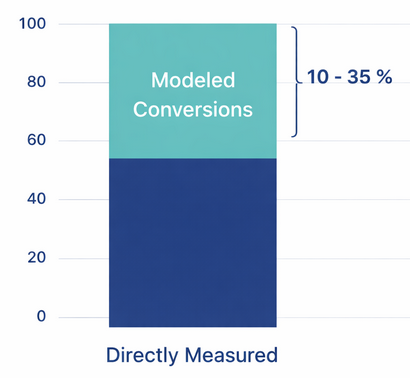
Modeled conversions (i.e., statistically estimated conversions where direct signals are missing) can account for 10 – 35 % of total reported results in Facebook ad reporting
Meta has reported that view-through conversions can account for 20–30% of total conversions in some verticals. When these are excluded, performance appears weaker than it actually is, encouraging premature budget cuts.
Misguided Optimization Decisions
When marketers rely on last-click data, they tend to optimize for channels and creatives that close conversions rather than those that create demand. This results in:
-
Reduced investment in prospecting and awareness campaigns
-
Overdependence on branded search and retargeting
-
Slower long-term revenue growth
-
Higher cost per acquisition as audiences saturate
In effect, last-click attribution rewards short-term efficiency at the expense of long-term scalability.
Better Ways to Measure Facebook Performance
To evaluate Facebook ads accurately, marketers need attribution approaches that reflect the full customer journey:
-
Multi-touch attribution distributes credit across multiple interactions, offering a more realistic view of channel impact.
-
Incrementality testing measures what would have happened without ads, isolating true lift rather than assumed contribution.
-
Blended performance analysis looks at overall revenue, customer acquisition cost, and marginal returns instead of isolated channel metrics.
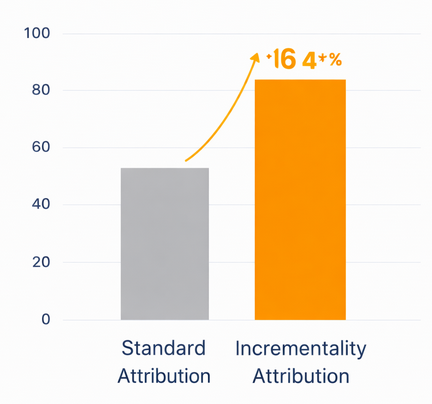
Advertisers testing incrementality-based attribution have seen a 46 % increase in incremental conversions over standard reporting methods
Brands that adopt these methods consistently find that Facebook’s true contribution is significantly higher than last-click reports suggest.
Conclusion
Last-click attribution creates a distorted understanding of Facebook ad performance by ignoring influence, cross-device behavior, and incremental impact. While it may feel safe and familiar, it encourages decisions that undermine sustainable growth. Moving beyond last-click is no longer optional for advertisers who want accurate measurement and smarter budget allocation.