Internal audience competition is one of the most common and expensive problems in Meta advertising. When multiple campaigns target overlapping audiences, your ads end up competing against each other in the auction, driving up costs and reducing overall performance.
What Is Internal Audience Competition?
Internal audience competition occurs when two or more campaigns, ad sets, or ads from the same advertiser participate in the same auction targeting the same or highly similar users.
Meta's advertising system uses an auction model. Every time a user becomes eligible to see an ad, the platform runs an auction among all eligible ads. If multiple ads from the same advertiser target that user, those ads can compete against each other.
This often happens when advertisers:
-
Run multiple campaigns with overlapping audiences
-
Use similar lookalike audiences across different campaigns
-
Combine broad targeting with multiple ad sets
-
Fail to exclude existing audiences from prospecting campaigns
Why Audience Overlap Hurts Performance
Internal competition can severely impact the efficiency of advertising budgets.
First, it increases CPM. When your ads compete with each other in the same auction, Meta's system treats them as separate bids. This can artificially inflate the cost required to win the impression.
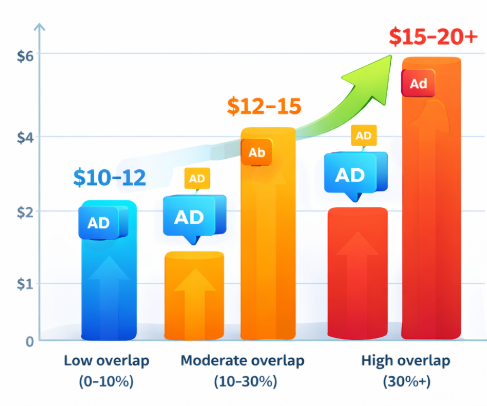
How increasing audience overlap can drive higher CPM in Meta Ads campaigns
Second, it fragments the learning phase. Each ad set receives fewer signals and conversions, which slows down optimization.
Third, it reduces campaign scalability. Instead of concentrating data and budget into high-performing audiences, performance gets spread across overlapping segments.
According to industry benchmarks, advertisers may waste up to 20–35% of their Meta ad spend due to inefficient audience overlap and campaign structure.
Meta itself has also reported that consolidating campaigns and reducing overlap can improve conversion performance by up to 15%.
Common Sources of Audience Competition
1. Multiple Lookalike Audiences
Running separate campaigns for several lookalike audiences (for example 1%, 2%, and 3%) can easily create overlap.
These audiences are not mutually exclusive. The 1% audience is included inside the 2% and 3% groups, which leads to competition between campaigns.
2. Broad Targeting Combined With Detailed Targeting
If one campaign targets a broad audience and another targets specific interests or behaviors, there is often significant overlap.
Broad targeting frequently includes many of the same users contained in more specific audiences.
3. Retargeting and Prospecting Overlap
A common structural mistake is failing to exclude retargeting audiences from prospecting campaigns.
For example:
-
Website visitors
-
Video viewers
-
Engaged social media users
If these audiences are not excluded properly, prospecting campaigns can compete with retargeting campaigns.
4. Multiple Campaign Objectives Targeting the Same Users
Running separate campaigns for conversions, traffic, and engagement targeting the same audience may lead to internal bidding competition.
How to Detect Audience Overlap
Before fixing the issue, advertisers need to identify where overlap occurs.
Meta Ads Manager provides an Audience Overlap tool that allows advertisers to compare saved audiences and estimate how many users exist in multiple segments.
Another indicator is unstable performance patterns across similar ad sets, including:
-
Fluctuating CPM
-
Inconsistent conversion costs
-
Frequent learning phase resets
If multiple ad sets target similar audiences and show similar performance trends, overlap may be present.
Strategies to Prevent Internal Audience Competition
1. Consolidate Campaign Structure
One of the most effective strategies is reducing the number of campaigns and ad sets targeting similar audiences.
Meta recommends consolidating campaigns whenever possible. Larger audiences provide more data for the algorithm and improve optimization.
For many advertisers, a structure with:
-
One prospecting campaign
-
One retargeting campaign
is significantly more efficient than running many small campaigns.
2. Use Clear Audience Exclusions
Always exclude lower-funnel audiences from upper-funnel campaigns.
Typical exclusions include:
-
Website visitors
-
Existing customers
-
Lead form submissions
-
App users
This ensures that prospecting campaigns focus on acquiring new users rather than competing with retargeting campaigns.
3. Avoid Redundant Lookalike Audiences
Instead of running multiple campaigns for overlapping lookalike percentages, consider using broader lookalike ranges in a single ad set.
For example, using a 1–3% lookalike audience reduces internal competition compared to separate 1%, 2%, and 3% campaigns.
4. Leverage Campaign Budget Optimization
Campaign Budget Optimization (CBO) allows Meta to allocate budget dynamically across ad sets based on performance.
By consolidating ad sets under a single campaign budget, advertisers can reduce internal competition while letting the algorithm prioritize the most effective audience segments.
5. Limit the Number of Active Ad Sets
Too many ad sets targeting similar users dilute performance data.
Meta recommends maintaining a manageable structure so each ad set receives enough impressions and conversions for effective learning.
A useful rule is ensuring each ad set can generate at least 50 conversions per week to exit the learning phase.
6. Use Broad Targeting When Possible
In many cases, broad targeting combined with strong creative and conversion signals performs better than fragmented audience segmentation.
Broad audiences allow Meta's machine learning system to identify the best users without forcing multiple overlapping segments.
Structuring Campaigns for Efficient Delivery
A simplified campaign architecture can dramatically reduce audience competition:
Prospecting Campaign
-
Broad or lookalike audiences
-
Creative testing
Retargeting Campaign
-
Website visitors
-
Engaged users
-
Product viewers
Customer Campaign
-
Upsell or retention
-
Existing customers
With proper exclusions between these segments, advertisers can minimize overlap while maintaining clear funnel stages.
Measuring Improvements
After restructuring campaigns, advertisers should monitor key performance metrics including:
-
CPM
-
Cost per acquisition (CPA)
-
Conversion rate
-
Frequency
If internal competition has been reduced successfully, advertisers often observe:
-
Lower CPM
-
Faster learning phases
-
More stable CPA
-
Higher conversion volume
Final Thoughts
Internal audience competition is a hidden inefficiency that affects many Meta advertising accounts. When campaigns target the same users, budgets are wasted and campaign optimization becomes more difficult.
By simplifying campaign structure, implementing strict audience exclusions, and consolidating overlapping audiences, advertisers can significantly improve ad delivery and overall performance.
Reducing internal competition allows Meta's algorithm to operate more effectively and ensures advertising budgets generate maximum impact.
Recommended Reading