Scaling spend feels like progress. Performance is stable, cost per result looks acceptable, and volume seems capped by budget. The natural reaction is simple: increase daily spend.
But higher budget can slow optimization. In some cases, it resets learning and lowers signal density. Instead of accelerating growth, it creates instability.
This article explains why that happens and how to scale without damaging performance.
Why more budget changes the learning dynamics
Meta’s delivery system optimizes based on event volume, auction feedback, and historical patterns. Budget is not a neutral input. It changes how aggressively the system explores inventory.
When you raise budget too quickly, the algorithm expands reach before it stabilizes on high-quality pockets. That expansion dilutes signal concentration.
If you want a deeper breakdown of learning behavior, read How to Use the Facebook Ads Learning Phase to Your Advantage.
The relationship between budget and signal density
Optimization depends on conversions per ad set. If you generate 50 conversions weekly at $100 per day, the system builds consistent patterns.
Now increase the budget to $300 overnight. The platform must find three times more conversion opportunities. It widens targeting and bids into less proven segments.
Signal density per impression drops. Variability increases.
This often looks like rising CPA during learning.
Learning phase resets and instability
Budget increases above certain thresholds can trigger learning resets. Even without a full reset, large changes destabilize delivery.
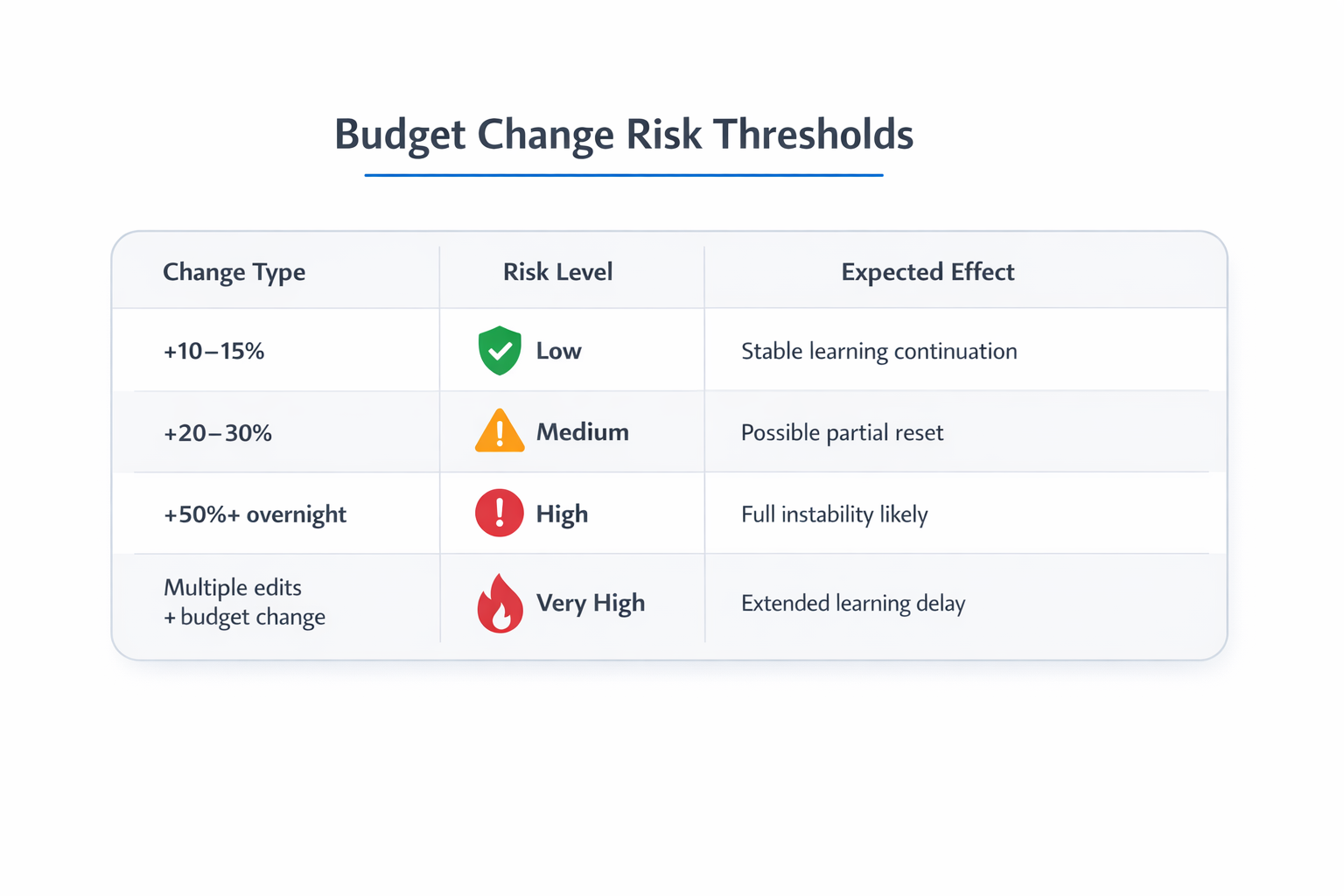
Common thresholds include:
-
20–30 percent budget jumps within 24 hours; these often restart learning at the ad set level.
-
Major daily swings across consecutive days; these prevent pattern consolidation.
-
Frequent manual edits combined with budget increases; this compounds volatility.
Each reset restarts exploration. Exploration increases cost temporarily.
If changes happen repeatedly, the system never exits instability.
For a detailed framework on scaling without resets, see The Right Way to Increase Ad Budgets Without Resetting Learning.
How aggressive scaling distorts auction behavior
Budget affects how the campaign competes in the auction. More budget means more aggressive participation.
Higher participation increases exposure to expensive impressions.
Expansion into higher-cost inventory
When budget rises, the system must clear more auctions. It moves beyond efficient segments into broader and less responsive audiences.
You may see:
-
Higher CPMs; the campaign enters more competitive placements.
-
Lower conversion rates; impressions reach colder segments.
-
Wider frequency distribution; exposure spreads across weaker prospects.
Performance metrics shift before the algorithm adapts.
If conversion tracking is slow or noisy, adaptation takes longer.
To understand auction mechanics more deeply, review How Meta Ads Decide Where to Spend Budget.
Bid pressure and value misalignment
With conversion objectives, the system estimates value per impression. When budget increases quickly, those estimates stretch.
The model experiments with impressions that have thinner historical validation. Early results often underperform.
This does not mean scaling fails. It means the learning window widens.
Structural reasons budget increases slow optimization
Budget alone is not the only factor. Account structure amplifies the effect.
If the structure is fragmented, scaling multiplies inefficiencies.
Too many ad sets, not enough events
When conversions are split across many ad sets, each ad set has weak signal density. Increasing budget spreads spend across all of them.
Instead of strengthening winners, you inflate underperformers.
Audit for:
-
Ad sets generating fewer than 50 weekly conversions; these lack stable learning.
-
Overlapping audiences; these compete internally and distort delivery.
-
Micro-segmentation without messaging differences; this fragments data without strategic gain.
Consolidation often improves scaling stability.
If internal competition is suspected, read Ad Set Cannibalization: When Your Facebook Campaigns Compete Against Each Other.
Creative fatigue disguised as scaling failure
Sometimes CPA rises after a budget increase because creative was already near saturation. Higher spend accelerates exposure frequency.
Frequency climbs. Engagement drops.
Instead of blaming budget, review:
-
Frequency trends over the last 7–14 days; rising frequency before scaling signals saturation.
-
CTR decay; declining engagement reduces auction efficiency.
-
Creative refresh cadence; stale creative limits scalable volume.
Budget magnifies underlying weaknesses.
How to scale without slowing optimization
Scaling works when it preserves signal strength. That requires controlled adjustments and structural alignment.
Use staged budget increases
Gradual increases allow the model to adapt without resetting learning.
Practical guidelines:
-
Increase budget by 15–20 percent every 48–72 hours; this protects learning stability.
-
Monitor conversion volume per ad set; ensure events scale proportionally.
-
Pause scaling if CPA spikes beyond historical variance; allow stabilization before the next increase.
This approach compounds performance instead of disrupting it.
Scale through structure, not just budget
Budget scaling is one lever. Structural scaling is often safer.
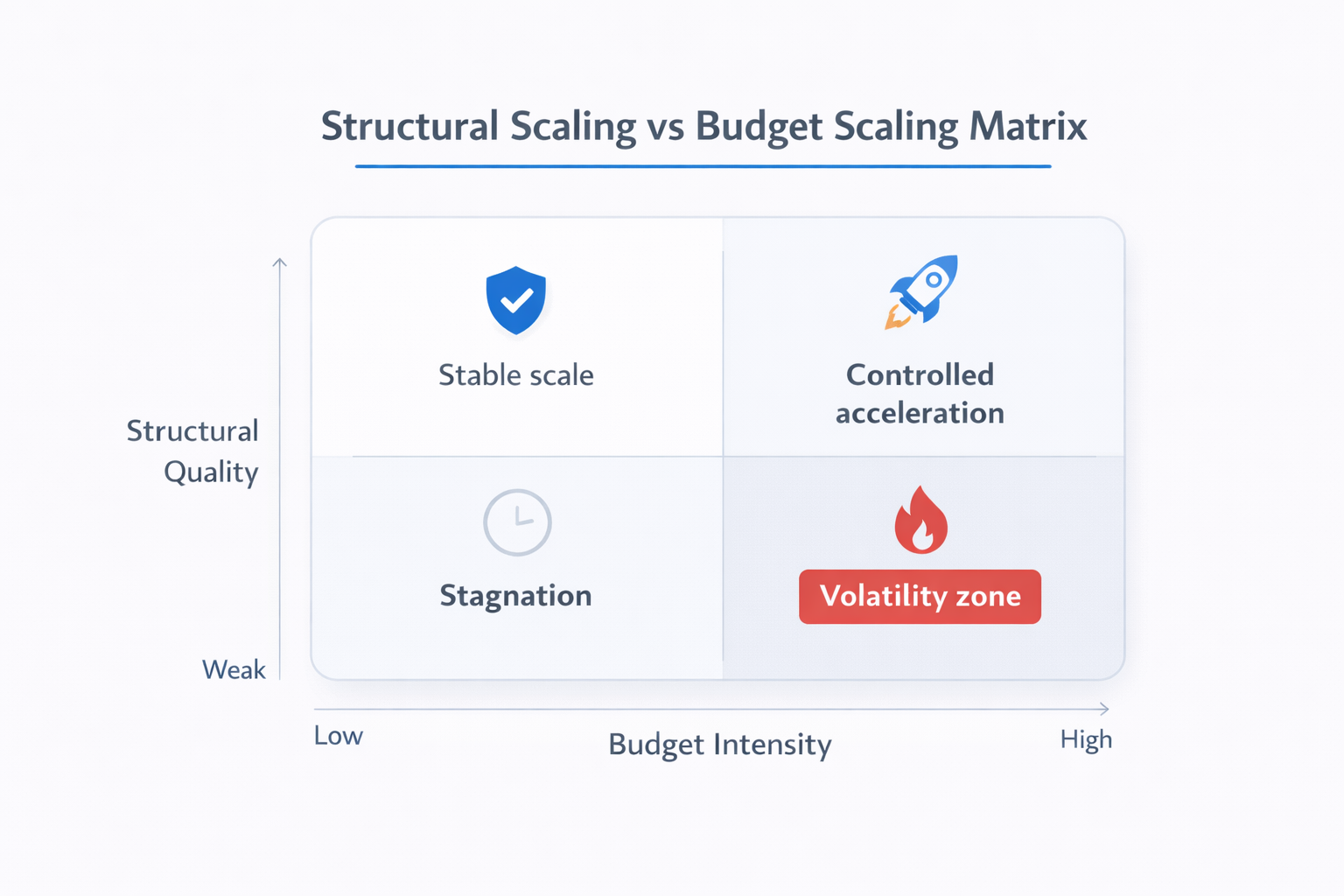
Consider:
-
Consolidating high-performing ad sets; concentrate signal instead of fragmenting it.
-
Expanding creative variations; support higher spend with broader messaging angles.
-
Testing broader audiences in separate campaigns; avoid destabilizing core performers.
This separates experimentation from revenue protection.
Monitor leading indicators, not just CPA
CPA reacts after damage occurs. Leading indicators show instability earlier.
Track:
-
CPM shifts; sudden increases indicate auction expansion.
-
Conversion rate trends; early declines signal weaker inventory.
-
Cost per unique click; rising costs reflect lower-quality reach.
If these metrics drift sharply after scaling, reduce volatility before losses compound.
When budget increases actually help optimization
Budget does accelerate learning when event volume is already constrained. If an ad set consistently hits the learning threshold but lacks impression share, higher spend can unlock scale.
This works best when:
-
The ad set already generates stable weekly conversions.
-
Creative performance is consistent across frequency levels.
-
Audience size supports expansion without heavy overlap.
In these cases, scaling feeds the model more validated data.
Optimization speeds up because signal quality remains intact.
Final perspective on scaling discipline
Increasing budget is not a neutral action. It changes exploration intensity, auction exposure, and signal density.
When scaling is controlled, performance compounds. When scaling is aggressive, learning resets and volatility rises.
Treat budget as a precision lever, not a volume switch. Stable optimization depends on how you scale, not how fast you scale.