Lookalike audiences often feel like a magic lever in Meta ads. You upload a seed audience, create a 1% lookalike, and suddenly your campaigns start finding new customers who behave like the ones you already have.
But sooner or later, many advertisers hit the same wall. Results flatten. CPA slowly creeps up. Increasing budgets doesn’t unlock more conversions the way it used to.
When this happens, it’s easy to assume the platform has stopped working. In reality, the issue is usually structural. Lookalikes don’t fail because the algorithm breaks. They plateau because the system runs out of meaningful patterns to replicate.
Once you understand why that happens, it becomes much easier to push past the ceiling.
Why Lookalike Audiences Stop Scaling
Lookalike audiences work by modeling patterns from your seed audience. Meta analyzes the behavior of those users and then searches for people who look statistically similar across the platform.
At first, this works extremely well. The algorithm quickly finds clusters of users who resemble your converters, and performance tends to improve quickly.
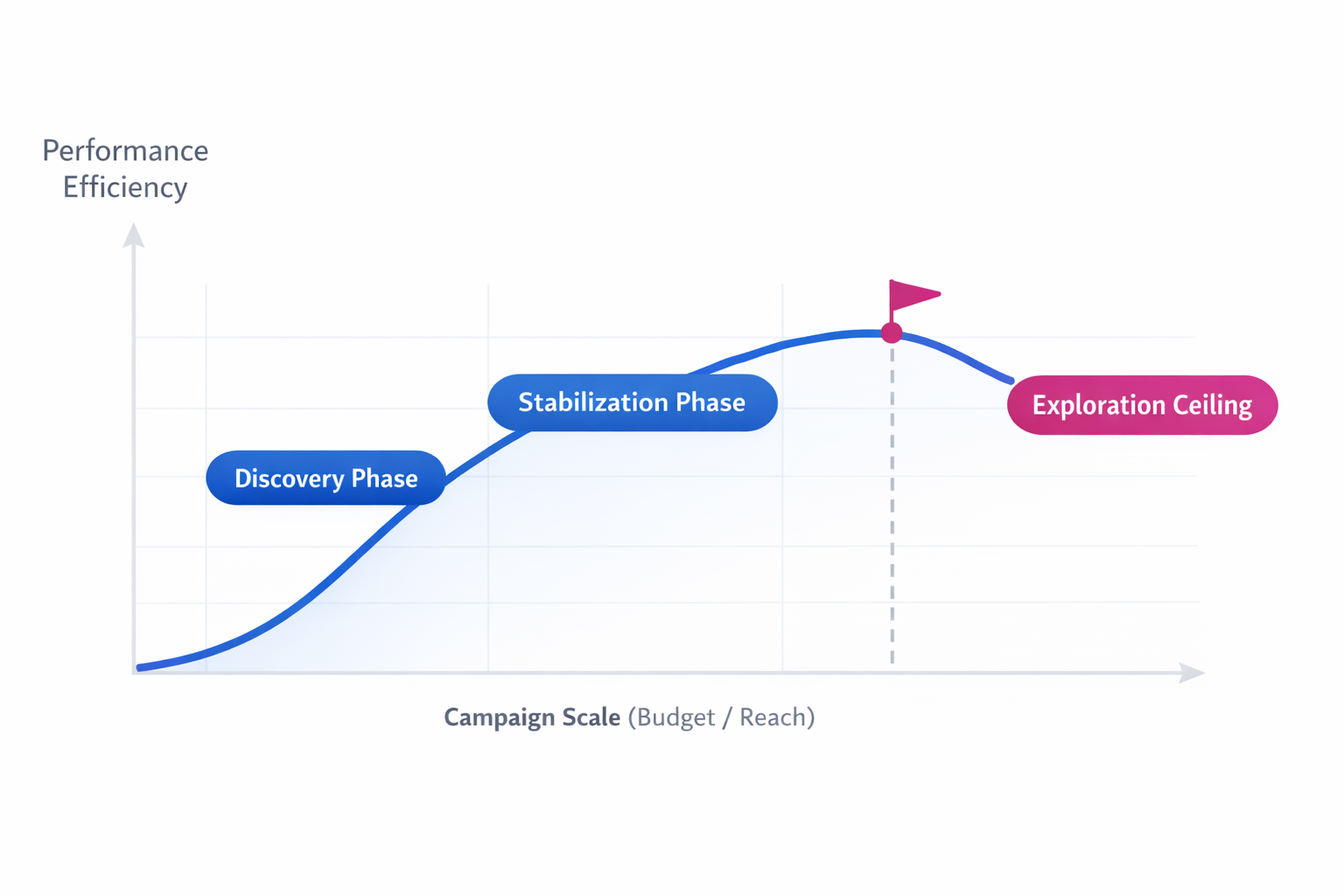
Over time, however, the model has to expand into weaker similarity layers. That shift usually creates three stages in a campaign’s lifecycle:
-
The discovery stage.
Early in the campaign, the system identifies users who closely resemble your seed audience. Conversions come relatively easily because the model is matching strong behavioral signals. -
The stabilization stage.
Once the obvious clusters are reached, the algorithm keeps expanding but the similarity becomes weaker. Results stabilize and scaling becomes slower. -
The exploration ceiling.
At some point, the algorithm simply runs out of users who strongly resemble your seed audience. To keep delivering impressions, it has to reach people who only partially match the original pattern.
This is the moment advertisers experience as a plateau. The campaign still runs, but performance gradually declines because the system is working with weaker signals.
If you want a deeper explanation of how lookalike modeling works, the Ultimate Guide to Facebook Lookalike Audiences breaks down the mechanics in more detail.
The Hidden Reasons Lookalikes Plateau
When a lookalike audience stops scaling, the cause is rarely obvious from the dashboard. The real limitation usually sits in the structure of the seed audience.
The Seed Audience Is Too Narrow
A lookalike can only replicate the patterns inside the seed. If those patterns represent a very specific type of user, the algorithm will keep rediscovering the same audience segment.
This happens more often than advertisers expect. For example, your seed audience might reflect:
-
One dominant creative angle.
If most conversions came from a single message or ad concept, the algorithm may overlearn that pattern and repeatedly search for users who respond to that exact style. -
One funnel stage.
Seeds built from early events, such as lead submissions or basic engagement, often represent curiosity rather than real purchase intent. -
A narrow demographic cluster.
If most conversions happened in one region or age group, the model may keep returning to that same pocket of users.
The algorithm is simply repeating the strongest signal it can find.
The Seed Uses Weak Behavioral Signals
Another common issue is that the seed audience is based on actions that don’t reflect real buying intent.
Signals like these often create fragile lookalike models:
-
Landing page views.
A page visit can come from accidental clicks or quick curiosity, so it rarely reveals whether someone is actually interested in buying. -
Lead form opens or partial submissions.
These actions can represent very low commitment, especially if the form requires little effort. -
Short engagement sessions.
A brief visit tells the algorithm almost nothing about whether the user understands or values the product.
Stronger seeds come from behaviors that signal real intent, such as:
-
Completed purchases or subscriptions.
-
Activated users who finished onboarding.
-
Repeat buyers or long-term customers.
These signals give the algorithm a much clearer behavioral fingerprint to model. If you want to explore this topic further, How to Build Lookalike Audiences that Actually Convert explains how stronger seeds change lookalike performance.
How to Tell When You’ve Hit the Plateau
Before restructuring a campaign, it helps to confirm that the problem really is a lookalike ceiling.
Several patterns tend to appear when a lookalike audience runs out of expansion room.
First, frequency often begins to rise, even if budgets remain stable. The algorithm starts showing ads to the same people more often because it struggles to find new users with strong similarity.
Second, CPA increases while CPM remains stable. This is an important signal. If auction costs stay the same but conversions drop, the issue usually isn’t competition. It’s audience quality.
Finally, budget increases stop producing proportional growth. Early in a campaign, doubling the budget might increase conversions significantly. Later on, those increases deliver far smaller gains.
When you see these three patterns together, the model has probably exhausted the strongest similarity clusters.
How to Push Beyond the Lookalike Ceiling
Breaking through a plateau usually requires improving the signals that guide the model rather than forcing more spend into the same audience.
Build Multi-Signal Seed Audiences
One of the most effective improvements is combining multiple high-intent behaviors inside a single seed.
Instead of relying on just one event, build a seed that includes users who:
-
Purchased within the last 90–180 days, which anchors the audience to recent buying behavior.
-
Visited high-intent pages multiple times, such as pricing pages or product comparisons.
-
Returned to the site repeatedly before converting, a pattern that often signals stronger intent.
-
Completed meaningful engagement actions, such as demo requests or product configuration tools.
Combining signals like these gives the algorithm a richer behavioral pattern to replicate.
Segment Your Seeds Instead of Mixing Everyone Together
Large seed audiences often contain very different types of customers. When all of those users are mixed together, the model ends up learning an average pattern that doesn’t describe anyone particularly well.
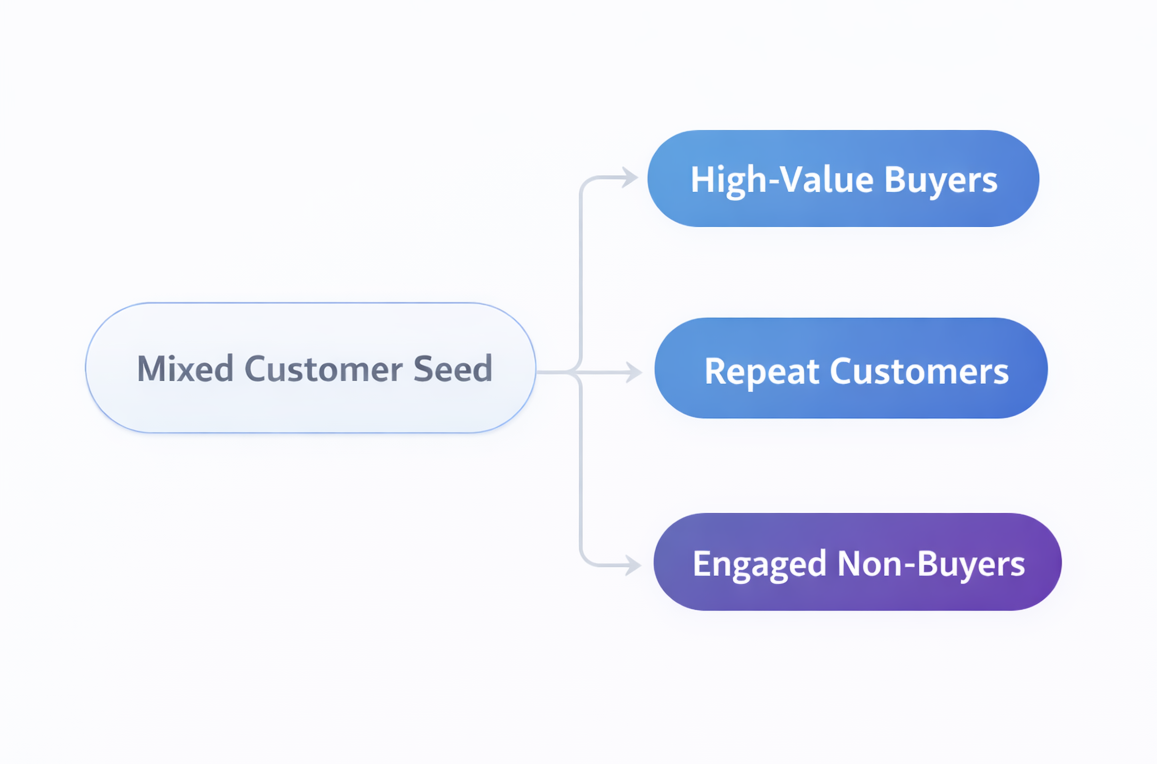
Segmenting the seed can reveal much stronger signals. For example, you might create separate seeds for:
-
High-value purchasers, which helps the algorithm prioritize profitable customer profiles.
-
Repeat buyers, whose behavior often reflects stronger long-term product fit.
-
Highly engaged non-buyers, who interact heavily with the product but haven’t converted yet.
This kind of segmentation is closely related to the broader strategy discussed in Custom vs Lookalike Audiences: What Works Best for Facebook Campaigns?
Expand the Source of Your Seed Data
Sometimes the best scaling tactic is adding new audience sources entirely.
For example, communities, niche groups, or highly engaged social audiences can reveal clusters of users who already share a strong interest in your category. Once those users enter your ecosystem, they can become powerful seed audiences for future lookalike models.
The strategy described in How to Build Your Target Audience from a Facebook Group is a good example of how new audience sources can feed stronger lookalike campaigns.
The Bigger Lesson About Lookalike Scaling
Lookalike audiences are powerful, but they aren’t unlimited growth engines. They work by replicating patterns, and those patterns come from the seed audience you provide.
When that seed becomes too narrow or repetitive, the model eventually runs out of similar users to find.
Advertisers who scale the furthest treat lookalikes as evolving systems. They constantly improve the quality of their seed audiences, introduce new behavioral signals, and expand the sources of user data feeding the model.
When you approach lookalikes that way, the plateau usually isn’t the end of scaling. It’s just a signal that the algorithm needs better patterns to learn from.